
A boa constrictor is one of the most rewarding reptiles you can keep in the United States — and one of the most commonly surrendered. The reason is almost never aggression. It’s almost always one of seven preventable mistakes: an enclosure that’s too small, a feeding schedule that’s too generous, a heat setup that’s unsafe, or a state law the owner never bothered to check.
If you’re reading this Boa Constrictor beginner guide, you’re already ahead of most first-time keepers. Boas live 20 to 30 years or more, females routinely reach 6 to 10+ feet, and adults weigh anywhere from 20 to 60 pounds depending on locality and genetics. This isn’t a starter snake you upgrade from in two years. It’s a decades-long commitment with a real physical presence in your home — one that can, if mismanaged, create health problems for the snake and legal problems for you.
This guide covers everything: the Boa Constrictor vs Red-Tailed Boa difference, adult boa enclosure size standards, the correct boa feeding schedule, humidity and heating setups suited to American homes, safe handling rules for large constrictors, and a state-by-state breakdown of the permits and bans you need to know before you buy. Let’s start with the mistake most owners make before they even bring the snake home.
Boa Constrictor vs. Red-Tailed Boa: Know What You’re Actually Buying
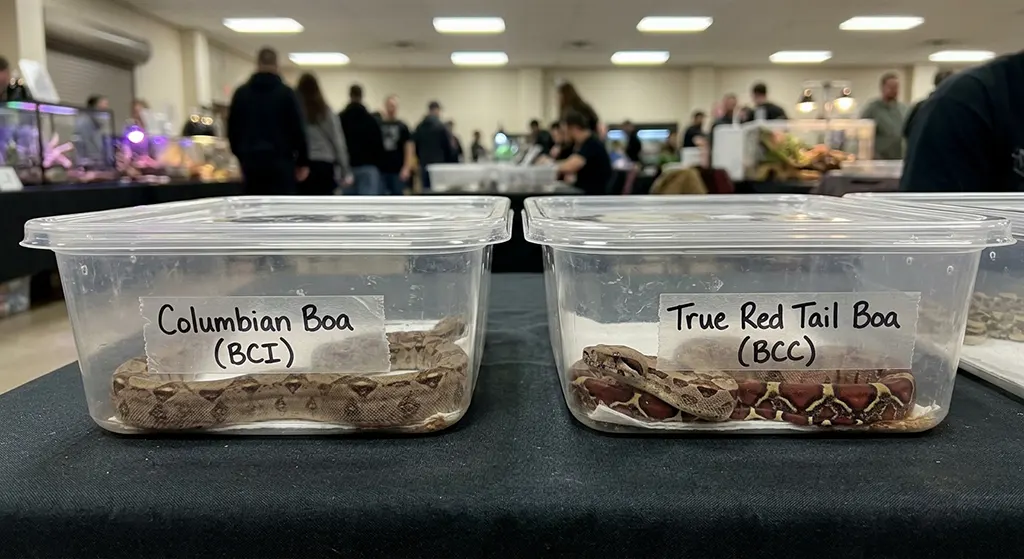
Walk into any US reptile expo and you’ll see bins labeled “red-tailed boa,” “Columbian boa,” “BCI,” and “BCC” — often used interchangeably by sellers who either don’t know or don’t care about the difference. As a buyer, you should care, because the difference affects adult size, price, and temperament expectations.
Here’s the taxonomy in plain terms:
Boa imperator (formerly Boa constrictor imperator) — This is the “common boa” or Colombian boa that dominates the US pet trade. Most animals sold as “red-tailed boas” are actually B. imperator. Adults typically reach 5 to 8 feet (females larger than males), with a thick, muscular build. They are hardy, widely captive-bred, and the recommended choice for a true beginner.
Boa constrictor constrictor (BCC) — The “true” red-tailed boa, primarily from the Guianas, Suriname, and Brazil. These animals typically develop a deeper red tail coloration, a more “bat-shaped” head pattern, and grow considerably larger — females commonly exceed 8 feet and can push past 10. They are also more sensitive to husbandry errors and stress in captivity, and command higher prices.
Central American and dwarf localities — True Boa constrictor from islands like Cay Caulker or Hog Island, and B. imperator from Central America, can stay notably smaller (4 to 6 feet), which makes them appealing for keepers with space constraints. However, “dwarf locality” claims are frequently exaggerated by sellers — ask for documented lineage.
The practical takeaway: if a seller advertises a tiny hatchling as a “dwarf red-tail,” be skeptical. Assume you’re buying a 6 to 8-foot adult unless proven otherwise, and plan your enclosure accordingly. If your seller can’t tell you whether the animal is BCI or BCC, that’s a red flag about the source.
The Complete Care Baseline: Enclosure, Heat, Humidity, and Feeding
Before we get to the seven mistakes, establish this baseline. Everything in this section reflects widely accepted captive husbandry standards for Boa constrictor and Boa imperator in the US hobby, consistent with the MSD Veterinary Manual’s reptile husbandry guidelines.
Adult Boa Enclosure Size: Bigger Than You Think
This is where most first-timers underestimate — badly.
- Hatchling/juvenile (under ~2 feet): A 20-gallon enclosure or equivalent tub works temporarily, with multiple tight hides.
- Sub-adult: Move up to a 4′ x 2′ x 2′ setup around 2.5 to 3 feet of snake length.
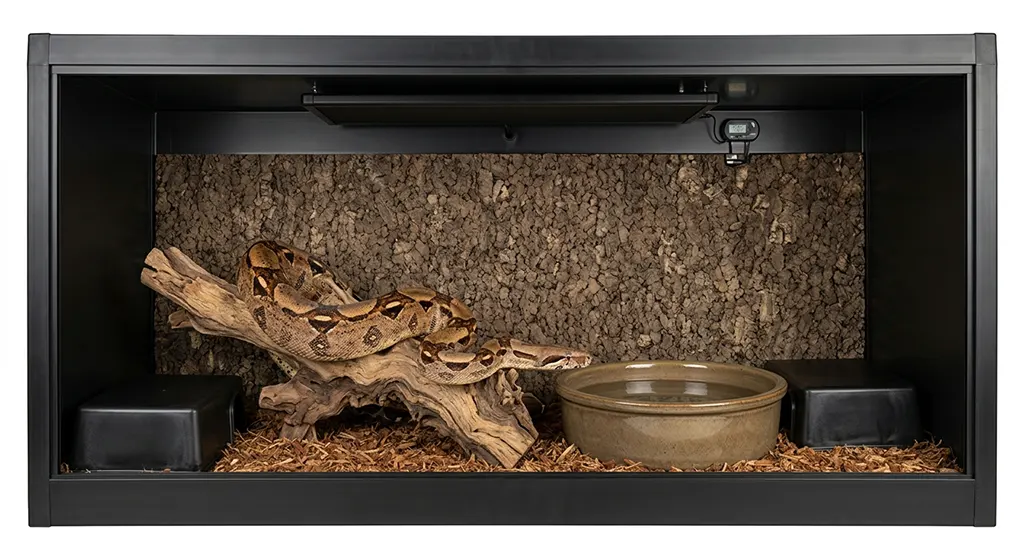
- Adult (industry minimum): 6′ x 2′ x 2′ feet, with 6′ x 3′ x 3′ strongly preferred for large females. The widely cited standard is that the enclosure should be at least half to two-thirds the snake’s length, and ideally allow it to stretch out fully along one side. For a 7-foot female, that means nothing smaller than 6 feet long.
In the US market, PVC enclosures (brands like Animal Plastics, Kages, Dragonhaus, and similar custom builders) have largely replaced glass terrariums for boas — and for good reason. Glass tanks lose heat and humidity rapidly, especially against the dry air produced by American forced-air HVAC systems in winter. A sealed PVC enclosure with lockable sliding glass or acrylic front doors holds 60–70% humidity with far less effort and prevents the escape attempts that boas are famous for. An adult boa can push open a screen-top lid that isn’t clipped or locked. Boas are stronger than they look, and they test latches constantly.
Whatever you choose, it needs: two hides (warm side and cool side), a large water bowl the snake can soak in, sturdy branches or a platform for climbing (boas climb far more than their reputation suggests), and substrate 2–3 inches deep — cypress mulch, coconut husk, or a mulch/topsoil blend all work well and hold moisture.
Temperature and Humidity: The Numbers That Matter
Boas are tropical animals, and US homes are engineered to be anything but tropical.
- Basking zone: 88–90°F (31–32°C)
- Ambient/cool zone: 78–80°F (25–26°C)
- Nighttime drop: acceptable, but never below 75°F (24°C)
- Standard humidity: 60–70%
- Shedding cycle: raise to 75–80% to ensure a clean shed
The gradient matters as much as the numbers. Your boa must be able to move between warm and cool zones to thermoregulate; a single uniformly warm enclosure is a recipe for chronic stress and poor digestion.
This is where American regional reality bites: winter heating in most of the US dries indoor air to 20–30% humidity. You’ll likely need a humidifier in the reptile room, daily misting, or a fogger on a hygrometer-linked timer. Monitor with digital thermometers/hygrometers at both ends — the analog dial units sold in pet stores are notoriously inaccurate.
Heating Equipment: Radiant Heat Panels Done Right
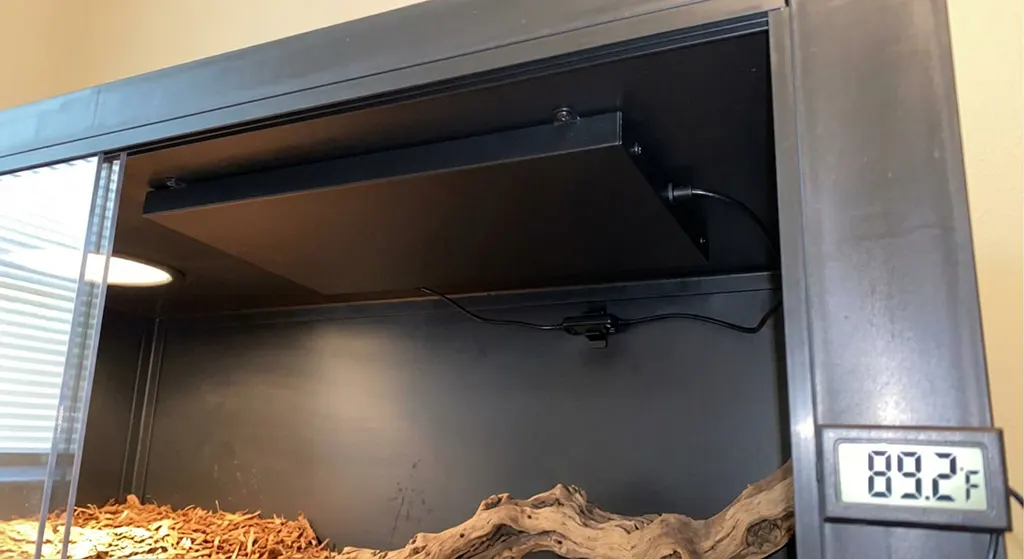
The gold-standard setup for a boa in 2026 is a Radiant Heat Panel (RHP) — sometimes paired with a Deep Heat Projector (DHP) — mounted inside the enclosure and controlled by a quality proportional thermostat (herpstat-style controllers are the hobby benchmark). RHPs emit gentle infrared warmth over a broad area without drying the air the way heat lamps do, which makes humidity management dramatically easier in US homes.
Two hard rules:
- Every heat source runs through a thermostat. Unregulated heat sources have killed countless reptiles. An RHP or DHP without a thermostat can turn an enclosure into an oven.
- No bare bulbs or heat rocks inside the enclosure. Boas will wrap around a heat rock and sustain serious burns without moving. If you must supplement visible light or basking heat, use a guarded, caged fixture.
Heat mats taped underneath a tub can work for juveniles but are a poor long-term solution for a heavy adult — and any mat under a tank must also be on a thermostat.
The Boa Feeding Schedule: Less Is More
Here’s the single most common way US owners kill their boas with kindness: feeding too often.
A healthy, properly-sized prey item produces a visible but modest lump. The standard schedule:
- Hatchling/juvenile: one appropriately sized rat pup or fuzzy every 7–10 days
- Sub-adult: one small/medium rat every 10–14 days
- Full adult: one large rat every 3–4 weeks
Adult boas have extremely slow metabolisms. An adult fed weekly will almost certainly become obese — and obese boas develop fatty liver disease, reduced lifespan, and breeding complications. Vets who specialize in reptiles (look for ARAV — the Association of Reptilian and Amphibian Veterinarians — members near you) report obesity as one of the most common presenting problems in pet boas.
Prey should be frozen-thawed, never live. Live rats injure and occasionally kill snakes, and in several US jurisdictions feeding live vertebrates raises animal-cruelty concerns. Thaw prey completely in warm water, warm it to roughly body temperature, and offer with tongs.
The 7 Costly Beginner Mistakes
With the baseline set, here are the seven mistakes — in rough order of how often they occur and how expensive (in dollars, vet bills, heartbreak, or legal trouble) they turn out to be.
Mistake #1: Underestimating the Adult Size (and Buying the Wrong Enclosure)
The number one surrender reason at US reptile rescues: “It got too big.” A $150 baby boa in a $80 glass tank becomes a 7-foot, 40-pound animal that needs a $600–$1,200 custom PVC enclosure.
Do the math before you buy the snake. A quality adult enclosure, properly equipped, costs more than the snake itself — often two to three times more. Factor in the RHP, thermostat, hygrometer, and the electricity to run a tropical microclimate inside a Michigan winter or an Arizona summer. If you can’t picture a 6-foot-long, lockable furniture-grade enclosure in your home for the next 25 years, a boa is the wrong species. Consider a rosy boa or a smaller colubrid instead.
Mistake #2: Power Feeding
“Power feeding” — feeding more often than the schedule above to force rapid growth — is the second most common mistake, and it’s driven by an understandable impulse: a growing snake is exciting, and feeding response is the most entertaining part of keeping a boa.
The cost is real. Rapid growth produces oversized, overweight animals with shortened lifespans, and juvenile females pushed to breed size early often develop egg-binding and other reproductive emergencies. Vets who specialize in reptiles (look for ARAV — the Association of Reptilian and Amphibian Veterinarians — members near you) report obesity as one of the most common presenting problems in pet boas.
Stick to the schedule. A slightly lean boa is a healthy boa. If you can’t easily feel the spine ridges under the muscle, reduce feeding frequency.
Mistake #3: Ignoring the Humidity Problem American Homes Create
Here’s a mistake that’s almost unique to US keepers. Your HVAC system doesn’t just heat your home — it strips moisture from the air all winter. A boa kept at 30% humidity will have stuck sheds, retained eye caps, and eventually chronic respiratory issues.
The fix is a sealed PVC enclosure (not an open-screen glass tank), a large water bowl, moisture-holding substrate, and willingness to mist daily or invest in an automated fogger during heating season. Keep a digital hygrometer at snake level, not on the wall. If your snake sheds in patches instead of one clean piece, your humidity is too low — full stop.
Mistake #4: Unsafe Heat Setup
Burns are among the most common reptile vet visits in the US, and they’re almost always preventable. The two offenders:
- Heat rocks — banned from sensible husbandry for decades, still sold in big-box pet stores. Never use one.
- Unregulated heat mats or basking bulbs — any heat source without a proportional thermostat can malfunction or simply run too hot.
The standard is non-negotiable: RHP or DHP + proportional thermostat + digital temperature gun or probe verification at snake level. Check your temps weekly. A $150 thermostat is cheaper than one emergency vet visit for thermal burns — and infinitely cheaper than losing the animal.
Mistake #5: Improper Handling — Especially After Feeding and Around the Neck
Boas are famously docile, which is exactly why people get careless with them.
The rules that experienced keepers follow:
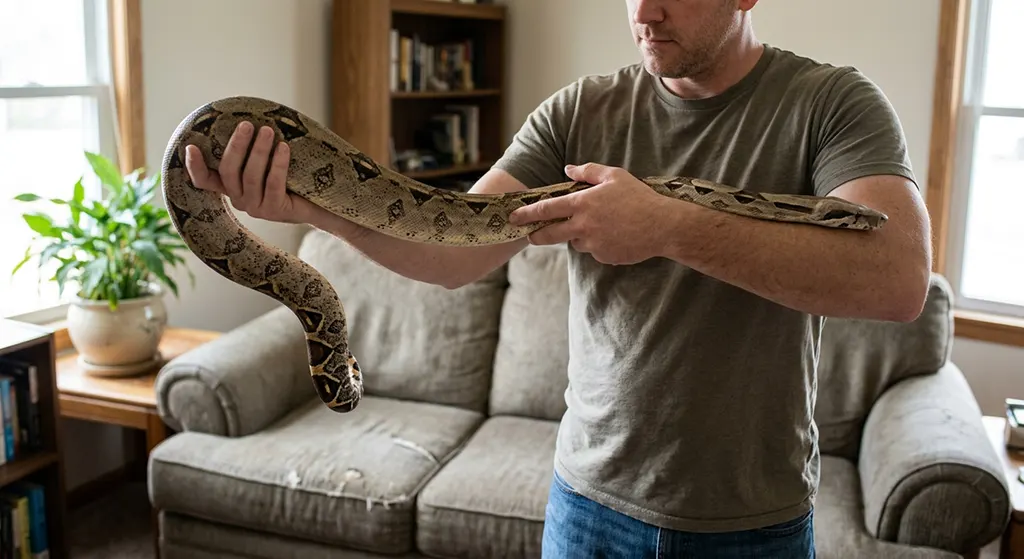
- Never handle within 48 hours of feeding. Disturbing a digesting boa risks regurgitation, which is dangerous for the snake (it can aspirate or damage the esophagus) and deeply unpleasant for you.
- Never wrap a large boa around your neck. It doesn’t matter how tame she is. An 8-foot boa doesn’t constrict out of malice — she constricts because something is wrapped around her, and her instinct is to hold on. Adult boas should be handled with the body supported, with a second person present for animals over about 6 feet.
- No handling around the face of children or other pets. Keep cats and dogs out of the room. Their movements trigger predatory/defensive responses in snakes.
- Wash your hands before and after. This protects you from salmonella (standard guidance from the CDC for all reptile keepers) and protects the snake from residues on your skin.
- Never handle a snake in feeding mode. If the animal is striking at the glass, wait. Use a snake hook to gently direct an intractable animal — hook training works well on boas.
The Association of Reptilian and Amphibian Veterinarians publishes large-constrictor safety guidance worth reading in full before your snake passes 5 feet.
Mistake #6: Skipping the Quarantine and the Reptile Vet
New keepers often buy a boa at a show, set it up, and never think about veterinary care until something goes wrong. Two fixes:
- Quarantine every new animal for a minimum of 60–90 days in a separate room, with separate equipment. Boas are prone to internal parasites, respiratory infections, and mites — all common in mass-produced expo animals. One vet visit with fecal testing at intake costs a fraction of treating a full-blown parasite load in your whole collection later. Viral respiratory pathogens are a quarantine concern too: serpentoviruses infect boas as well as pythons, and an apparently healthy snake can still be a carrier. See our guide to serpentovirus in ball pythons.
- Identify an ARAV-member exotics vet before you need one. General-practice dog-and-cat vets often won’t see snakes at all. When a respiratory infection hits — and in dry-winter US homes, it eventually does — a 24-hour delay finding a vet can be the difference between a $200 antibiotic course and a dead animal.
Mistake #7: Ignoring State and Local Law
This is the mistake that turns an expensive pet into a legal problem — and it’s the one this guide will not let you make.
Here’s the counterintuitive truth: Florida does not currently restrict private ownership of Boa constrictor. Despite the state’s aggressive rules on invasive reptiles, FWC’s 2021 expansion of the Prohibited species list (Chapter 68-5, Florida Administrative Code) targeted Burmese and other python species, anacondas, and related high-risk animals — the boa constrictor was not included, and it also does not appear on the federal 50 CFR 16.15 injurious wildlife list. It is also not a Class II species. Note that this can change at any commission meeting; verify directly with FWC (myfwc.com) before purchasing, and understand that Florida’s rules on importing and transporting wildlife still apply to dealers and breeders.
Now the states that will stop you:
- Hawaii: A total ban on all snake species, full stop. Possession is a felony-level offense with massive fines. There is no permit path for pet boas.
- New York City: The municipal health code prohibits the entire family Boidae. Legal in most of New York State, illegal in the five boroughs.
- California: Boa constrictor is on the state’s restricted species list, and possession as a personal pet is generally not permitted. California keepers should look elsewhere entirely.
- Louisiana: Boa constrictor is individually named on the state’s restricted nonnative species list — a permit is required regardless of the snake’s size.
- Missouri: Dangerous reptiles over 8 feet must be registered with county law enforcement.
- Delaware, West Virginia, New Mexico: Permit requirements of various kinds apply — check before you buy.
And beyond state law, check your county and city codes. Municipal bans on large constrictors exist in cities across Texas, Ohio, and elsewhere, often layered on top of permissive state law. Apartment leases and HOA rules add another layer.
The rule that matters: laws change, and they change often. Before any purchase, verify with (a) your state fish & wildlife agency, (b) your county animal control, and (c) your municipal code. A ten-minute phone call can save you a confiscated snake and a fine.
Handling and Safety Protocols for Large Constrictors
A brief consolidated protocol for when your boa outgrows the “easy” phase:
- Two-person rule for snakes over 6 feet or 20 pounds.
- Support the body, control the head end with a gentle grip behind the head only when necessary — never squeeze the neck.
- Keep sessions short — 15 to 30 minutes is plenty — and always end on a calm note.
- Secure the room. Close doors, block gaps under furniture, keep other animals out. An escaped 7-foot boa in a US suburban home is a 911-call event whether you like it or not, and an embarrassing one to explain to animal control.
- Have an emergency plan. Know your vet’s number, know your local animal control’s non-emergency line, and teach everyone in the household that the snake is never to be handled alone or unsupervised.
The Real Cost: A First-Year Budget for US Owners
One thing no pet store employee will tell you: the snake is the cheapest part of this hobby. Here’s an honest first-year budget for a boa purchased as a juvenile and raised into an adult setup, using mid-range US retail pricing:
One-time setup costs:
| Item | Typical US Price |
|---|---|
| Custom PVC adult enclosure (6′ x 2′ x 2′ or larger) | $600–$1,200 |
| Radiant Heat Panel + proportional thermostat | $150–$300 |
| Digital thermometers/hygrometers (x2, both ends) | $30–$60 |
| Hides (x2), water bowl, branches, decor | $80–$150 |
| Substrate (initial bulk order) | $40–$80 |
| Snake hook, feeding tongs, misc. tools | $30–$50 |
| Setup subtotal | ~$930–$1,840 |
Recurring annual costs:
| Item | Typical US Price |
|---|---|
| Frozen rats (200–300g adults, bulk ordering) | $200–$400/yr |
| Substrate replacement | $100–$200/yr |
| Electricity (RHP runs 24/7 in most climates) | $100–$250/yr |
| Annual wellness vet visit (once adult) | $80–$150 |
| Recurring subtotal | ~$480–$1,000/yr |
Add $100–$300 for the snake itself (pet-quality captive-bred BCI) and a $100–$250 emergency vet buffer, and a realistic all-in first-year number is $1,500–$3,000. That’s not a scare figure — it’s what responsible ownership actually costs. Keepers who skip the proper setup to save money end up paying it back in vet bills, replaced equipment, or a surrendered animal. If you’re working with a tighter budget, our ball python setup cost breakdown walks through a tiered approach from budget tub to full PVC.
A practical staging strategy: buy the full adult enclosure up front, and partition it with a visual barrier while the snake is small. Boas are secretive animals; a 20-gallon zone inside a large PVC enclosure with a hide at each end works perfectly for a juvenile, and you’ll never have to buy a second enclosure. This is the single best money-saving tip in this entire guide.
Shopping Smart: What to Buy, What to Skip
A few field notes from the US market:
- Buy the enclosure and RHP from specialty builders, not big-box stores. The PVC enclosures sold by reptile-specific builders (Animal Plastics, Kages, Dragonhaus, and similar) are engineered for exactly this species. The glass “reptile tanks” sold at chain pet stores are designed for geckos, not 40-pound boas.
- Don’t cheap out on the thermostat. A proportional (dimming/pulse) thermostat is the one piece of equipment where the budget option genuinely endangers your animal. This is the item to buy once and buy right.
- Buy frozen rodents in bulk online. Per-item pricing at local pet stores is two to three times the bulk-shipped rate. A small chest freezer dedicated to feeders pays for itself within months.
- Skip the “reptile humidity gauge” section of chain stores. A $10 digital thermometer/hygrometer combo from any hardware or home store is more accurate than most branded reptile units.
- UVB is optional but beneficial. Boas are nocturnal/crepuscular and can thrive on a proper diet without UVB, but low-level UVB lighting (a shadedweller-style T5 fixture) is increasingly recommended by reptile vets for metabolic health. If your budget allows, add it.
- Avoid impulse decor. One sturdy branch that can bear the snake’s full weight is worth more than five flimsy plastic plants. Boas will crush, push over, or pull down anything not rated for their weight.
Enrichment and Normal Behavior: What a Healthy Boa Looks Like
New keepers frequently panic over normal boa behavior. Learn these patterns and you’ll save yourself a dozen worried forum posts:
- Hiding constantly is normal. Boas are ambush predators that spend most of their lives motionless in a secure spot. A boa that hides 23 hours a day is a boa being a boa. Surface activity is brief and mostly happens at dusk and dawn.
- Refusing a meal occasionally is normal. Skip-feeding happens around sheds, seasonal cooling (especially in winter), breeding season, and for no reason at all. An adult boa refusing one or two scheduled meals is not an emergency. Worry only when a refusal is paired with visible weight loss or other symptoms.
- Shedding in patches signals low humidity, not illness. Fix the humidity before assuming anything is wrong.
- Slow movement is normal; limpness is not. Know the difference between a relaxed boa and a weak one. A boa that cannot right itself or support its body is a vet visit, immediately.
- Climbing declines with age but never stops. Adults are heavier and less arboreal than juveniles, but they still benefit from and use climbing opportunities. Provide them at every life stage.
- Winter slowdown is real. Many US keepers observe reduced appetite and activity from November through February, mirroring the dry season in their native range. Don’t fight it — adjust feeding frequency down slightly and let the animal follow its own rhythm.
FAQ: Boa Constrictor Care for Beginners
How big do boa constrictors get?
Females of Boa imperator commonly reach 6–8 feet; Boa constrictor constrictor females can exceed 8–10 feet. Males stay smaller, typically 5–6 feet for BCI. Weight ranges from roughly 20 to 60 pounds for large adults. Assume the larger end of the range when planning.
How long do boa constrictors live?
With proper care, 20–30 years is typical, and some individuals exceed 35. This is a longer commitment than most dogs.
Are boa constrictors good beginner snakes?
They’re among the better large-snake choices — hardy, usually docile, and widely captive-bred. But “beginner-friendly” assumes you can handle the adult size, cost of a proper enclosure, and legal requirements. If any of those are in doubt, start with a smaller species — our breakdown of the best pet snakes for beginners compares temperament, cost, and care difficulty side by side.
Are boa constrictors legal in Florida?
Yes, currently — boa constrictors are not on Florida’s Prohibited or Conditional species lists, and they are not Class II wildlife. Rules change, so confirm with FWC directly before purchasing.
Are boa constrictors legal in California?
Generally no for personal pets — the species is on California’s restricted list. Check with CDFW for any current exception before assuming otherwise.
What humidity does a boa constrictor need?
60–70% ambient, raised to 75–80% during sheds. In winter, most US homes need active humidification to hit these numbers — a sealed PVC enclosure makes this far easier.
How often should I feed my boa?
Hatchlings/juveniles every 7–10 days, sub-adults every 10–14 days, adults every 3–4 weeks. One appropriately sized frozen-thawed rat per feeding. Never power feed.
Do boa constrictors bite?
Rarely, and bites from adults are defensive, not predatory — a quick strike and release. Still, an adult boa bite requires medical attention (deep punctures, possible infection), and the real risk with large constrictors is constriction, not teeth. Follow the handling protocols above and the risk is minimal.
Glass tank or PVC enclosure?
PVC, without question, for anything past the juvenile stage. It holds humidity, holds heat, and is escape-proof when built properly — all three of which are struggles with glass in American homes.
Conclusion: The Boa You Commit to Is the Boa You Get
The gap between a thriving adult boa and a surrender case is almost never luck. It’s the enclosure bought at adult size instead of baby size, the feeding schedule respected instead of rushed, the thermostat installed instead of assumed, the county ordinance checked instead of guessed.
If you do this right — a 6-foot PVC enclosure, an RHP on a proportional thermostat, 60–70% humidity, a conservative feeding schedule, quarantine and a reptile vet on file, and verified state and local legality — you get one of the most impressive and interactive animals in the reptile hobby for the next quarter-century.
Get any of the seven mistakes wrong, and you’ll join the long line of owners learning the expensive way. Now you don’t have to.
Next steps:
- Verify your state, county, and city rules (start with your state fish & wildlife agency and local animal control)
- Find an ARAV-member reptile veterinarian near you at arav.org
- Price out a complete adult PVC enclosure setup before buying the snake — the enclosure should be ready before the animal arrives
- Bookmark FWC (myfwc.com) if you’re in Florida, CDFW (wildlife.ca.gov) if you’re in California, and USARK’s state law tracker for national changes
This content is for educational purposes only and does not substitute professional veterinary diagnosis or treatment. If you observe any symptoms of illness, injury, or abnormal behavior, please consult a qualified exotic animal veterinarian immediately.
For more details, please review our full Medical Disclaimer.