
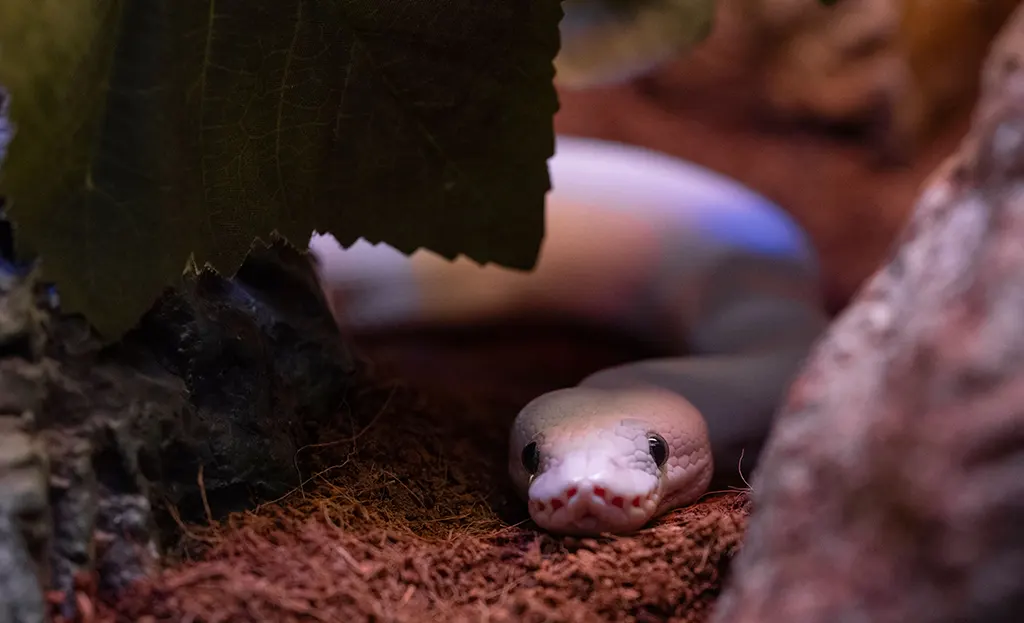
A ball python breathing with its mouth open, producing bubbles around its nostrils, or making unusual respiratory sounds may appear to have a routine respiratory infection (RI).
But what if it isn’t a routine infection?
One important possibility is serpentovirus, a group of viruses associated with serious respiratory disease in snakes. Historically, these viruses have often been called snake nidoviruses, and ball python nidovirus (BPNV) remains a familiar term among keepers and veterinarians.
The distinction matters because not every respiratory infection is serpentovirus, and not every snake infected with serpentovirus will look obviously sick.
A snake may appear normal while carrying an infection, and symptoms alone cannot reliably distinguish viral disease from bacterial pneumonia, other infectious causes, or husbandry-related problems.
A 2025 case report from Thailand adds another important piece to the picture. Researchers confirmed serpentovirus in a pet ball python with severe respiratory disease, documenting the first confirmed case in Thailand.
For keepers, breeders, and anyone maintaining multiple snakes, the practical question isn’t simply what this virus is. It’s how to recognize a potential problem, protect other animals, and avoid mistakes that delay diagnosis.
This guide explains what the research actually shows, what remains uncertain, and how to build a more defensible quarantine and testing strategy.
What Is Ball Python Serpentovirus?
Serpentoviruses are RNA viruses in the order Nidovirales. The term nidovirus is still widely used in reptile medicine and hobby discussions, although the classification and terminology have evolved.
Ball python nidovirus is the historical name commonly associated with serpentovirus infections in ball pythons.
These viruses have been associated with respiratory disease, including pneumonia, increased respiratory secretions, and, in some cases, fatal illness.
However, one distinction is essential: serpentovirus is not synonymous with every ball python respiratory infection.
Respiratory disease in snakes can have several causes:
- Serpentovirus and other viral pathogens
- Bacterial infections
- Fungal infections
- Parasitic disease
- Poor ventilation or inappropriate environmental conditions
- Aspiration or other respiratory injuries
Some cases involve multiple problems simultaneously. A snake may have an underlying viral infection with a secondary bacterial complication.
That is one reason an antibiotic response, or lack of one, cannot establish the diagnosis by itself.
Why the name Nidovirus still appears everywhere
You may encounter several terms in veterinary papers, laboratory reports, and breeder discussions:
- Ball python nidovirus (BPNV)
- Reptile-associated nidovirus
- Serpentovirus
- Serpentovirus infection
These terms overlap in historical usage, but they should not automatically be treated as interchangeable names for every virus in the broader group.
For practical purposes, when searching for diagnostic services or scientific literature, use both ball python nidovirus and ball python serpentovirus.
This helps avoid missing useful information published under older terminology.
What the 2025 Thailand Case Report Actually Reveals
The paper First case of serpentovirus infection in a ball python (Python regius) in Thailand: a case report with molecular characterization was published in 2025.
Research reference: PMC12295528
Journal: Veterinary Research Forum, 2025;16(6):361–364
DOI: 10.30466/vrf.2024.2034234.4345
Read the full case report on PubMed Central.
The case deserves attention, but the details are more informative than the headline.
1. What happened to the snake?
The report described a nine-month-old male ball python presented to the Reptile Science Clinic at the Queen Saovabha Memorial Institute in Bangkok.
The snake had been purchased from a private breeder.
According to the report, the owner noticed respiratory problems approximately five months after acquisition.
Clinical signs included:
- Open-mouth breathing
- Clear nasal discharge
- Excessive salivation
- Audible respiration
- Reduced appetite
- Progressive emaciation
The snake had also developed oral inflammation and other severe clinical abnormalities by the time of veterinary presentation.
Despite veterinary intervention, the animal died approximately two weeks after presentation.
Postmortem examination revealed extensive mucus accumulation, oral tissue necrosis, and severe catarrhal pneumonia.
The researchers identified serpentovirus RNA in lung tissue.
Sequence analysis found greater than 95% identity with a previously described US ball python serpentovirus sequence.
The identified virus grouped with known US ball python serpentoviruses in the study’s phylogenetic analysis.
2. Does this prove international pet trade transmission?
Not conclusively.
The authors discussed the international exotic pet trade as a plausible route of introduction, particularly because ball pythons are not native to Thailand.
The close genetic relationship between the Thai virus and previously identified US ball python serpentoviruses adds context to that hypothesis.
However, the report did not establish the exact origin of the infection, the precise transmission event, or a complete international trade pathway.
The source of the snake’s infection could not be confirmed.
This distinction matters for breeders and buyers.
The case supports concern about cross-border pathogen movement. It does not prove that a particular exporting country, importer, wholesaler, or breeder was responsible.
3. Why one case matters, but cannot tell us everything
This was a case report, not a population-wide surveillance study.
It establishes that a confirmed infection occurred in a pet ball python in Thailand.
It does not establish:
- The percentage of Thai ball pythons infected
- The current prevalence of serpentovirus in North American collections
- The percentage of infected snakes that die
- Whether large commercial breeders have higher infection rates than small breeders
- Whether every infected snake eventually develops respiratory disease
The report also highlights a larger diagnostic issue: the authors noted that other pathogens, including bacteria and fungi, could not be completely ruled out as contributors to the clinical disease.
The lesson is not that every ball python is at risk of imminent death.
It is that serpentovirus deserves consideration when investigating serious or persistent respiratory disease, especially in collections where multiple snakes may have been exposed.
Snake Nidovirus Symptoms: What Should You Look For?
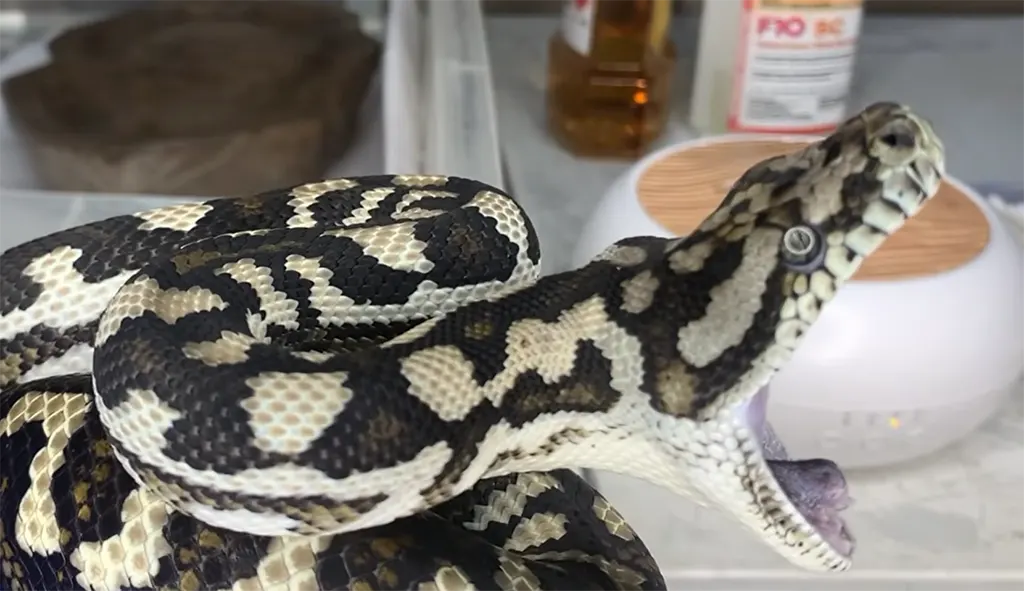
Photo via YouTube (Sydney Reptiles)
One of the most dangerous misconceptions about respiratory disease in snakes is that visible symptoms always appear early.
They don’t.
Some infected snakes may show no obvious clinical signs. Others develop mild abnormalities before progressing to significant respiratory distress.
There is no single symptom that reliably confirms serpentovirus.
Early or less obvious warning signs
Watch for changes such as:
- Intermittent wheezing or unusual breathing sounds
- Occasional increased saliva
- Small amounts of oral or nasal discharge
- Unusual swallowing movements
- Reduced feeding response
- Persistent respiratory noises without obvious discharge
These signs are nonspecific.
A ball python that skips a meal is not automatically sick, and a single unusual breath does not establish an infection.
Look for patterns, changes from baseline, and combinations of symptoms.
More concerning respiratory signs
Symptoms requiring prompt veterinary assessment include:
- Repeated open-mouth breathing
- Thick or persistent mucus
- Bubbles or discharge around the nostrils
- Excessive oral secretions
- Marked lethargy
- Progressive weight loss
- Labored breathing
- Abnormal oral tissues
Ball python breathing with mouth open is a warning sign, not a diagnosis.
Snakes may occasionally open their mouths during normal activities such as yawning or adjusting their jaws after feeding.
Repeated open-mouth breathing at rest, especially with mucus, abnormal respiratory sounds, or increased breathing effort, is much more concerning.
Severe breathing difficulty, blue or gray oral tissues, collapse, or pronounced weakness warrants emergency veterinary attention.
Do not wait for a complete set of symptoms.
Ball Python RI vs. Serpentovirus: How Are They Different?
This is where many online care guides oversimplify the problem.
A respiratory infection is a clinical description. It is not a single disease with a single cause.
Serpentovirus can cause respiratory disease, but respiratory symptoms can also result from bacteria, environmental stressors, or other conditions.
The two categories overlap clinically.
| Feature | General respiratory infection | Serpentovirus-associated disease |
|---|---|---|
| Possible causes | Bacteria, viruses, fungi, husbandry problems, other conditions | Serpentovirus infection |
| Nasal discharge | Possible | Possible |
| Mouth breathing | Possible | Possible |
| Wheezing | Possible | Possible |
| Pneumonia | Possible | Possible |
| Severe mucus accumulation | Possible | Reported in severe cases |
| Secondary bacterial infection | Possible | May complicate disease |
| Confirmation | Depends on suspected cause | Appropriate molecular testing, interpreted clinically |
| Treatment | Cause-specific | Veterinary supportive care and management of complications |
This comparison has an important limitation: the first column is not a single disease, and the second is not a uniform clinical presentation.
You cannot diagnose serpentovirus by comparing a snake’s symptoms against an internet checklist.
Why a snake may worsen after routine RI treatment
Suppose a keeper notices mucus and wheezing.
They raise the enclosure temperature, increase humidity, and arrange treatment for a presumed bacterial infection.
The snake continues to deteriorate.
Several explanations are possible:
- The original diagnosis was incorrect.
- A viral infection is driving the disease.
- A secondary infection is present but incompletely controlled.
- The animal has significant pneumonia requiring more intensive care.
- The enclosure adjustments created additional environmental problems.
- The treatment was inappropriate for the actual cause or was insufficient for disease severity.
Antibiotics do not eliminate serpentovirus.
Likewise, raising the temperature cannot remove a virus from an infected animal.
Correct thermal support can help prevent husbandry-related stress, but excessive heat may worsen dehydration or other complications.
Humidity also needs to remain appropriate for the species and enclosure. Constantly increasing humidity or using improvised steam treatments is not a substitute for veterinary treatment.
For region-specific temperature and humidity targets, see our ball python regional climate control guide.
Avoid force-feeding, unsupervised medication, or home nebulization protocols without veterinary direction.
For a snake struggling to breathe, the priority is diagnosis and stabilization—not experimenting with environmental settings.
How Does Serpentovirus Spread Between Snakes?
Transmission control is particularly important in multi-snake collections.
Published research supports respiratory secretions as an important transmission concern.
Close contact with infected snakes, contaminated equipment, and exposure to infectious secretions may create opportunities for transmission.
Potentially relevant pathways include:
- Direct contact between snakes
- Contaminated handling equipment
- Shared water bowls or accessories
- Contaminated hands or gloves
- Contaminated enclosure surfaces
- Respiratory secretions and potentially short-range aerosols
- Possible fecal-oral exposure
Serpentovirus RNA has been detected in oral samples, tracheal washes, gastrointestinal material, and feces in published work.
Detection of viral RNA does not automatically prove that every route is equally important or that every positive sample represents infectious virus.
The exact contribution of individual transmission routes under normal household conditions remains incompletely characterized.
Nevertheless, basic biosecurity should account for contamination beyond the snake’s body.
Can an apparently healthy snake spread serpentovirus?
Potentially, yes.
Research on captive snakes has documented persistent infection and has raised concerns about clinically normal carriers and transmission within collections.
This is a major reason visual health checks alone are inadequate.
A new snake can appear alert, feed consistently, and have no visible respiratory discharge while still presenting a biosecurity risk.
However, not every apparently healthy snake is infected, and not every positive animal will necessarily develop severe disease.
The practical implication is straightforward: appearance is useful for monitoring health, but it cannot replace appropriate testing and quarantine.
Why Buying From a Large Breeder Is Not Automatically Safer
Large breeders, established hobby breeders, and small private sellers can all maintain healthy collections.
Business size alone is not a meaningful infection diagnosis.
A large operation may have excellent veterinary oversight, documented health screening, strict quarantine, and dedicated staff.
A small breeder may have excellent biosecurity—or very limited facilities and no systematic testing.
The relevant factors are operational.
What can increase risk in a breeding facility?
Potential risk factors include:
High animal density: More animals can create more opportunities for exposure when infection enters a collection.
Shared equipment: Reusing cleaning tools, feeding tools, or handling materials without effective sanitation can transfer contamination.
Mixed quarantine and resident animals: New arrivals may expose established snakes if isolation is incomplete.
Frequent animal movement: Breeding exchanges, sales, shows, and acquisitions can introduce animals from multiple sources.
Inadequate health records: Without acquisition dates, test results, and illness histories, identifying exposure groups becomes difficult.
Delayed disease recognition: Mild symptoms may be overlooked when hundreds of animals are involved.
These factors can apply to any collection, not just commercial facilities.
Five questions to ask before buying a ball python
- Are newly acquired snakes physically separated from established animals?
- Is there a documented quarantine and health-monitoring process?
- Has serpentovirus testing been performed, and can the seller explain the test and results?
- Have there been unexplained respiratory illnesses or deaths in the collection?
- What happens if a snake develops symptoms after purchase?
A confident sales pitch is not equivalent to a biosecurity program.
A breeder who can explain the process, acknowledge limitations, and provide credible records is giving you more useful information than one who simply claims every snake is healthy.
A Realistic Quarantine Protocol for Ball Pythons
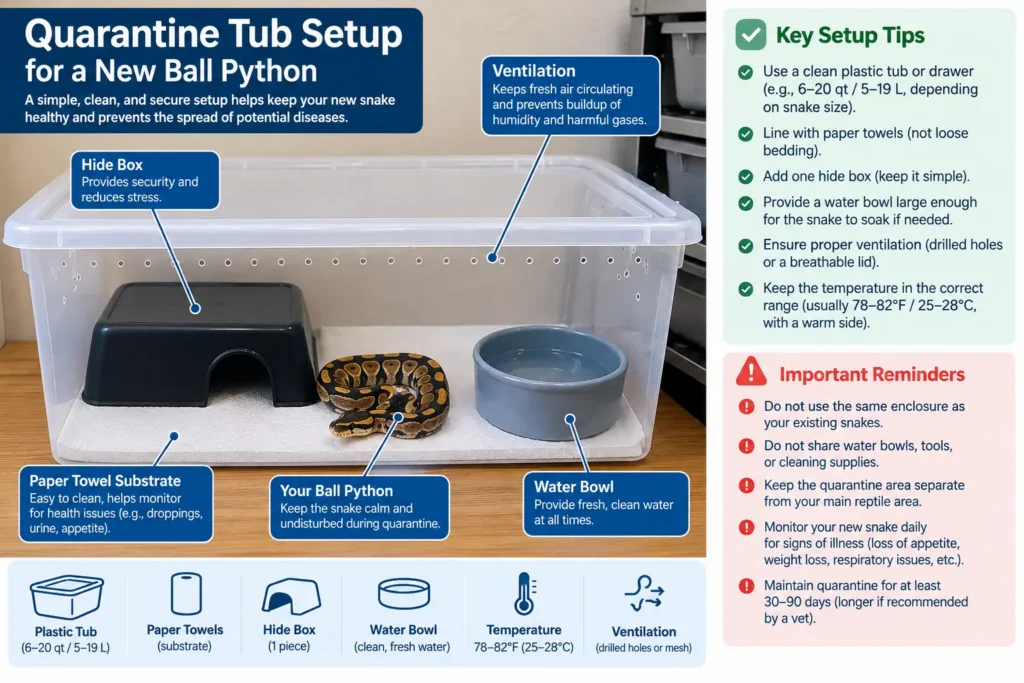
Quarantine is one of the most valuable tools available to private keepers.
But there is a difference between putting a new snake in another enclosure and establishing a genuine biosecurity barrier.
A quarantine enclosure should prevent contact, shared equipment, and accidental contamination.If you’re setting up a separate enclosure for the first time, our ball python enclosure setup guide covers ventilation, heating, and hides.
Important: A 90-day quarantine with two PCR tests is a conservative management strategy that some keepers may choose with veterinary guidance. It is not a universally validated serpentovirus elimination protocol, and 90 days does not guarantee that a snake is virus-free.
The optimal timing of repeat testing depends on exposure history, clinical findings, the test used, and veterinary interpretation.
Step 1: Establish a physically separate quarantine area
Ideally, house new arrivals in a separate room with independent equipment.
Use:
- A secure, easy-to-clean enclosure
- Dedicated feeding tongs
- Dedicated water bowls
- Disposable or dedicated cleaning materials
- Separate waste bags
- A digital thermometer and appropriate environmental monitoring
- A dedicated quarantine log
Avoid stacking quarantine animals directly beside established animals when this allows accidental contact or contamination.
If a separate room is impossible, maximize physical separation and seek veterinary advice about the limitations of the setup.
A separate enclosure in the same room is better than co-housing, but it is not equivalent to a fully separate quarantine area.
Step 2: Start the quarantine clock carefully
Record:
- Acquisition date
- Seller and source information
- Previous housing arrangements
- Previous illnesses or treatments
- Feeding history
- Initial body weight
- Initial respiratory observations
- Diagnostic results
For a cautious 90-day program, count the period from acquisition and isolation, provided there has been no subsequent exposure.
If the snake develops symptoms, tests positive, or experiences a new exposure, reassess the quarantine period with a reptile veterinarian rather than simply completing the original calendar.
Do not release an animal from quarantine solely because 90 days have passed.
Step 3: Arrange baseline testing
Discuss serpentovirus RT-PCR testing with a reptile veterinarian.
For clinically affected snakes, the University of Guelph Animal Health Laboratory identifies deep tracheal swabs or trans-tracheal lung lavage samples as preferred clinical samples.
These are veterinary procedures, not routine owner-collected swabs.
Other sample types may be accepted by particular laboratories, but sample suitability varies.
Ask the laboratory:
- Which specimen is validated for the test?
- Does the laboratory accept oral or oropharyngeal swabs?
- Is a specific transport medium required?
- Should the specimen be refrigerated or shipped frozen?
- What is the expected turnaround time?
- Does the assay detect the relevant serpentovirus variants?
A routine mouth swab is not automatically equivalent to a deep tracheal sample.
The correct specimen and collection method can materially affect diagnostic usefulness.
Step 4: Repeat testing strategically
A conservative program might look like this:
| Time | Action |
|---|---|
| Day 0 | Physical examination, history, baseline assessment, discuss PCR |
| Early quarantine | Complete baseline testing as advised |
| Throughout quarantine | Daily visual checks and regular weight monitoring |
| Around day 60–90 | Consider repeat PCR based on veterinary advice |
| Before introduction | Review exposure history, clinical status, and test results |
This schedule is an example of a risk-management framework, not a scientifically established universal schedule.
If the initial test is negative, repeat testing may be useful because viral shedding, specimen quality, and infection timing can affect detection.
However, two negative tests do not provide absolute certainty.
The appropriate interval between tests should be determined by the veterinarian and diagnostic laboratory.
For animals with known exposure to a positive snake, a generic new-arrival schedule is insufficient. A collection-level testing and isolation plan may be necessary.
Step 5: Follow quarantine hygiene every day
A practical daily routine:
- Inspect established, apparently healthy snakes first.
- Handle quarantine animals last.
- Change gloves between animals or animal groups.
- Never reuse contaminated water bowls, tools, or cleaning materials.
- Remove waste without dragging contaminated materials through the facility.
- Wash hands after handling animals and equipment.
- Disinfect appropriately cleaned surfaces.
- Record respiratory changes and unusual behavior.
If infection is suspected, reverse the usual workflow for the affected animal: isolate it immediately, dedicate personnel and equipment, and prevent contamination of other enclosures.
A consistent workflow is often more effective than a complicated protocol that nobody follows reliably.
A Breeder’s Mistake That Could Spread an Infection
Imagine a keeper with 12 ball pythons who buys a visually impressive new morph.
The seller has a good reputation. The snake looks healthy and feeds normally.
The keeper places it in a separate enclosure for two weeks, then moves it into the main collection area.
Several weeks later, the new snake develops abnormal respiratory sounds.
Other snakes subsequently begin showing concerning symptoms.
The keeper now faces a potential collection-wide exposure problem.
This is a useful hypothetical scenario, not a documented case report. The specific 12-snake outbreak, timeline, and outcome are illustrative and should not be mistaken for a verified breeder experience.
The scenario demonstrates why short quarantine periods and seller reputation alone cannot establish disease-free status.
It also highlights an important point: when respiratory symptoms appear in multiple snakes, the problem may no longer be limited to the first symptomatic animal.
At that stage, a veterinarian may recommend testing several animals, mapping shared exposures, and separating potentially affected groups.
Do not assume that every snake in the collection is infected, but do not assume that apparently healthy snakes are safe either.
How to Disinfect for Snake Nidovirus
Photo via YouTube (Oxyfresh)
Disinfection is not simply spraying a product over a dirty enclosure.
Organic material, including mucus, feces, urates, and substrate debris, can interfere with disinfectant performance.
The correct process is:
Remove debris → Clean → Apply an appropriate disinfectant → Maintain contact time → Rinse or dry as directed.
Which disinfectants should you consider?
Two products or product categories frequently discussed in veterinary biosecurity are:
1. F10SC Veterinary Disinfectant
F10SC is a veterinary disinfectant containing quaternary ammonium and biguanide active ingredients.
The manufacturer provides product-specific directions for environmental disinfection and higher-level disinfection.
However, a broad-spectrum product claim does not automatically establish effectiveness against every serpentovirus strain under every real-world condition.
For US keepers, check the actual EPA-registered product label, approved uses, dilution, contact time, and safety instructions.
Do not assume that every F10 product or formulation has identical instructions.
2. Accelerated hydrogen peroxide (AHP) products
AHP-based disinfectants are used in veterinary infection control.
Their efficacy depends on the specific formulation, target pathogen, concentration, and contact time.
General veterinary disinfectant references describe broad antimicrobial activity for certain AHP formulations, but this should not be interpreted as direct proof that every product has been validated against ball python serpentovirus.
Use a product with appropriate labeled claims and obtain veterinary guidance when managing a confirmed outbreak.
A critical disinfection rule
Do not invent a dilution or contact time.
For example, a manufacturer’s general environmental dilution may differ from its directions for resistant organisms.
A product that works under one laboratory condition may not work equally well when mucus or other organic material remains on a surface.
Never mix disinfectants.
Do not expose snakes to concentrated cleaning chemicals, wet chemical residues, disinfectant aerosols, or fumes.
Remove animals from the treatment area and follow label directions for ventilation, rinsing, and safe re-entry.
What about porous materials?
Cardboard hides, wooden accessories, damaged enclosure surfaces, and heavily contaminated porous materials are difficult to disinfect reliably.
For suspected or confirmed contamination, disposable items should generally be discarded safely.
Reusable items should only be retained if they can be thoroughly cleaned and effectively disinfected.
When in doubt, replacement may be safer than attempting to salvage a porous item.
Don’t forget your hands and workflow
A disinfectant alone cannot compensate for poor handling practices.
Potential contamination can travel through:
- Gloves
- Clothing
- Feeding tools
- Water bowls
- Cleaning brushes
- Waste containers
- Enclosure handles
Create separate workflows for clean and quarantine areas.
If your collection has a confirmed outbreak, consult a reptile veterinarian about a written facility-level biosecurity plan.
Serpentovirus RT-PCR Test: Diagnosis and What Results Mean
PCR-based testing is one of the principal diagnostic approaches for detecting serpentovirus.
The Merck Veterinary Manual describes PCR testing for nidovirus and identifies oral swabs and tracheal washes as diagnostic sampling approaches.
The University of Guelph Animal Health Laboratory offers a serpentovirus RT-PCR service and specifies preferred specimens for clinical and postmortem testing.
How does RT-PCR work?
Serpentovirus is an RNA virus.
Reverse transcription polymerase chain reaction (RT-PCR) converts viral RNA into complementary DNA and amplifies target sequences for detection.
Real-time RT-PCR, also called RT-qPCR, monitors amplification during the testing process.
Depending on the assay, the laboratory may report:
- Detected
- Not detected
- Inconclusive or invalid
Interpretation depends on the assay and specimen.
A positive result indicates that the targeted viral genetic material was detected. It does not, by itself, establish the severity of illness or prove that the detected material represents infectious virus.
A negative result does not automatically rule out infection.
Why can a test be negative in an infected snake?
Potential reasons include:
- The specimen was collected at an unhelpful time.
- The sample did not contain enough detectable viral material.
- The sampling method was inadequate.
- Viral shedding was intermittent or below the detection threshold.
- The assay does not adequately detect the relevant viral variant.
- The specimen was improperly handled or transported.
This is why the veterinarian should select the specimen and interpret the result in the context of symptoms and exposure history.
Should every new ball python receive a PCR test?
Not every situation has the same risk.
For a collection with multiple snakes, planned acquisitions, or valuable breeding animals, pre-purchase screening and post-arrival testing can be reasonable components of biosecurity.
For a pet-only keeper with one existing snake, the decision may depend on veterinary assessment and the source animal’s history.
Testing can provide valuable information, but it should not create a false sense of security.
The most useful approach combines:
- Reputable sourcing
- Physical quarantine
- Appropriate diagnostic testing
- Repeated observation
- Consistent hygiene
Is Serpentovirus in Ball Pythons Curable?
There is currently no established, proven curative antiviral treatment for ball python serpentovirus infection.
This is one of the most important points for keepers to understand.
Veterinary care focuses on stabilizing the animal, managing respiratory complications, and addressing secondary disease where appropriate.
Supportive care may include:
- Appropriate thermal support
- Fluid therapy
- Nutritional management
- Respiratory monitoring
- Veterinary-directed oxygen support when indicated and available
- Carefully selected treatment for secondary bacterial infections
- Hospitalization or other interventions for severe disease
Treatment must be individualized.
A severely affected snake may require intensive veterinary management.
Do antibiotics help?
They may help when a bacterial infection is also present.
However, antibiotics do not eliminate serpentovirus.
Giving antibiotics without appropriate veterinary assessment may delay the correct diagnosis and expose the animal to unnecessary treatment.
Secondary bacterial infection is a legitimate concern in severe respiratory disease, but it should not be assumed in every case.
Is there a vaccine?
There is no established, routinely available, proven effective vaccine for preventing serpentovirus disease in pet ball pythons.
The Merck Veterinary Manual discusses the lack of specific treatment and notes that a vaccine under development has not been effective.
Veterinary supportive care remains the practical foundation of treatment.
What is the survival rate?
There is no reliable single survival percentage that can be applied to all serpentovirus-positive ball pythons.
Published studies differ in:
- Snake species
- Viral strains
- Clinical severity
- Collection conditions
- Testing methods
- Case selection
- Follow-up duration
A case report describing one fatal infection cannot establish a general mortality rate.
Likewise, an outbreak with substantial mortality in a particular collection cannot predict an individual snake’s outcome.
Early veterinary intervention is sensible, but it does not guarantee survival.
The most useful prognostic information comes from the individual animal’s respiratory status, disease severity, hydration, body condition, diagnostic findings, and response to treatment.
Frequently Asked Questions
Can a ball python have serpentovirus without symptoms?
Yes, apparently healthy snakes can carry infection.
Research has identified persistent infection in captive snakes and has raised concerns about asymptomatic or subclinical carriers.
A snake that feeds consistently and looks healthy may still warrant quarantine and diagnostic screening.
How much does a serpentovirus PCR test cost?
There is no single universal price.
The total cost may include:
* Veterinary examination
* Sample collection
* Laboratory testing
* Shipping and handling
* Follow-up appointments
* Additional diagnostics
A simple laboratory test fee may not reflect the total cost of diagnosing a sick snake.
Ask the reptile veterinarian for a current estimate and whether the laboratory accepts samples directly from veterinary practices.
The University of Guelph Animal Health Laboratory publishes its testing service information online, but pricing and availability should be confirmed directly.
Can I test my ball python at home?
Home collection may be possible for certain laboratory-approved specimens, but collection requirements vary.
Deep tracheal sampling and lung lavage should be performed by appropriately trained veterinary professionals.
Do not attempt invasive sampling at home.
Before collecting any swab, confirm the accepted specimen type, collection method, transport medium, and shipping requirements with the receiving laboratory.
Is 30 days of quarantine enough?
Thirty days may be insufficient for a cautious biosecurity program when considering a pathogen that can be difficult to detect.
However, 90 days is not a scientifically guaranteed safe interval either.
Quarantine duration and testing should be tailored to the source, exposure history, and diagnostic plan.
For collections with a known positive animal, quarantine and testing requirements may be substantially more complex.
Should I use F10SC or accelerated hydrogen peroxide?
Both product categories have applications in veterinary environmental hygiene.
Neither should be assumed effective against every serpentovirus strain without considering the specific product’s evidence and label.
Choose a product appropriate for the intended surface and use it exactly as directed.
Cleaning before disinfection is essential.
For a confirmed outbreak, consult a reptile veterinarian about product selection and facility decontamination.
Can I keep an infected snake if it has no symptoms?
This requires a careful decision.
A snake that tests positive may pose a risk to other snakes, even if it appears healthy.
Possible management options include long-term isolation, dedicated equipment, and veterinary monitoring.
If you maintain a breeding collection, the implications are particularly important because animal movement and shared handling increase the complexity of disease control.
Discuss the animal’s welfare and long-term management with a reptile veterinarian.
Can serpentovirus spread to dogs, cats, or humans?
Current evidence does not establish serpentovirus as a zoonotic threat to humans.
These viruses are primarily recognized as reptile pathogens.
However, good hygiene remains important because reptiles may carry other organisms that can infect people, including Salmonella.
Wash your hands after handling reptiles and their enclosures, and keep reptile equipment away from food preparation areas.
Should I stop buying ball pythons because of serpentovirus?
Not necessarily.
The existence of a serious pathogen does not mean every ball python is infected or every breeder is unsafe.
Instead, use a risk-based purchasing strategy.
Ask questions, request health records, quarantine new arrivals, and discuss testing with your veterinarian.
A transparent seller and a robust biosecurity plan are more meaningful than appearance, morph rarity, or breeder size alone.
If you’re comparing listings, our ball python morphs and price guide shows what a transparent seller’s listing usually includes.
Your Ball Python Respiratory Health Action Checklist
Use this checklist whenever you acquire a new snake or notice possible respiratory abnormalities.
If your ball python appears sick
- Check whether breathing is normal at rest.
- Look for nasal discharge, mucus, bubbles, or excessive saliva.
- Check for repeated open-mouth breathing.
- Record current weight and compare it with previous records.
- Review enclosure temperatures and environmental conditions.
- Photograph or video abnormal breathing when safe to do so.
- Contact a reptile veterinarian promptly.
- Ask whether serpentovirus RT-PCR and other respiratory diagnostics are appropriate.
- Isolate the affected snake and stop animal transfers.
- Do not begin force-feeding, medication, or improvised respiratory treatments without veterinary guidance.
Emergency warning: A snake struggling to breathe, showing blue or gray oral tissues, or becoming profoundly weak needs urgent veterinary attention.
If you are bringing home a new ball python
- Obtain the seller’s health and acquisition records.
- Ask about respiratory illness or unexplained deaths in the source collection.
- Prepare a physically separate quarantine enclosure.
- Establish dedicated tools and cleaning materials.
- Record the arrival date and initial body weight.
- Discuss baseline serpentovirus PCR testing with your veterinarian.
- Maintain quarantine with daily health checks.
- Consider repeat testing based on veterinary guidance.
- Disinfect appropriately and maintain clean-to-quarantine workflow.
- Do not introduce the snake solely because it looks healthy or a calendar period has elapsed.
If a snake tests positive
- Obtain veterinary interpretation of the result.
- Stop animal sales, transfers, breeding exchanges, and other movements that could expose additional snakes until risk is assessed.
- Identify animals that shared space, equipment, or handling.
- Establish separate equipment and handling procedures.
- Discuss testing priorities for exposed animals.
- Create a documented isolation and monitoring plan.
- Review enclosure cleaning and disinfection procedures.
- Reassess the plan as new results become available.
Final Thoughts: Prevention Is More Valuable Than Panic
Serpentovirus deserves serious attention in ball python husbandry.
The 2025 Thailand case report reinforces the importance of recognizing respiratory disease, investigating potential viral causes, and understanding that pathogens can move through captive animal populations.
But the scientific evidence also calls for restraint.
A single case cannot establish worldwide prevalence, prove a specific international transmission chain, or determine the survival odds for every infected snake.
The most important practical lesson is that respiratory symptoms should trigger investigation, not guesswork.
Do not assume that every respiratory infection is serpentovirus.
Do not assume that every snake with serpentovirus will die.
And do not assume that a healthy appearance, a reputable seller, or a negative test guarantees freedom from infection.
For individual keepers, the strongest defense is sensible quarantine, appropriate diagnostic testing, consistent hygiene, and prompt veterinary care.
For breeders, the same principles need to extend across the entire collection.
These measures cannot eliminate every risk, but they can make a meaningful difference in protecting the snakes already in your care.
Veterinary References and Further Reading
- Laoungbua P, et al. (2025). First case of serpentovirus infection in a ball python (Python regius) in Thailand: a case report with molecular characterization. Veterinary Research Forum, 16(6):361–364.
Read the full paper – PMC12295528 - Merck Veterinary Manual. Viral Diseases of Reptiles.
Read the veterinary reference - University of Guelph Animal Health Laboratory. Serpentovirus (Reptile Nidovirus) – PCR.
Testing information and specimen requirements - Hoon-Hanks LL, et al. (2019). Longitudinal and cross-sectional sampling of serpentovirus (nidovirus) infection in captive snakes reveals high prevalence, persistent infection, and increased mortality in pythons and divergent serpentovirus infection in boas and colubrids. Frontiers in Veterinary Science, 6:338.
Read the study – PMC6786048 - Hoon-Hanks LL, et al. (2018). Respiratory disease in ball pythons (Python regius) experimentally infected with ball python nidovirus. Virology, 517:77–87.
Find the study on PubMed - Comolli JR, Divers SJ. (2021). Respiratory diseases of snakes. Veterinary Clinics of North America: Exotic Animal Practice, 24(2):321–340.
- F10 Products. F10SC Veterinary Disinfectant – Product Information.
Read product information
Editorial note: The 90-day quarantine and repeat-testing framework in this article is a conservative management suggestion, not a universally validated protocol. Diagnostic decisions, treatment, and outbreak management should be directed by a qualified reptile veterinarian.
This content is for educational purposes only and does not substitute professional veterinary diagnosis or treatment. If you observe any symptoms of illness, injury, or abnormal behavior, please consult a qualified exotic animal veterinarian immediately.
For more details, please review our full Medical Disclaimer.