
How to recognize early belly scale changes, prevent moisture-related skin damage, and maintain healthy humidity without keeping your substrate wet.
Your ball python looks perfectly normal until one day you notice something strange when it stretches across the enclosure floor: a few pinkish spots on its belly.
At first, you might think it’s just getting ready to shed. Perhaps you recently increased the humidity because its last shed was incomplete. Maybe you’ve been misting the enclosure more frequently, or adding water to the coconut substrate to keep the humidity gauge around 60%.
But what if those pink spots are the earliest warning signs of ball python scale rot?
Scale rot is one of those problems that can catch inexperienced keepers off guard. The frustrating part is that the advice commonly repeated online—keep humidity up, mist regularly, and avoid a dry enclosure—can become counterproductive when it leads to persistently wet bedding.
Here’s the important distinction: your snake needs sufficiently humid air, not permanently wet skin and substrate.
In this guide, we’ll explain how to recognize early belly scale rot, distinguish suspicious discoloration from normal skin changes, and solve the humidity problem without creating another one.
We’ll also look at a practical enclosure-management approach that separates ambient humidity from substrate moisture, so you can maintain a healthy environment throughout the year, including during dry North American winters and air-conditioned summers.
Important veterinary note: Scale rot is a medical condition, not simply a cosmetic problem. Early skin changes can have several causes, and photographs or home observations cannot reliably establish a diagnosis. The guidance below is intended for husbandry correction and basic first aid, not a substitute for examination by a reptile veterinarian.
1. What Is Ball Python Scale Rot? Understanding the Problem Before Treating It
Ball python scale rot is commonly used to describe ulcerative or necrotic dermatitis, a skin condition associated with tissue damage and secondary infection.
It is not simply a snake having discolored belly scales.
According to the Merck Veterinary Manual, ulcerative dermatitis occurs in snakes and lizards exposed to unfavorable environmental conditions, particularly excessive moisture and unhygienic bedding.
Moist, contaminated substrate encourages bacterial and fungal growth. Skin damage and exposure to waste products can further increase the risk of infection.
Several bacteria, including Aeromonas and Pseudomonas species, may be involved.
Importantly, Merck also explains that classic necrotic dermatitis in ball pythons can develop from within the skin and is not always the result of obviously dirty husbandry.
This means even a keeper with an otherwise clean enclosure should not automatically dismiss suspicious lesions.
Why Does Scale Rot Usually Affect the Belly?
The ventral surface of a ball python spends much of its time in contact with the enclosure floor.
If the substrate remains damp, contaminated, or poorly maintained, the belly scales may experience prolonged exposure to moisture and irritants.
Small areas of skin damage can then become entry points for infection.
The situation becomes more concerning when:
- Water collects underneath the substrate.
- Wet bedding remains in contact with the snake for extended periods.
- Urates and feces are not removed promptly.
- The enclosure has inadequate ventilation.
- The snake has an existing abrasion or damaged scale.
- An improperly controlled heat source causes thermal injury.
However, there is an important distinction between a humid enclosure and a wet enclosure.
A properly maintained ball python habitat can support relatively high humidity without keeping the snake’s contact surfaces continuously soaked.
That distinction is the foundation of preventing scale rot.
2. Ball Python Scale Rot Early Signs: What to Look for During Week 1
The biggest challenge with early scale rot is that the first visible changes can look surprisingly harmless.
A keeper may notice a slightly pink belly, a dull patch of scales, or a small discoloration and assume the snake is simply preparing to shed.
Unfortunately, waiting until the belly develops obvious sores or dark, damaged tissue can allow a localized problem to progress.
The following is a practical visual inspection framework. It is not a scientifically validated seven-day staging system. There is no established rule that scale rot must progress through specific visual stages within one week.
The goal is to help you recognize suspicious changes early enough to seek veterinary advice.
2.1 Pink Belly Discoloration: When Should You Be Concerned?
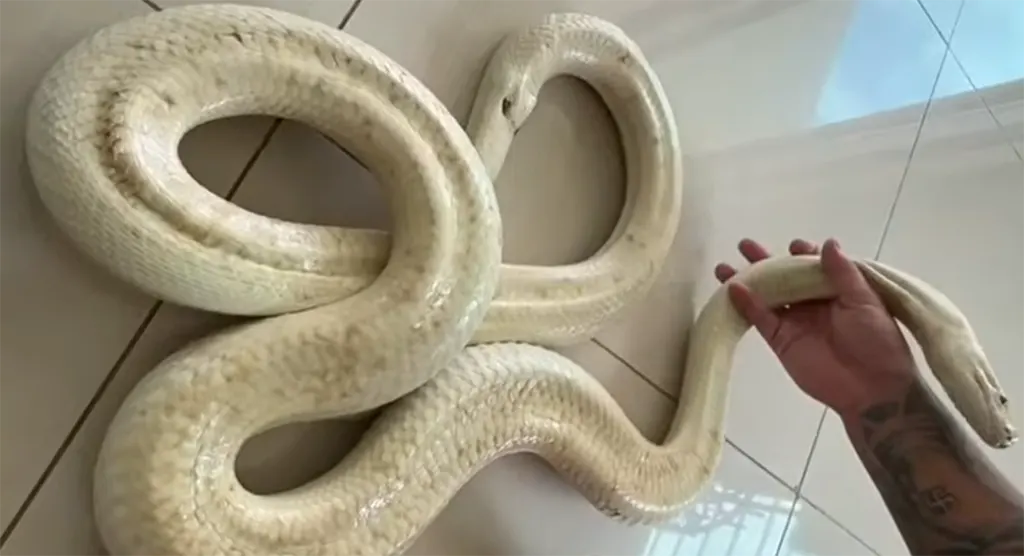
Photo via YouTube (sotrachan7649)
One of the first things keepers often notice is a pink or reddish area on the ventral scales.
However, pink coloration alone does not confirm scale rot.
A ball python may temporarily develop a pinkish appearance before shedding, particularly as the skin changes during the premolt period.
The important question is whether the discoloration looks like a generalized change or a localized lesion.
Pay attention to:
- Localized pink patches: Small, distinct areas that look different from the surrounding belly scales deserve closer attention.
- Irregular reddish marks: Spots that do not follow the normal pattern of the scales may indicate irritation or underlying tissue damage.
- Persistent discoloration: A suspicious patch that remains visible or becomes more pronounced after the snake completes a shed should not be dismissed.
- Changes in individual scales: Look for scales that appear raised, damaged, blistered, or unusually soft.
Merck describes scale rot as a process that can begin with hemorrhage into the scales before pustules and open ulcerated lesions develop.
This is why new, unexplained belly discoloration deserves attention even before an obvious wound appears.
2.2 Matte or Dull Scales: Normal Premolt or Something Else?
A ball python approaching a shed may look duller than usual.
Its colors may become less vibrant, and the skin may appear slightly cloudy. These are normal premolt changes.
The problem is that surface appearance alone is not enough to distinguish normal shedding from early skin disease.
Use the following comparison:
| Observation | More consistent with normal shedding | More concerning |
|---|---|---|
| Overall appearance | Generalized dullness | Localized abnormal patches |
| Belly coloration | Mild, widespread pinkness may occur | Distinct red or brown lesions |
| Scale texture | Generally intact | Raised, damaged, blistered scales |
| Skin surface | No open wounds | Soft, damaged, or ulcerated areas |
| Progression | Follows a normal shed cycle | Persists or deteriorates |
Do not peel scales, scrape discoloration, or attempt to remove suspected damaged tissue.
If you cannot confidently distinguish the two, take clear photographs and contact a reptile veterinarian.
2.3 Soft Scales, Blisters, and Raised Areas
This is where the situation becomes more concerning.
A localized area that appears swollen, blistered, or structurally different from the surrounding scales should not be treated as ordinary premolt coloration.
Merck identifies blister disease as an early form of ulcerative dermatitis. Some blisters may resolve without progressing to open ulcers if treatment begins early, but a thermal injury can produce a similar appearance.
That distinction matters because the treatment for an infection is not necessarily the same as the treatment for a burn.
Watch for:
- Fluid-filled blisters.
- Raised or separated ventral scales.
- Localized swelling.
- Small areas of damaged or missing skin.
- Redness accompanied by changes in scale structure.
Do not puncture a blister. Doing so can damage the tissue and introduce additional bacteria.
At this point, arranging a veterinary examination is much safer than experimenting with home treatments.
2.4 Brown, Black, or Wet-Looking Lesions: Advanced Warning Signs
Advanced scale rot may involve:
- Dark brown or black areas of damaged tissue.
- Open sores or ulcers.
- Discharge or moist, exudative lesions.
- Areas of necrotic skin.
- Swelling and inflammation around affected scales.
These are not signs to monitor casually at home.
The Merck Veterinary Manual explains that ulcerative dermatitis can progress to secondary infection and, in severe cases, septicemia.
If you see open wounds, tissue necrosis, or discharge, arrange prompt veterinary care.
If your snake also develops lethargy, weakness, loss of coordination, or abnormal breathing, treat the situation as an emergency.
A Practical Week 1 Belly Inspection Routine
Instead of checking your snake randomly, establish a consistent inspection routine.
| When | What to check | What to record |
|---|---|---|
| Day 1 | Entire ventral surface | Baseline photographs |
| Day 2–3 | Previously noticed patches | Size, color, texture |
| Day 4–5 | Belly scales and surrounding skin | Any new lesions |
| Day 6–7 | Overall appearance | Improvement, persistence, or progression |
This schedule is for observation, not permission to delay treatment for a week.
If a lesion looks suspicious on Day 1, contact a reptile veterinarian immediately rather than waiting for Day 7.
Take photographs under consistent lighting, preferably with a ruler or another non-contact size reference placed nearby. Avoid repeatedly handling the snake just to inspect the same spot.
3. The Humidity Paradox: Why Keeping Your Ball Python Too Wet Can Cause Problems
This is probably the most misunderstood part of preventing ball python scale rot.
Many new keepers encounter conflicting advice:
- Keep humidity high to prevent dehydration.
- Mist the enclosure regularly.
- Add water to coconut fiber.
- Never allow the substrate to dry out.
Then they discover that persistently wet bedding can contribute to skin disease.
So, which advice is correct?
The answer is that ambient humidity and substrate wetness are two different environmental measurements.
3.1 Ambient Humidity vs. Substrate Wetness
Let’s separate these two concepts.
Ambient humidity refers to the amount of water vapor present in the enclosure air.
It is measured as relative humidity (RH), expressed as a percentage.
Substrate wetness refers to the amount of liquid water retained in the bedding itself.
It is not measured by the hygrometer.
For example, an enclosure could have:
- 65% relative humidity in the air.
- Substrate that feels dry on the surface.
- A slightly moist lower substrate layer.
- A localized humid hide containing damp sphagnum moss.
This can be a perfectly reasonable environmental arrangement.
By contrast, another enclosure might show exactly the same 65% RH while having waterlogged coconut fiber, wet bedding around the water bowl, and condensation collecting underneath the substrate.
The hygrometer cannot tell you that the bedding is saturated.
This is why chasing a particular humidity reading without inspecting the actual substrate can lead to trouble.
3.2 Why the Traditional 60% Humidity Rule Is Incomplete
You may have seen care sheets recommending approximately 55%–70% humidity for ball pythons.
That range is often used as a practical husbandry target, but it should not be treated as a universal medical threshold.
Published husbandry recommendations differ.
For example:
- PetMD describes approximately 40%–60% as its general habitat range, with humidity increased to around 70% during shedding.
- ReptiFiles recommends a higher humidity environment, generally around 60%–80% during the day, with naturally occurring nighttime increases.
The important takeaway is not that one number automatically prevents scale rot.
A single humidity reading cannot establish whether an enclosure is healthy.
You must also consider:
- Whether the enclosure has adequate ventilation.
- Whether the substrate is retaining excessive liquid water.
- Whether contaminated bedding is being removed.
- Whether the temperature gradient is appropriate.
- Whether the snake has access to a suitable humid retreat.
A keeper who maintains 60% humidity with saturated bedding may have a greater husbandry problem than someone maintaining a higher reading with appropriately managed substrate.
Do not deliberately lower humidity to prevent scale rot. Correct the wetness and sanitation problem instead — and in a genuinely dry room, holding that humidity steady without soaking the bedding is the harder half of the problem, which our ball python low humidity fix walks through step by step.
3.3 Why Wet Substrate Creates a Skin-Infection Risk
The biological explanation is relatively straightforward.
Moisture alone does not automatically cause infection.
However, persistently wet and contaminated bedding creates favorable conditions for microorganisms to multiply.
When skin is exposed to a combination of:
- Excess moisture.
- Fecal or urate contamination.
- Irritating waste products.
- Existing scale damage.
The risk of dermatitis and secondary infection increases.
Merck specifically identifies moist, contaminated bedding as an important factor in ulcerative dermatitis.
It also describes how bacteria such as Aeromonas and Pseudomonas can contribute to secondary infections, potentially leading to systemic disease.
There is another issue worth remembering: poor enclosure heating and inappropriate floor-heating equipment can damage skin, making the problem more complicated.
Therefore, if you discover a suspicious belly lesion, do not assume that moisture is the only possible cause.
4. The Better Solution: Build a Humidity Gradient Instead of Wetting the Entire Enclosure
The conventional approach of trying to maintain one uniform humidity reading throughout the enclosure misses an important opportunity.
A better strategy is to provide environmental choices.
Your ball python should have access to suitable air humidity, a warm area, a cooler retreat, and a localized humid microenvironment without being forced to rest on constantly wet bedding.
Think of this as spatial humidity management combined with substrate zoning.
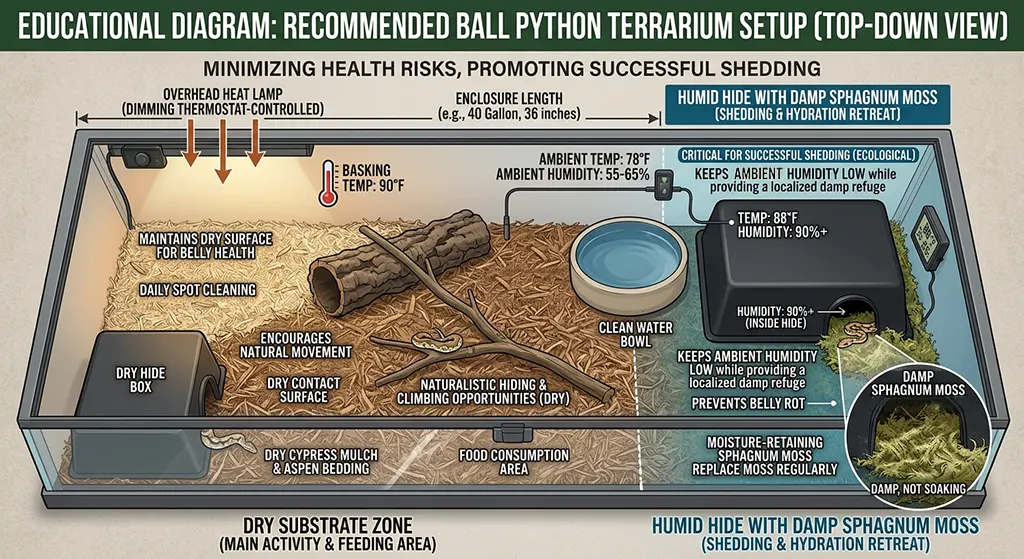
4.1 Create Separate Dry-Surface and Moisture-Retaining Zones
A practical enclosure can be organized into three functional areas.
Zone A: Dry Contact Surface
This is the main area where your snake moves and rests.
The upper surface of the substrate should not be muddy, saturated, or continuously wet.
Appropriate materials may include:
- Cypress mulch.
- Coconut husk.
- Suitable soil-based reptile substrate.
- Clean paper towels when monitoring a sick or injured snake.
The exact substrate depends on your enclosure design, ventilation, and maintenance routine.
Zone B: Moisture-Buffering Substrate
The lower portion of a suitable moisture-retaining substrate can hold some moisture to help stabilize enclosure humidity.
However, it should not become waterlogged or develop standing water.
A simple squeeze test can help identify obvious saturation:
- A handful of substrate may feel slightly cool and moist.
- It should not release water when squeezed.
- It should not feel muddy or produce standing liquid.
- There should be no persistent foul smell or visible mold.
This is a practical husbandry check, not a laboratory measurement of moisture content.
Zone C: Localized Humid Hide
A humid hide provides a small, controlled microenvironment.
You can use a suitable enclosed hide lined with lightly damp sphagnum moss.
The moss should be moist rather than dripping wet.
Check it regularly, remove contaminated material, and replace it if mold develops or it begins to smell unpleasant.
The hide should also be positioned so that the snake can choose between different temperatures.
A humid hide is not a replacement for appropriate overall enclosure humidity. It is an additional option.
4.2 How to Maintain Higher Air Humidity Without Constantly Spraying the Snake
This is the practical part that many new keepers need.
If your enclosure becomes too dry, do not automatically spray the entire floor.
Try the following adjustments in order.
Step 1: Check the enclosure’s ventilation.
A screen-top glass tank may lose moisture much faster than a well-designed PVC enclosure.
If you have excessive ventilation, consider whether the enclosure design is appropriate for maintaining stable conditions.
Do not completely seal the enclosure. Adequate fresh-air exchange remains important.
Step 2: Check the substrate depth and composition.
A deeper layer of suitable substrate can act as a moisture reservoir.
The idea is to retain moisture below the surface rather than leaving the entire floor wet.
Step 3: Adjust the water bowl location.
A sufficiently large, stable water bowl can contribute to enclosure humidity through evaporation.
Keep it clean and position it where it cannot easily be tipped over.
Step 4: Add moisture gradually to the lower substrate layer.
If the humidity remains too low, carefully add water to suitable moisture-retaining substrate rather than repeatedly soaking the snake’s contact surface.
Check the substrate afterward to ensure it is not saturated.
Step 5: Monitor humidity at more than one location.
A digital hygrometer near the cool side and another in the humid retreat can provide a more useful picture than a single gauge attached to the enclosure wall.
Also monitor temperatures independently.
The objective is a stable, healthy environment—not a perfect number on one display.
4.3 What About North American Seasonal Changes?
Humidity management becomes particularly challenging when indoor conditions change.
A setup that works perfectly in spring may become difficult to maintain during winter heating season.
| Seasonal situation | Common problem | Practical adjustment |
|---|---|---|
| Cold, dry winter | Indoor heating reduces RH | Check room humidity and enclosure ventilation |
| Summer air conditioning | Dry indoor air and temperature fluctuations | Recheck both temperature and humidity |
| Rainy season | Excessive moisture and poor drying | Check substrate and ventilation more frequently |
| Seasonal shedding | Increased demand for a suitable humid environment | Provide a maintained humid hide |
For keepers in colder US and Canadian climates, central heating can make maintaining humidity particularly difficult.
In warmer regions, air conditioning can create a similar problem.
The important lesson is to adjust the enclosure based on actual measurements rather than following the same misting routine throughout the year — our ball python regional climate control guide breaks down what actually changes by region and season, from winter heating season to summer air conditioning.
5. A Common Beginner Mistake: When Trying to Fix Humidity Creates Scale Rot Risk
Consider a common beginner scenario.
The following is an illustrative husbandry scenario, not a documented veterinary case or a verified individual owner’s story.
A new keeper purchases a ball python and sets up a glass enclosure with coconut fiber substrate.
They read online that ball pythons need approximately 60% humidity.
Initially, the hygrometer displays 48%.
Worried about dehydration and incomplete shedding, the keeper begins spraying the enclosure heavily every morning and evening.
The coconut fiber becomes increasingly wet.
Rather than checking the moisture content of the bedding, the keeper focuses on the humidity gauge. Eventually, the display reaches 60%, so they assume the problem has been solved.
On Day 7, while handling the snake, they notice several unusual pinkish patches on its belly.
Their first reaction is to increase misting again because they believe the snake needs more humidity.
Unfortunately, that response may make an existing moisture-related skin problem worse.
What Went Wrong?
There are three separate mistakes here.
Mistake 1: Treating the hygrometer as the only indicator of enclosure health.
The humidity reading does not tell you whether the substrate is saturated.
Mistake 2: Using repeated surface misting as the primary humidity-control method.
Spraying the floor repeatedly can leave the snake’s contact surface wet without providing a stable long-term humidity solution.
Mistake 3: Confusing the need for humid air with the need for wet bedding.
A ball python can benefit from appropriately humid air while still needing clean, suitable contact surfaces.
What Should the Keeper Do Instead?
The correct response is not to stop providing humidity.
It is to:
- Photograph the suspicious belly areas.
- Arrange a reptile-veterinary examination if scale rot is suspected.
- Remove wet or contaminated bedding.
- Temporarily use clean paper towels for easier monitoring if appropriate.
- Correct the enclosure’s moisture-retention and ventilation problems.
- Continue providing suitable humidity through a better-managed enclosure.
The biggest lesson is simple:
Never sacrifice substrate hygiene just to make the hygrometer display a particular number.
6. How to Treat Scale Rot on a Ball Python: A Safe Home-Care Approach
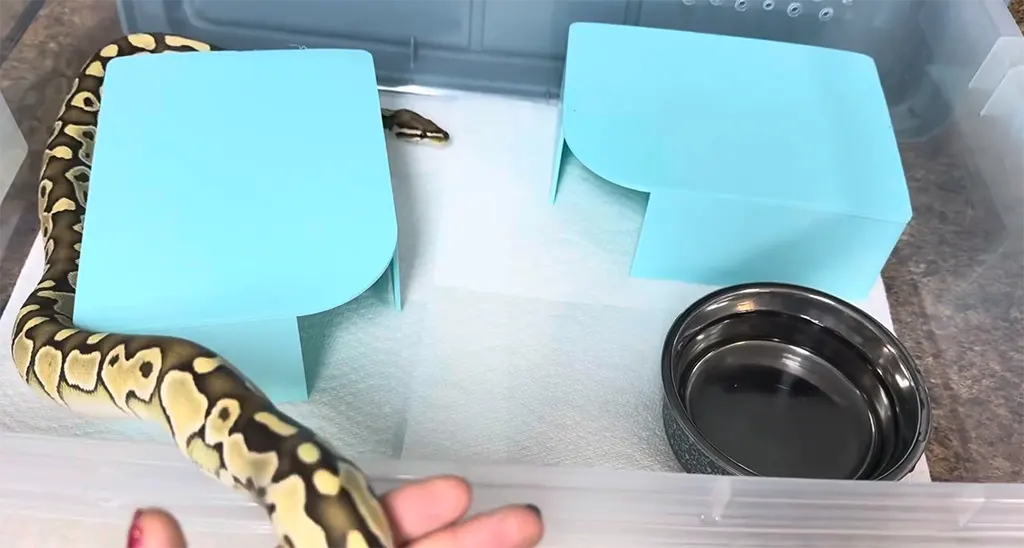
Photo via YouTube (Graceful Pythons)
If you suspect ball python scale rot, your first priority should be preventing additional skin damage.
Home care has limitations.
Mild-looking skin discoloration may not be scale rot, and a lesion that appears small externally may involve deeper tissue.
The safest approach is to combine immediate husbandry correction with veterinary assessment.
Step 1: Remove Wet and Contaminated Substrate
For a snake with suspicious skin lesions, clean paper towels are often useful as temporary bedding.
They offer several advantages:
- You can see new discharge or bleeding easily.
- Waste is easy to identify and remove.
- There is less loose substrate contacting the affected skin.
- Changes in the lesion can be photographed and monitored.
Set up a clean, appropriately heated temporary enclosure.
Provide a secure hide, clean water, and suitable temperature and humidity conditions.
Do not put the snake in a cold, damp container simply because it is being quarantined.
If the animal has a suspected infection, keep its equipment separate from other reptiles and follow appropriate hygiene procedures.
Replace soiled paper towels promptly.
This temporary arrangement is intended to improve cleanliness and monitoring, not to cure an established infection.
Step 2: Avoid Scrubbing or Peeling Damaged Scales
One of the worst things you can do is try to remove abnormal-looking scales manually.
Do not:
- Peel off raised scales.
- Scrape away dark tissue.
- Pop blisters.
- Use a toothbrush to scrub the belly.
- Apply household cleaning products.
- Attempt to remove necrotic tissue yourself.
Damaged skin needs careful handling.
Aggressive cleaning can create additional trauma and make an existing lesion worse.
Step 3: Should You Use Chlorhexidine or Povidone-Iodine?
Chlorhexidine and povidone-iodine are commonly used antiseptics in veterinary wound management.
LafeberVet’s Wound Management in Exotic Animals discusses both agents as options for wound preparation.
It also emphasizes that contaminated wounds should be cleaned carefully, and that directly scrubbing damaged tissue can interfere with healing.
Gentle irrigation is preferable to aggressive mechanical cleaning.
However, there is an important distinction between general wound-management guidance and a treatment protocol specifically validated for ball python scale rot.
I would not recommend applying an arbitrary concentration of chlorhexidine or povidone-iodine to a snake’s belly without veterinary guidance.
The appropriate product, dilution, application method, and frequency depend on the lesion, tissue condition, and diagnosis.
In particular:
- Do not use concentrated chlorhexidine directly on damaged tissue.
- Do not assume that every iodine preparation is suitable for reptile wounds.
- Do not substitute alcohol or hydrogen peroxide for a veterinarian-approved wound-cleaning solution.
- Do not allow the snake to ingest or repeatedly contact antiseptic residue.
If you cannot reach a reptile veterinarian immediately, keep the animal on clean paper towels, correct the environment, and ask a veterinary professional whether gentle sterile saline irrigation is appropriate.
Step 4: Understand When Antibiotics Are Necessary
This is where online home-treatment advice often becomes misleading.
Some articles make it sound as though every case of scale rot can be fixed with an antiseptic wash.
That is not medically reliable.
According to the Merck Veterinary Manual, ulcerative or necrotic dermatitis can require:
- Debridement of damaged tissue.
- Systemic antimicrobial treatment.
- Topical antimicrobial treatment.
- Improved sanitation and husbandry.
The decision to prescribe antibiotics depends on the severity and extent of infection, the condition of the animal, and the veterinarian’s examination.
For more significant infections, cytology, Gram staining, and bacterial culture with susceptibility testing may help identify the organisms involved and guide drug selection.
Merck’s guidance on reptile bacterial diseases specifically emphasizes diagnostic testing and responsible antimicrobial selection.
There is no reliable universal rule such as:
- Use antibiotics after exactly seven days.
- Start antibiotics whenever the belly turns pink.
- Use the same antibiotic for every snake.
- Stop treatment as soon as the redness disappears.
These shortcuts can lead to inappropriate treatment.
Never use leftover antibiotics or human prescription medications without veterinary direction.
7. When Is Scale Rot a Veterinary Emergency?
Not every abnormal belly marking requires an emergency-room visit.
However, certain changes should move you beyond home observation.
The following table provides a practical guide.
| Finding | Recommended response |
|---|---|
| Mild, generalized pinkness before shedding, with intact scales | Monitor the shed cycle and enclosure conditions |
| New, localized unexplained discoloration | Contact a reptile veterinarian for advice |
| Persistent redness or raised scales | Arrange prompt veterinary examination |
| Blisters or suspected skin infection | Veterinary assessment promptly |
| Open ulcers or discharge | Urgent veterinary examination |
| Black or necrotic tissue | Urgent veterinary treatment |
| Lethargy, weakness, loss of coordination, or breathing problems | Emergency veterinary care |
Why Severe Cases Cannot Be Treated at Home
Merck explains that ulcerative dermatitis can progress to systemic bacterial infection.
This is particularly concerning because reptiles may not show obvious signs of illness until a disease process has become advanced.
If your ball python develops systemic symptoms, waiting for a topical treatment to work is dangerous.
A veterinarian may need to assess:
- The depth and extent of tissue damage.
- Whether necrotic tissue needs professional debridement.
- Whether systemic infection is present.
- Whether bacterial culture and susceptibility testing are appropriate.
- Whether systemic antibiotics and supportive care are necessary.
The exact treatment plan must be determined by the attending veterinarian.
A Note About the Term SPAH
One source detail deserves clarification.
The organization commonly known as the Association of Reptilian and Amphibian Veterinarians is abbreviated ARAV, not SPAH.
I could not verify an authoritative ARAV publication establishing a specific antibiotic-treatment threshold for ball python scale rot.
Therefore, this article does not attribute a specific antibiotic concentration, treatment duration, or intervention threshold to ARAV.
For clinical guidance, the Merck Veterinary Manual and an examination by a qualified reptile veterinarian are more appropriate references than an unverified social-media treatment protocol.
8. How to Prevent Ball Python Scale Rot From Returning
Once the immediate problem has been addressed, the next goal is preventing recurrence.
A healthy enclosure is not simply one with a good humidity reading.
It is an environment where temperature, humidity, sanitation, and substrate conditions work together.
8.1 Use a Digital Thermometer and Hygrometer
Avoid relying entirely on inexpensive analog gauges.
Ideally, monitor:
- Warm-side ambient temperature.
- Cool-side ambient temperature.
- Humidity near the snake’s normal resting area.
- Humidity inside the humid hide, if one is provided.
Remember that humidity changes with temperature.
A single sensor mounted high on the enclosure wall may not accurately represent conditions at the substrate surface.
8.2 Clean Waste Immediately
Feces, urates, and contaminated substrate should be removed promptly.
Do not allow waste to remain buried in moisture-retaining bedding.
For naturalistic setups, inspect areas around hides, water bowls, and frequently used resting locations.
These are places where waste and excess moisture can accumulate unnoticed.
8.3 Inspect the Substrate Regularly
A substrate can look dry on top while retaining excessive moisture underneath — and a living soil bed hides that water far deeper than loose bedding does, which our bioactive ball python setup reality check covers in detail.
Check the lower layers periodically.
Look for:
- Standing water.
- Persistent muddy areas.
- Unpleasant odors.
- Mold growth.
- Bedding that remains saturated.
- Contamination hidden beneath hides.
If you find any of these problems, correct them rather than simply adding more dry bedding on top.
8.4 Check Heating Equipment
Incorrect heating can contribute to skin damage and complicate the diagnosis of suspected scale rot.
Use a properly regulated thermostat for every applicable heat source — our ball python enclosure setup guide covers where the probe goes, what the gradient should read, and why probe placement is where most heat problems actually start.
Check surface temperatures with an infrared thermometer and monitor ambient temperatures with reliable digital sensors.
Avoid unregulated heating devices and direct contact with excessively hot surfaces.
A suspected burn can look similar to an early skin infection, so veterinary examination is especially important when the lesion is localized near a heating element.
8.5 Maintain a Consistent Inspection Routine
You do not need to handle your ball python every day to check its health.
Instead, use routine enclosure maintenance as an opportunity to observe:
- Belly scale appearance.
- Skin condition.
- Shed quality.
- Activity and behavior.
- Appetite and body condition.
- Substrate cleanliness.
Take photographs whenever you notice an unusual change.
A consistent visual record can help your veterinarian identify whether a lesion is changing.
9. Frequently Asked Questions About Ball Python Scale Rot
Can ball python scale rot start as pink belly spots?
Yes, early skin changes may include redness or hemorrhage beneath individual scales.
However, pink belly spots are not diagnostic of scale rot.
Normal premolt coloration, irritation, minor trauma, and thermal injuries can look similar.
Pay attention to whether the discoloration is localized, persistent, or accompanied by changes in scale texture.
If you are unsure, consult a reptile veterinarian.How do I treat scale rot on a ball python at home?
Start by removing wet or contaminated bedding and providing a clean temporary enclosure with paper towels.
Maintain appropriate temperatures and humidity, monitor the affected area, and arrange veterinary assessment.
Do not scrape damaged scales, puncture blisters, or apply concentrated antiseptics.
Established scale rot may require professional wound management, debridement, and systemic antibiotics.Can high humidity cause scale rot?
High humidity alone does not automatically cause scale rot.
The greater concern is prolonged exposure to wet, contaminated bedding, especially when skin damage is present.
A properly ventilated enclosure can maintain relatively high ambient humidity while keeping the main contact surface clean and appropriately dry.Should I lower humidity if my ball python has scale rot?
Not necessarily.
Reducing humidity indiscriminately can create dehydration and shedding problems.
Instead, address saturated substrate, contamination, and inadequate ventilation while maintaining an appropriate humidity environment.
If your snake has an active skin lesion, ask your veterinarian about the appropriate temporary enclosure conditions.Is 60% humidity enough for a ball python?
It depends on the husbandry recommendations being followed, the enclosure design, and the actual environmental conditions.
PetMD and ReptiFiles publish different general humidity recommendations.
A reading of 60% should not automatically be considered either perfect or inadequate.
Monitor the enclosure consistently, provide suitable humidity options, and pay attention to the condition of the substrate and your snake’s skin.Can scale rot heal without antibiotics?
Some early skin changes may resolve once the underlying irritation or environmental problem is corrected.
However, established bacterial infection, ulceration, or necrotic tissue may require veterinary treatment, including systemic antibiotics.
It is not possible to determine whether antibiotics are necessary from belly coloration alone.
A veterinarian can evaluate the lesion and determine whether diagnostic testing or medication is appropriate.How long does it take for ball python scale rot to heal?
There is no universal recovery timeline.
Healing depends on the depth of tissue damage, whether infection is present, the animal’s overall health, and the treatment provided.
Superficial irritation and deeper ulcerative dermatitis should not be expected to heal at the same rate.
Follow the veterinarian’s instructions and continue monitoring the affected skin until healing is confirmed.Can a ball python get scale rot from a humid hide?
A properly maintained humid hide does not automatically cause scale rot.
However, continuously saturated moss, accumulated waste, and moldy or contaminated materials can create an unhealthy environment.
Keep the moss lightly moist, inspect it regularly, and replace it when contaminated.
The snake should also have access to other suitable resting areas.Can I use paper towels permanently after scale rot?
Paper towels are useful for temporary quarantine and monitoring because they are easy to replace and make skin changes visible.
They can also be a longer-term option in certain husbandry situations.
However, if you return your snake to a naturalistic enclosure, make sure the underlying moisture and sanitation problems have been corrected first.
10. Final Takeaway: Humid Air, Clean Bedding, Healthy Scales
Ball python scale rot is a condition that deserves attention, but preventing it does not require keeping your enclosure artificially dry.
The real challenge is understanding the difference between the moisture your snake needs and the moisture that creates unhealthy contact surfaces.
Remember these five principles:
- Inspect early: Pink belly patches, unusual discoloration, blisters, and damaged scales deserve attention.
- Do not rely on one number: A hygrometer measures relative humidity, not substrate saturation.
- Manage moisture by zone: Maintain suitable ambient humidity while avoiding persistently wet contact surfaces.
- Keep the enclosure clean: Remove contaminated bedding and maintain a suitable humid hide.
- Know when to seek veterinary care: Blisters, ulcers, discharge, necrosis, and systemic symptoms require professional assessment.
The goal isn’t to achieve a perfectly dry enclosure or obsess over a fixed 60% reading.
It is to create an environment where your ball python can stay hydrated, shed properly, thermoregulate, and rest without prolonged exposure to contaminated or saturated bedding.
Healthy humidity and healthy skin should work together—not compete with each other.
11.Ball Python Scale Rot Prevention & Inspection Checklist
Use this practical checklist to inspect your ball python’s belly, evaluate enclosure moisture, and identify potential scale rot problems before they become more serious. Work through each section during routine enclosure maintenance.
1. Belly & Skin Health Inspection
Check your ball python’s ventral scales under good lighting.
- Inspect the entire belly for unusual pink or red patches.
- Look for localized reddish-brown or pale discoloration.
- Check for raised, separated, blistered, or unusually soft scales.
- Look for open sores, discharge, dark tissue, or missing scales.
- Compare suspicious areas with previous photographs.
- Check whether discoloration is localized or part of a generalized premolt color change.
- Record any changes in appearance, size, or texture.
Action required:
- No suspicious changes: Continue routine monitoring.
- New or persistent localized discoloration: Contact a reptile veterinarian.
- Blisters, ulcers, discharge, or suspected necrosis: Arrange urgent veterinary assessment.
- Weakness, abnormal breathing, or loss of coordination: Seek emergency veterinary care.
Important: Do not peel scales, puncture blisters, scrape lesions, or wait a full week to see whether suspicious skin damage progresses.
2. Humidity & Temperature Inspection
Check environmental conditions instead of relying on one hygrometer reading.
- Record relative humidity (RH) on the warm side.
- Record relative humidity (RH) on the cool side.
- Check humidity inside the humid hide, if provided.
- Confirm that the thermometer and hygrometer are functioning correctly.
- Check warm-side and cool-side ambient temperatures.
- Verify that all applicable heating equipment is controlled by an appropriate thermostat.
- Check surface temperatures with an infrared thermometer.
- Look for excessive condensation or poor air circulation.
Practical humidity target:
- Use an appropriate species-specific humidity target rather than chasing one fixed number.
- Maintain sufficient ambient humidity without keeping the entire enclosure floor wet.
- Reassess conditions when indoor heating or air conditioning changes seasonally.
3. Substrate Moisture & Hygiene Inspection
Check both the surface and the lower substrate layers.
- Touch the substrate surface in frequently used resting areas.
- Check underneath hides and around the water bowl.
- Inspect lower substrate layers for excessive moisture.
- Check for standing water or muddy, saturated bedding.
- Look for mold, unpleasant odors, or hidden waste.
- Remove feces and urates promptly.
- Replace contaminated or persistently wet substrate.
- Confirm that the snake has clean, appropriate resting surfaces.
Substrate moisture check:
- Surface is not muddy or continuously wet.
- Moisture-retaining substrate is not waterlogged.
- No standing water is trapped underneath the bedding.
- No persistent mold or foul odor is present.
4. Humidity Gradient & Enclosure Setup
Create separate functional zones instead of soaking the entire enclosure.
- Provide a suitable warm-side retreat.
- Provide a suitable cool-side retreat.
- Maintain a clean, appropriately dry main substrate surface.
- Use suitable moisture-retaining substrate where appropriate.
- Provide a humid hide with lightly damp sphagnum moss if needed.
- Ensure the moss is moist but not dripping wet.
- Inspect the humid hide regularly for mold and contamination.
- Keep the water bowl clean and prevent spills.
- Maintain adequate ventilation without allowing excessive moisture loss.
If humidity is too low:
- Check for excessive ventilation.
- Review substrate depth and moisture-retention properties.
- Consider whether the water bowl is appropriately sized.
- Add moisture carefully to suitable lower substrate layers when appropriate.
- Recheck humidity after adjustments.
- Avoid repeatedly spraying the snake and the entire enclosure floor.
5. Suspected Scale Rot: Immediate Response Checklist
If you discover suspicious belly discoloration or damaged scales:
- Take clear photographs of the affected area.
- Record when the changes were first noticed.
- Contact a qualified reptile veterinarian.
- Remove wet or contaminated substrate.
- Prepare a clean temporary enclosure with paper towel bedding if appropriate.
- Provide suitable temperature and humidity conditions.
- Keep clean water and a secure hide available.
- Replace soiled paper towels promptly.
- Keep equipment separate from other reptiles.
- Follow veterinary instructions for wound cleaning and medication.
Do NOT:
- Scrub or peel damaged scales.
- Pop blisters or remove necrotic tissue.
- Apply concentrated chlorhexidine or iodine without veterinary guidance.
- Use alcohol or hydrogen peroxide on the lesion.
- Administer leftover antibiotics or human medications.
- Delay veterinary care while trying multiple home remedies.
6. Weekly Monitoring Record
Use this simple record to identify environmental changes and monitor your snake’s condition.
| Inspection item | Observation |
|---|---|
| Date | __________ |
| Warm-side humidity | __________ |
| Cool-side humidity | __________ |
| Warm-side temperature | __________ |
| Cool-side temperature | __________ |
| Substrate surface condition | Dry / Slightly moist / Wet |
| Lower substrate condition | Dry / Moist / Saturated |
| Humid hide condition | Clean / Needs replacement |
| Belly appearance | Normal / Discoloration / Lesion |
| Waste and substrate condition | Clean / Needs maintenance |
| Changes since last inspection | __________ |
7. Final Prevention Check
Before finishing your enclosure inspection, confirm:
- My ball python has access to suitable ambient humidity.
- The main substrate surface is not persistently wet.
- The humid hide is clean and properly maintained.
- No contaminated bedding or hidden waste remains.
- Temperature and humidity are being monitored reliably.
- Heating equipment is properly regulated.
- I have recorded and photographed any suspicious skin changes.
- I know when to contact a reptile veterinarian.
The Golden Rule: Humid Air, Clean Bedding, Healthy Scales.
Your goal is not to keep the entire enclosure dry or constantly wet. It is to maintain appropriate humidity while preventing prolonged contact with saturated or contaminated substrate.
This checklist is for husbandry monitoring and early warning. It does not diagnose scale rot or replace veterinary treatment.
References & Further Reading
The following veterinary and husbandry resources informed this article. They are included so readers can explore the underlying clinical information rather than relying exclusively on online keeper discussions.
1. Merck Veterinary Manual – Bacterial Diseases of Reptiles
Covers ulcerative and necrotic dermatitis, scale rot, predisposing environmental factors, secondary bacterial infections, and veterinary treatment considerations.
Read the Merck Veterinary Manual
2. Merck Veterinary Manual – Clinical Procedures for Reptiles
Provides information about diagnostic testing, antimicrobial selection, and responsible antibiotic use in reptiles.
Read the clinical procedures guide
3. LafeberVet – Wound Management in Exotic Animals
Discusses wound preparation, antiseptic selection, irrigation, and the importance of avoiding unnecessary mechanical damage to injured tissue.
Read the wound management guide
4. ReptiFiles – Ball Python Lighting, Temperature & Humidity Guide
Provides detailed ball python husbandry information, including humidity management, temperature gradients, and enclosure moisture control.
Read the ball python humidity guide
5. PetMD – Ball Python Care Sheet
Offers an additional reference for general ball python husbandry, humidity, and substrate maintenance.
Medical disclaimer: This article is educational and does not replace diagnosis or treatment by a licensed veterinarian experienced with reptiles. Do not independently administer antibiotics or undertake invasive wound treatment.
This content is for educational purposes only and does not substitute professional veterinary diagnosis or treatment. If you observe any symptoms of illness, injury, or abnormal behavior, please consult a qualified exotic animal veterinarian immediately.
For more details, please review our full Medical Disclaimer.