
Disclaimer: This article references general husbandry standards widely accepted in the herpetological community. For species-specific health concerns, always consult a qualified reptile veterinarian through the Association of Reptilian and Amphibian Veterinarians (ARAV).
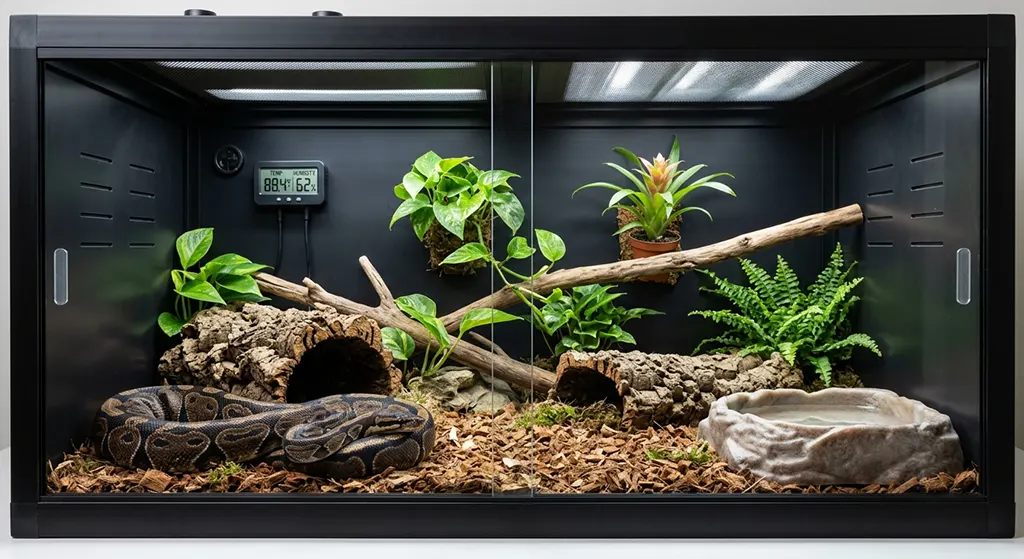
Setting up a ball python enclosure sounds simple — until your snake refuses to eat, sheds in patches, or develops a respiratory infection. In most cases, the root cause traces back to one thing: the enclosure environment isn’t right.
The good news? Once you understand the core principles of ball python tank setup — proper sizing, correct temperatures, and stable humidity — maintaining a healthy habitat becomes second nature. This guide walks you through every decision, from choosing the right enclosure to dialing in your heating and humidity, based on widely accepted captive husbandry standards aligned with the MSD Veterinary Manual reptile care guidelines, so your ball python doesn’t just survive — it thrives.
Choosing the Right Enclosure Size
One of the most common questions new keepers ask is: what size enclosure does a full-grown ball python actually need?
The short answer: bigger than most pet stores will tell you.
Adult Ball Python Cage Size
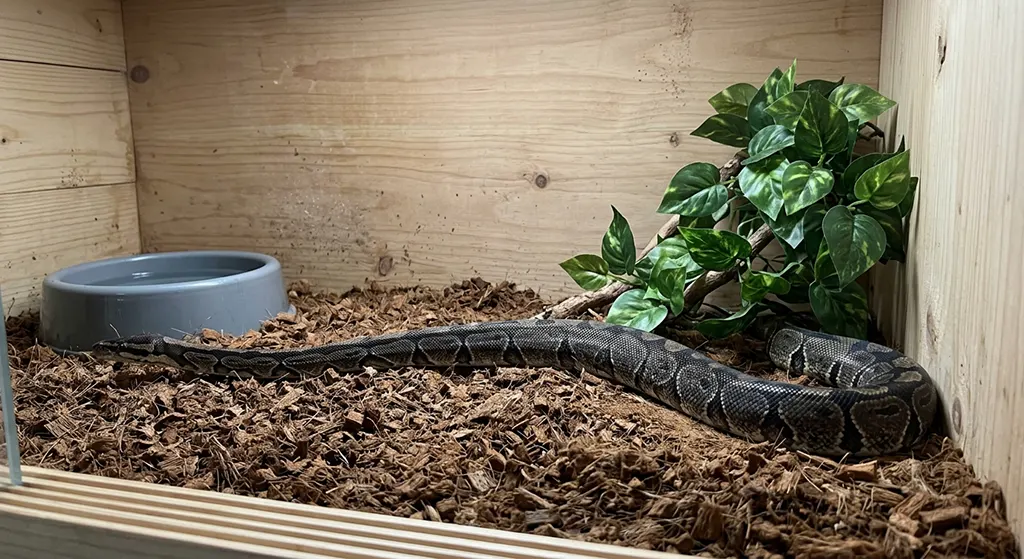
The current herpetological standard for an adult ball python is a minimum of 4 feet long × 2 feet deep × 2 feet tall (roughly 120 gallons). This size provides enough floor space for your snake to stretch out fully, explore, and thermoregulate across a meaningful temperature gradient.
Adult female ball pythons typically reach 3–5 feet in length and are stockier than males. A 4×2×2 enclosure gives them room to move naturally, which supports better muscle tone, healthier digestion, and reduced stress.
Juvenile and Hatchling Enclosures
For hatchlings and juveniles under about 2 feet long, a smaller setup works better. A 20-gallon long tank or a similarly sized tub (approximately 30″ × 12″) provides a sense of security without overwhelming a young snake.
That said, you don’t need to buy multiple enclosures. Many keepers start juveniles in a appropriately sized tub or glass tank, then upgrade to the 4×2×2 setup as the snake approaches 2.5–3 feet in length. Others go straight to the adult-sized enclosure and add extra hides and clutter to help a young snake feel secure. Both approaches work — the key is providing adequate cover.
Enclosure Materials: Glass vs. PVC vs. Tubs
The material you choose affects nearly every aspect of your ball python tank setup, from humidity retention to heat efficiency. Here’s an honest breakdown of each option.
Glass Terrariums
Glass tanks (brands like Exo Terra or Zoo Med) are widely available and offer excellent visibility. However, they come with real drawbacks for ball pythons:
- Humidity escapes quickly through the screen top, making it harder to maintain the 60–70% baseline
- Heat loss is significant, which means higher energy costs and more strain on your heating equipment
- Screen tops can be damaged by heat lamps over time
If you do use glass, you’ll need to cover most of the screen top with foil tape or acrylic panels to trap humidity and heat. It’s workable, but it requires more effort.
PVC Enclosures (Recommended)
PVC ball python enclosures have become the gold standard among serious keepers, and for good reason:
- Superior humidity retention — solid walls and limited ventilation keep moisture where it belongs
- Energy efficient — insulated panels hold heat far better than glass
- Radiant heat panel compatibility — the most effective heating method for ball pythons
- Secure and stackable — front-opening doors with locking mechanisms
Brands like Animal Plastics, Kages, and Dragonhaus offer pre-built PVC enclosures in standard sizes. The upfront cost is higher than glass, but the long-term benefits in husbandry stability are well worth it. For a full breakdown of what a complete setup costs at every budget tier, see our ball python setup cost guide.
Plastic Tubs (Budget-Friendly)
Modified storage tubs (like Sterilite or Iris containers) are a legitimate, cost-effective option — especially for juveniles or quarantine setups. With a few drilled ventilation holes, a heat source, and two hides, a tub can maintain excellent humidity and temperature stability.
The downside is limited visibility and less aesthetic appeal. But from a purely functional standpoint, tubs work remarkably well.
Temperature: The Non-Negotiable Foundation
Ball pythons are ectotherms. They rely entirely on their environment to regulate body temperature, which drives digestion, immune function, and overall metabolism. Getting your ball python temperature and humidity right isn’t optional — it’s the foundation of everything else.
The Temperature Gradient
Your enclosure must provide a thermal gradient — a warm side and a cool side — so your snake can move between zones as needed.
| Zone | Temperature Range |
|---|---|
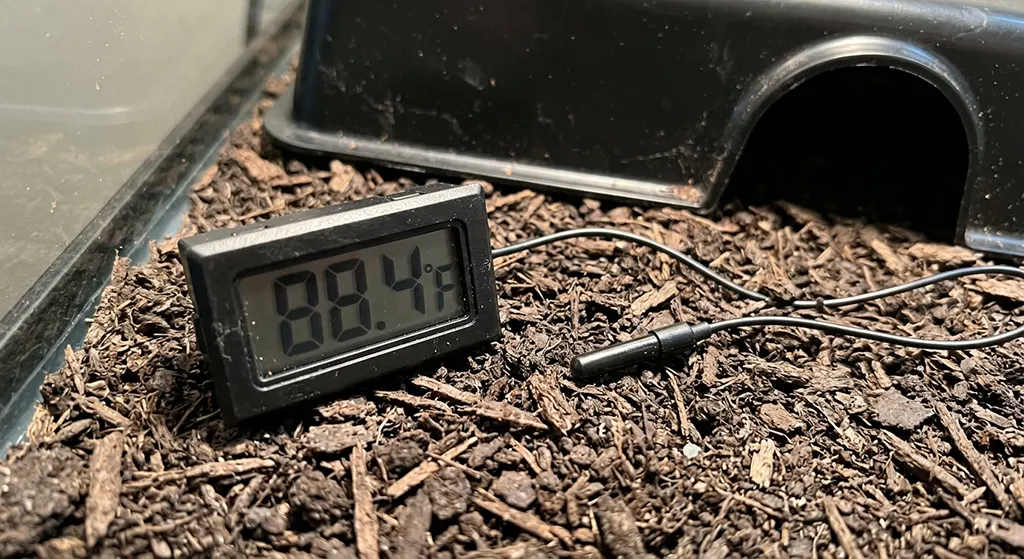
| Warm Side / Basking Spot | 88°F – 92°F (31°C – 33°C) |
| Cool Side | 78°F – 80°F (25°C – 27°C) |
| Absolute Minimum (anywhere in the enclosure) | Never below 75°F (24°C) |
Temperatures consistently below 75°F can suppress your snake’s immune system and digestive function. If your ball python is refusing food, the first thing to check is whether the warm side is actually hitting 88–92°F at the substrate level. Our ball python not eating troubleshooting guide walks through the full diagnostic checklist.
Heating Equipment Options
Radiant Heat Panels (RHP) — Mounted to the ceiling of PVC enclosures, RHPs provide gentle, ambient warmth without producing light. They’re the most recommended heating source for ball pythons in enclosed setups.
Heat Mats / Under-Tank Heaters (UTH) — These attach to the bottom or side of the enclosure and create a warm zone. They work well in glass and tub setups but should always be paired with a thermostat. Never run a heat source without one.
Deep Heat Projectors (DHP) — These emit infrared heat that penetrates deeper into muscle tissue, mimicking natural sun-warmed surfaces. They’re a solid alternative or supplement to RHPs, especially in taller enclosures.
Ceramic Heat Emitters (CHE) — Produce heat without light, useful for boosting ambient temperatures in cooler rooms. Like all heat sources, they require a thermostat.
Critical rule: Every heat source must be regulated by a quality thermostat (brands like Herpstat, Vivarium Electronics, or Inkbird are widely used in the hobby). Unregulated heat sources can reach temperatures that cause severe burns or kill your snake.
Do Ball Pythons Need Lighting?
Ball pythons are nocturnal/crepuscular and don’t require UVB lighting to survive. However, providing a low-level UVB light (such as a shadedweller or 5–7% UVB tube) is increasingly encouraged by reptile veterinarians as a beneficial supplement for calcium metabolism and overall health. A standard day/night light cycle of 12 hours on / 12 hours off also helps regulate your snake’s circadian rhythm.
Humidity: The #1 Struggle for Ball Python Keepers
If there’s one thing that frustrates ball python owners more than anything else, it’s humidity. Too low, and your snake gets stuck shed, dry skin, and potentially respiratory issues. Too high for extended periods (above 80% with poor ventilation), and you risk bacterial growth and scale rot.
Target Humidity Levels
| Phase | Humidity Range |
|---|---|
| Normal / Baseline | 60% – 70% |
| Shedding (pre-shed through shed) | 70% – 80% |
You’ll know a shed is coming when your snake’s eyes turn blue (the “blue phase”), followed by a clearing period, then the actual shed. Start bumping humidity up as soon as you notice the blue phase.
How to Keep Humidity Up in a Ball Python Tank
This is one of the most-searched questions in the hobby, and for good reason. Here’s what actually works:
1. Choose a humidity-friendly enclosure. As covered above, PVC enclosures retain moisture far better than glass. If you’re struggling with humidity in a glass tank, switching to PVC solves most of the problem immediately. For a full dry-climate playbook, see our ball python low humidity fix guide.
2. Use the right substrate. The best substrate for ball python enclosures is one that holds moisture without molding. Top choices include:
- Coconut husk / coco blox — Excellent moisture retention, low dust, natural appearance
- Cypress mulch — Holds humidity well, readily available at garden stores (ensure it’s untreated)
- Coconut fiber (coir) — Works well, especially when mixed with other substrates
- Organic topsoil mixes — Some keepers blend topsoil with coconut fiber and cypress for a bioactive-ready base
Avoid aspen shavings (they mold quickly at high humidity), pine and cedar (toxic oils), and sand or reptile carpet (poor humidity retention, risk of ingestion or injury).
3. Layer substrate 2–4 inches deep. A deeper substrate bed holds more moisture and releases it slowly over time. Pour water into the corners of the substrate (not on the surface) and let it wick through the layers. This creates a moisture reservoir without making the top layer soggy.
4. Reduce ventilation. In glass tanks with screen tops, cover 60–80% of the screen with foil tape, acrylic, or a custom cut panel. In PVC enclosures, adjustable vents let you fine-tune airflow.
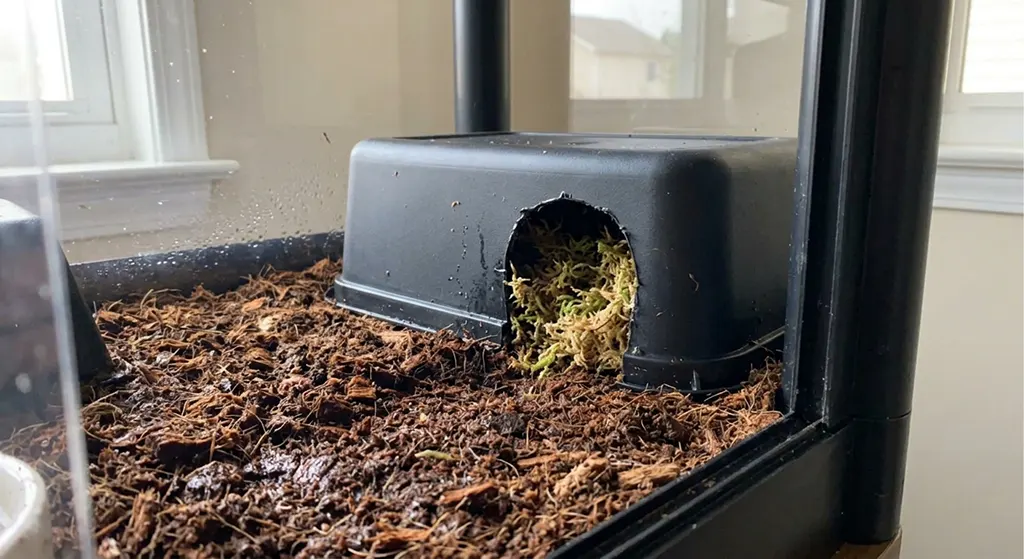
5. Add a humid hide. A humid hide is a small enclosed hide (like a plastic container with a hole cut in the lid) filled with damp sphagnum moss. Your snake can retreat to it whenever it needs extra moisture, especially during shed cycles. This is one of the most effective tools in your humidity arsenal.
6. Mist strategically. Light misting in the morning can help, but avoid over-misting — constantly wet surfaces promote bacterial growth. The goal is sustained ambient humidity, not a rainforest downpour.
Step-by-Step Ball Python Enclosure Setup
Now that you understand the principles, here’s how to put it all together. Follow these steps in order for a fully functional ball python tank setup.
Step 1: Place and Position the Enclosure
Set your enclosure in a room-temperature-stable area of your home, away from direct sunlight, drafts, and exterior walls. Room temperature significantly affects how hard your heating equipment needs to work. Ideal room temperature is 70–75°F.
Step 2: Install Heating Equipment
Mount or position your primary heat source on the warm side of the enclosure. If using a radiant heat panel or deep heat projector, install it toward one end of the ceiling, not centered. If using a heat mat, place it under one end of the tank or along one side.
Connect every heat source to a thermostat. Position the thermostat probe on the substrate surface directly under (or below, for UTH) the heat source. Set the thermostat to maintain 88–92°F at that probe location.
Step 3: Add Substrate
Pour your chosen substrate into the enclosure at a depth of 2–4 inches. Lightly pack it down. Moisten the substrate by pouring water into the corners and mixing — you want the lower layers damp and the top layer barely moist to the touch.
Step 4: Install Thermometers and Hygrometer
Place digital thermometer/hygrometer probes on both the warm side and cool side at substrate level. Analog dials are notoriously inaccurate — digital probes are essential. You need to verify both ends of the temperature gradient and the ambient humidity at all times.
Step 5: Add Hides (Minimum: Two)
Provide at least two hides — one on the warm side and one on the cool side. Each hide should be snug (your snake should touch the sides when coiled inside) and fully enclosed with a single entrance. Ball pythons are ambush predators that spend most of their time hidden; without adequate hides, they become stressed.
Popular options include:
- Commercial resin or plastic caves
- Cork bark half-logs (placed upside down against the wall)
- Small plastic containers with entrance holes cut in the side
Step 6: Add Water Dish and Clutter
Place a sturdy water dish large enough for your snake to soak in on the cool side. Soaking is especially important during shed cycles. Refresh the water daily.
Add clutter — artificial plants, branches, additional cork bark — to break up sight lines and make your snake feel secure. In a large 4×2×2 enclosure, clutter is not decoration; it’s essential environmental enrichment that encourages natural exploration. If your snake has balance or neurological issues such as Spider wobble, choose low, stable climbing features instead of tall branches.
Step 7: Let the Enclosure Stabilize
Before introducing your snake, run the enclosure for at least 24–48 hours and verify:
- Warm side substrate temperature: 88–92°F
- Cool side substrate temperature: 78–80°F
- Ambient humidity: 60–70%
- All equipment functioning properly
Only place your ball python inside once conditions are stable and verified.
Frequently Asked Questions
What size enclosure does a full-grown ball python need?
The minimum recommended size for an adult ball python is 4 feet × 2 feet × 2 feet (approximately 120 gallons). This provides adequate space for thermoregulation, movement, and environmental enrichment. Adult females, which grow larger than males, especially benefit from this footprint.
How do I keep humidity up in my ball python tank?
The most effective strategies are: (1) use a PVC enclosure instead of glass, (2) switch to a moisture-retentive substrate like coconut husk or cypress mulch at 2–4 inches deep, (3) reduce ventilation by covering screen tops, (4) pour water into the substrate corners rather than misting the surface, and (5) provide a humid hide filled with damp sphagnum moss.
What is the best substrate for a ball python enclosure?
Coconut husk (coco blox), cypress mulch, and coconut fiber are the most widely recommended substrates. They retain moisture effectively, resist mold when maintained properly, and allow for natural burrowing behavior. Avoid aspen, pine, cedar, sand, and reptile carpet.
What temperature should my ball python enclosure be?
Maintain a warm side basking spot of 88–92°F (31–33°C) and a cool side of 78–80°F (25–27°C). Temperatures anywhere in the enclosure should never drop below 75°F (24°C). Always use a thermostat with every heat source.
Do ball pythons need UVB lighting?
Ball pythons can survive without UVB, but low-level UVB exposure (such as a shadedweller or 5–7% UVB tube) is increasingly recommended by reptile veterinarians as a beneficial supplement. A consistent 12-hour day/night light cycle is also important for circadian rhythm regulation.
How often should I clean the enclosure?
Spot-clean waste and urates daily. Perform a full substrate change and disinfect the enclosure every 4–8 weeks, depending on enclosure size and how well you maintain spot cleaning. If you notice mold, mites, or persistent odor, clean immediately regardless of schedule.
Final Checklist: Your Ball Python Enclosure at a Glance
Before bringing your snake home, confirm the following:
- [ ] Enclosure sized appropriately (20-gallon for juveniles; 4×2×2 ft for adults)
- [ ] PVC, glass (modified), or tub enclosure selected
- [ ] Heat source installed on warm side and connected to a thermostat
- [ ] Warm side temperature verified at 88–92°F (substrate level)
- [ ] Cool side temperature verified at 78–80°F
- [ ] Digital thermometers/hygrometers placed on both sides
- [ ] Humidity holding at 60–70% (70–80% during shed)
- [ ] Substrate at 2–4 inches depth, moisture-retentive type
- [ ] Two snug hides — one warm, one cool
- [ ] Water dish large enough for soaking, placed on cool side
- [ ] Clutter and enrichment items added
- [ ] Enclosure running stable for 24–48 hours before introduction
The Bottom Line
A well-built ball python enclosure isn’t about buying the most expensive equipment — it’s about understanding what your snake needs and creating an environment that meets those needs consistently. Temperature gradients, humidity control, proper substrate, and adequate hides form the four pillars of ball python husbandry.
Start with the right-sized enclosure, invest in a quality thermostat, choose a humidity-friendly substrate, and monitor your conditions daily. Your ball python will reward you with healthy sheds, consistent feeding, and a long, comfortable life.
If you’re setting up your first enclosure, take your time. Get the conditions right before your snake comes home, and you’ll avoid the vast majority of problems that plague new keepers. When the time comes to pick your snake up for the first time, our guide to holding a ball python safely covers the trust-building routine.
This content is for educational purposes only and does not substitute professional veterinary diagnosis or treatment. If you observe any symptoms of illness, injury, or abnormal behavior, please consult a qualified exotic animal veterinarian immediately.
For more details, please review our full Medical Disclaimer.