
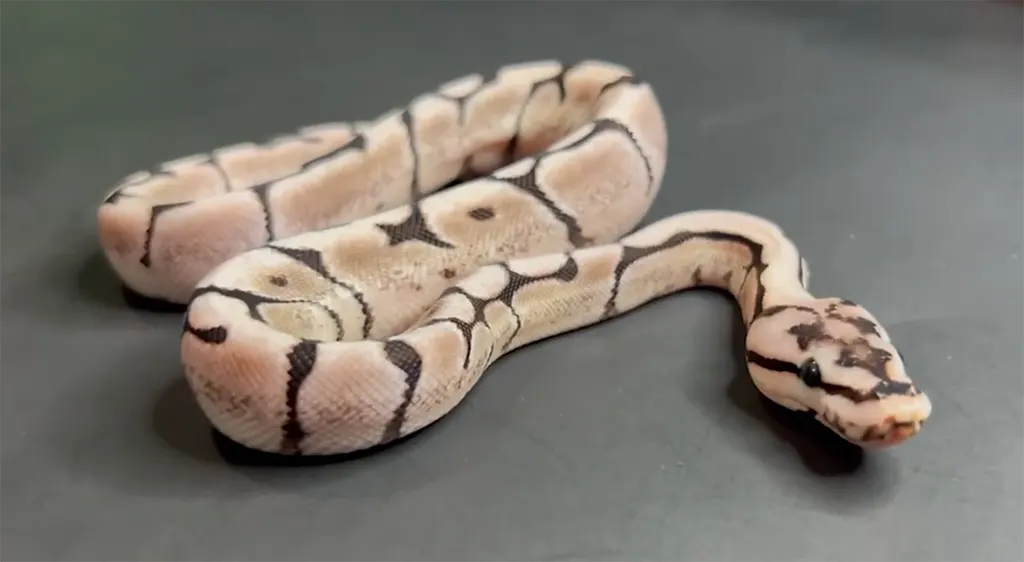
Photo via YouTube (Warfel’s Morphs)
Finding out that your Spider ball python has a neurological wobble can be unsettling, especially if you purchased your snake expecting a healthy, easy-to-care-for pet.
Perhaps your snake sways its head when you approach. Maybe it misses its prey repeatedly, twists its neck into unusual positions, or struggles to keep its balance. You may even wonder whether its behavior is normal for a Spider morph or a sign that something is seriously wrong.
The most important thing to understand is this: A ball python with wobble syndrome is not automatically suffering beyond a reasonable quality of life. However, a striking appearance or continued feeding does not automatically mean the snake is doing well, either.
What matters is how well your snake can perform essential daily activities, including moving, resting, righting itself, drinking, feeding, and recovering from routine stress.
This guide explains how to recognize ball python Spider morph wobble, evaluate its severity, improve your snake’s environment, troubleshoot feeding difficulties, and make informed quality-of-life decisions with a qualified reptile veterinarian.
You’ll also find a practical assessment checklist you can use to monitor your snake over time.
What Is Spider Wobble Syndrome in Ball Pythons?
Spider wobble syndrome, commonly called the Spider wobble, is a neurological disorder associated with the Spider color and pattern morph of the ball python (Python regius).
Affected snakes may exhibit abnormal head movements, impaired coordination, balance problems, and difficulty accurately striking or constricting prey.
The condition is especially associated with the Spider morph, although neurological abnormalities have also been discussed in other ball python morphs, including Champagne, Woma, and Hidden Gene Woma lines.
The precise mechanisms and risks should not be assumed to be identical across these morphs.
Why does the Spider morph cause wobble?
Research has identified structural abnormalities in the inner ear of Spider ball pythons.
A 2022 anatomical study examined the inner-ear structures of Spider and wild-type ball pythons and found differences involving the semicircular canals, ampullae, and sacculus. These structures are associated with balance and spatial orientation.
The findings provide strong anatomical evidence for an association between abnormal inner-ear development and wobble syndrome.
However, the complete developmental and genetic mechanisms remain incompletely understood. The condition should not be reduced to a proven single-gene mutation at a specific neurological location.
A reasonable current explanation is that abnormal development of the vestibular system contributes to the balance and coordination problems observed in affected snakes.
Importantly, Spider wobble is not simply a contagious disease that a snake catches from another snake.
It is associated with the morph’s inherited developmental characteristics, although a new or worsening neurological problem still requires investigation.
Does every Spider ball python have wobble?
Spider ball pythons are strongly associated with the condition, but the severity and visibility of signs can vary.
Some snakes show subtle head sway, particularly during excitement or feeding. Others experience pronounced disorientation, corkscrewing, or impaired righting responses.
An individual snake’s behavior may also change with stress, handling, temperature, feeding excitement, or other environmental factors.
A mild-looking wobble should not be assumed harmless without observing the animal’s actual functioning.
Likewise, severe-looking movements during a brief episode do not establish the snake’s overall quality of life.
7 Signs of Ball Python Spider Wobble
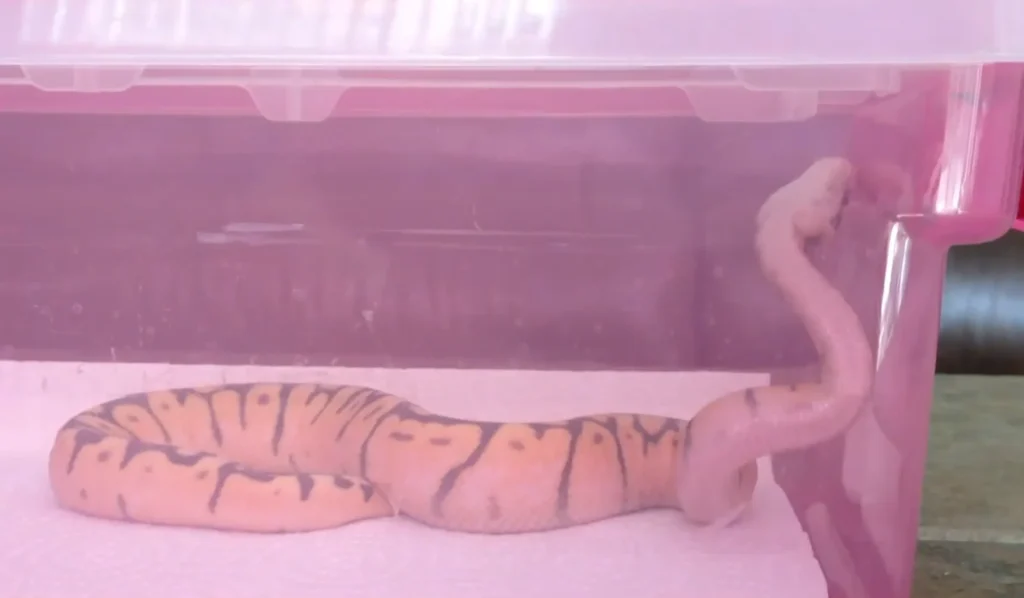
Photo via YouTube (GrasshopperSunset)
Recognizing the difference between common wobble behaviors and other neurological warning signs is essential.
1. Head tremors
Head tremors are small, repeated movements of the head, often side to side.
They may become more noticeable when the snake is alert, excited, or attempting to locate prey.
Observe whether the tremor is occasional, persistent, or interfering with the snake’s ability to position its head normally.
2. Head swaying and poor coordination
The snake may move its head in an exaggerated side-to-side motion or struggle to coordinate its movements.
You might notice difficulty reaching a hide entrance, following an object, or maintaining a stable feeding position.
3. Corkscrewing
Spider ball python corkscrewing describes abnormal twisting or rolling movements, often involving the head and neck.
Some affected snakes may rotate their heads sharply, twist their upper bodies, or display disorganized movements when stimulated.
Corkscrewing can occur in wobble syndrome, but it is not exclusive to Spider wobble.
New, sudden, or rapidly worsening corkscrewing deserves prompt veterinary assessment.
4. Star-gazing
Star-gazing refers to an abnormal upward head posture, sometimes with the head tilted back or held toward the ceiling.
It should not automatically be attributed to Spider wobble.
Persistent upward posturing can accompany several neurological or systemic disorders, including serious disease.
A snake displaying new star-gazing behavior should be evaluated by a reptile-experienced veterinarian.
5. Striking misses
Some snakes have difficulty accurately directing a feeding strike.
They may strike beside the prey, overshoot it, or struggle to maintain a coordinated grip.
Repeated misses can make feeding stressful and increase the risk of injury or prolonged feeding attempts.
6. Difficulty righting itself
A healthy snake placed in an unusual position can generally coordinate movements to return to a normal posture, although the speed and ease of recovery vary.
An affected snake may struggle to regain its normal position after rolling or losing balance.
A severely impaired righting response is particularly concerning if it interferes with safe movement or resting.
Do not deliberately flip or repeatedly reposition your snake to test this reflex.
7. Poor grip and abnormal movement
A wobble-affected snake may have difficulty maintaining a stable grip while moving.
You may notice slipping, awkward body positioning, or difficulty negotiating enclosure features.
This becomes more important when the snake is climbing, moving around water bowls, or attempting to enter a hide.
The 4-Tier Spider Wobble Severity Scale
One of the biggest frustrations for keepers is the lack of a universally validated home scoring system for Spider wobble severity.
The following four-tier scale is a practical husbandry screening framework, not a clinically validated veterinary grading system.
It is intended to help you describe observed function, track changes, and communicate clearly with your veterinarian.
It cannot diagnose the cause of neurological signs or independently determine whether euthanasia is appropriate.
| Tier | Observable signs | Functional interpretation |
|---|---|---|
| Tier 1: Mild | Subtle head sway or tremor; coordinated movement most of the time | Daily activities appear largely unaffected |
| Tier 2: Moderate | Noticeable head instability, occasional striking misses, intermittent awkward movement | Most activities remain possible, but accommodations may help |
| Tier 3: Severe | Frequent corkscrewing, repeated feeding difficulties, substantial balance problems or impaired righting | Important daily functions may be compromised; veterinary assessment is needed |
| Tier 4: Extreme | Persistent or disabling disorientation, inability to maintain a safe position, repeated failure of essential activities | Serious welfare concern requiring urgent veterinary assessment |
Tier 1: Mild wobble
The snake displays subtle head movement but navigates its enclosure reasonably well.
Typical observations:
- Head sway occurs occasionally.
- The snake enters and exits its hide without substantial difficulty.
- It can move to its water bowl.
- It can maintain a stable resting posture.
- Feeding is generally successful.
Management priority: Maintain a predictable environment and establish a baseline.
Even a Tier 1 snake needs appropriate husbandry and regular observation.
Tier 2: Moderate wobble
The neurological signs are obvious, particularly during feeding or excitement.
Typical observations:
- The head may swing noticeably while tracking prey.
- The snake occasionally misses its target.
- Movement may become awkward on uneven surfaces.
- It may need more time to orient itself.
- Routine feeding attempts may become stressful.
Management priority: Reduce feeding complexity, improve enclosure safety, and record feeding performance.
A snake in this tier may still maintain a good quality of life if it can perform essential activities comfortably and reliably.
Tier 3: Severe wobble
The condition significantly interferes with daily functioning.
Possible observations:
- Frequent or pronounced corkscrewing.
- Repeated inability to secure appropriately offered prey.
- Difficulty navigating ordinary enclosure features.
- Frequent loss of balance.
- Trouble maintaining a normal resting position.
Management priority: Arrange a reptile veterinary examination promptly and establish a documented welfare plan.
Do not assume that a snake at this tier must be euthanized. Determine which impairments are manageable and which are causing persistent distress or compromising essential needs.
Tier 4: Extreme wobble
This tier describes a serious functional and welfare concern, not merely dramatic head movements.
Warning signs include:
- Repeated inability to maintain a safe body position.
- Inability to reach water or shelter safely.
- Severe disorientation that prevents normal movement.
- Persistent failure to feed despite appropriate veterinary-guided support.
- Repeated injuries, exhaustion, or apparent ongoing distress associated with neurological impairment.
Management priority: Seek urgent veterinary care.
If the animal is unable to remain safely positioned, is repeatedly injured, or cannot access essential resources, do not wait for a long observation period before seeking help.
A veterinarian must assess whether treatment, supportive care, environmental changes, or humane euthanasia is the most appropriate option.
How should you score your snake?
Do not assign a tier based on one dramatic episode.
Observe your snake during ordinary activities and consider its most consistent functional limitations.
A useful rule is to record two separate observations:
- Neurological signs: What movements or coordination problems are visible?
- Daily functionality: What essential activities can the snake complete independently and safely?
For example, a snake might have frequent head sway but still move, rest, drink, and feed normally.
Another snake may display relatively subtle head movements but repeatedly fail to reach water or maintain a safe resting position.
The second animal may have the more concerning welfare situation despite appearing less neurologically dramatic.
How to Improve the Quality of Life of a Wobble Ball Python
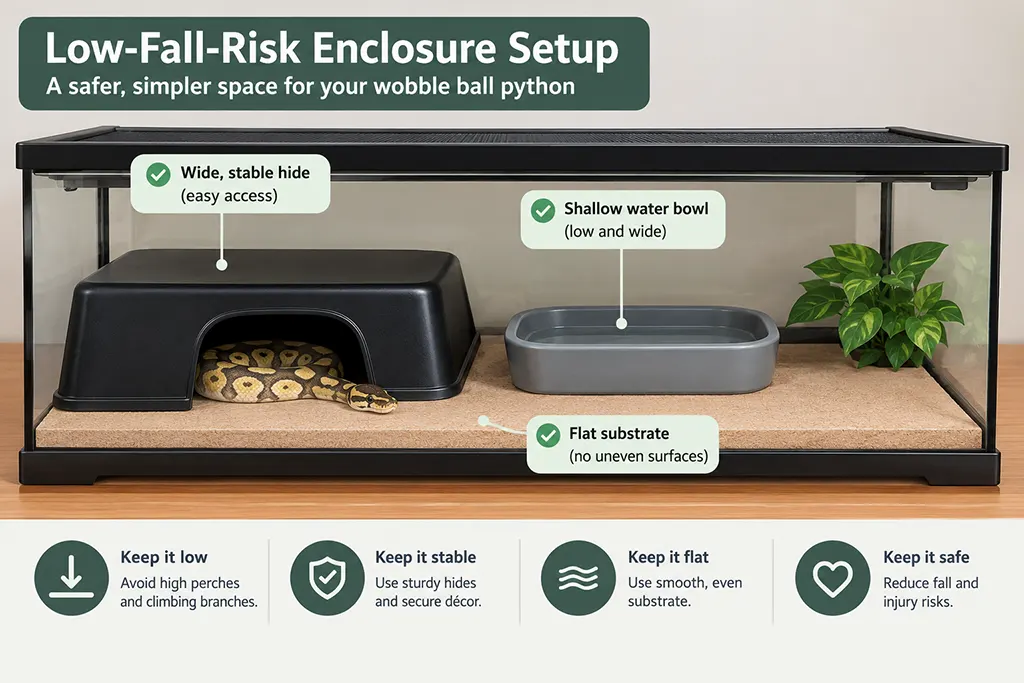
The objective is not to eliminate every abnormal movement.
There is currently no established husbandry technique that cures the underlying Spider-associated neurological condition.
Instead, focus on reducing preventable hazards, avoiding unnecessary stress, and making essential activities easier.
1. Create a low-fall-risk enclosure
A wobble-affected snake may have difficulty maintaining balance while climbing.
This does not mean every affected ball python must live in a barren enclosure.
It means climbing opportunities should match the snake’s actual coordination.
Consider the following modifications:
- Lower elevated branches: Remove tall climbing structures that create a meaningful fall risk.
- Provide broad resting surfaces: Use stable platforms and low, securely supported features where appropriate.
- Eliminate unstable decorations: Avoid objects that can tip, shift, or collapse.
- Secure all climbing features: Check for gaps where the snake could become trapped.
- Keep essential resources accessible: Place hides and water within easy reach.
A low, stable arrangement is generally preferable to a complicated vertical layout for a snake with substantial balance problems.
However, the enclosure must still provide adequate usable space, a suitable thermal gradient, secure hiding places, and normal behavioral opportunities.
Do not solve wobble by permanently confining the snake to an excessively small container.
For more guidance, see our Ball Python Enclosure Size article.
2. Choose a safer water bowl
Water access is particularly important when coordination is impaired.
A broad, shallow, stable water bowl can reduce the difficulty of drinking and help prevent accidental tipping.
A low-sided stainless-steel bowl may be a practical option if it has:
- A stable, non-rocking base.
- Smooth, safe edges.
- Sufficient capacity for normal drinking.
- A design that allows the snake to approach and withdraw easily.
Stainless steel is not automatically safer than every other material. Bowl shape, weight, edge design, stability, and accessibility matter more than the material alone.
Keep the water clean and replace it regularly.
Avoid excessively deep or narrow bowls that make entry and exit difficult for your individual snake.
Do not assume a wobble-affected snake cannot swim. Nevertheless, unnecessary drowning hazards should be eliminated.
3. Use secure, supportive substrate
Choose a substrate that provides stable footing and is suitable for ball python husbandry.
Depending on your setup, appropriate options may include suitable reptile-safe paper-based products or other established substrates.
Prioritize:
- Stable movement.
- Easy monitoring of waste.
- Low dust.
- No sharp or abrasive components.
- Appropriate humidity management.
Avoid loose, unstable piles that could make movement more difficult.
For snakes that frequently lose balance, a relatively even surface may be easier to navigate.
4. Maintain correct temperature and humidity
Neurological signs can become harder to interpret when basic husbandry is incorrect.
Use reliable digital thermometers and a suitable humidity monitoring device.
Provide an appropriate thermal gradient based on current ball python husbandry guidance, with a thermostat controlling any heat source that requires one.
Do not increase enclosure temperatures in an attempt to treat wobble.
Excessive heat, dehydration, and poor husbandry can cause additional health problems and may complicate neurological assessment.
Maintain suitable humidity without leaving the enclosure persistently wet or poorly ventilated.
If you need to review the basics, see our ball python temperature and humidity control guide.
5. Reduce unnecessary handling
Handling can be stressful for some wobble-affected snakes, especially if movement or balance becomes more impaired during excitement. If you’re unsure about the basics, our guide to holding a ball python safely covers the standard routine.
When handling is necessary:
- Support the body from underneath.
- Keep the snake close to a secure surface.
- Avoid elevated handling positions.
- Prevent sudden falls.
- Keep sessions brief when the snake shows signs of stress.
Do not grab the snake behind the head or attempt to immobilize its neck to control wobble.
Avoid repeatedly provoking abnormal movements to obtain photographs or videos.
A short video recorded during naturally occurring symptoms may be useful for your veterinarian, provided filming does not interfere with safe care.
How to Feed a Wobble Ball Python Without Increasing Stress
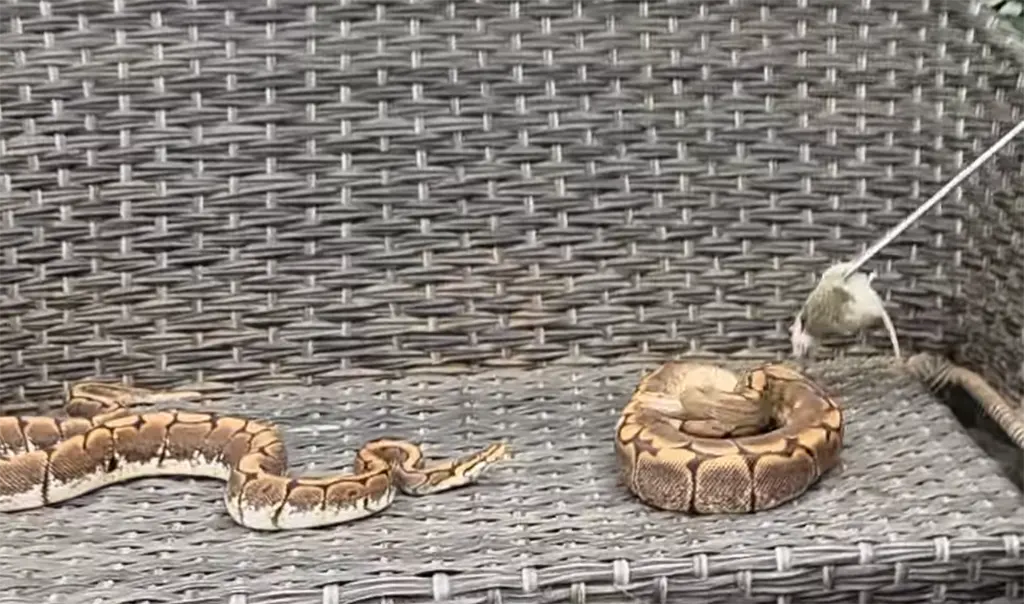
Photo via YouTube (Wild Education)
Feeding is often the most challenging part of caring for a snake with neurological impairment.
A snake that cannot accurately locate or strike prey may appear uninterested in food, even when it has a feeding response.
However, not every feeding refusal in a Spider ball python is caused by wobble syndrome.
Temperature problems, shedding, seasonal changes, stress, illness, prey presentation, and other factors can also contribute.
If your snake has stopped eating, our Ball Python Not Eating guide can help you review common husbandry-related causes.
Step 1: Establish a predictable feeding routine
Feed according to the snake’s age, body condition, prey size, health, and established feeding schedule.
Avoid repeatedly offering food throughout the day.
Frequent attempts may increase stress without improving the likelihood of a successful meal.
Use an appropriately sized, safely prepared prey item according to established reptile feeding guidance.
Never use live prey as a shortcut for a snake that misses its target. Live rodents can seriously injure snakes, especially those with impaired coordination.
Step 2: Simplify the feeding environment
For a snake with moderate or severe wobble, consider making feeding less complicated.
You can:
- Reduce unnecessary activity around the enclosure.
- Ensure the snake has secure footing.
- Use a predictable feeding location.
- Avoid sudden movements or loud disturbances.
- Allow sufficient time for the snake to orient itself.
Many snakes can feed successfully in their usual enclosure without being moved.
Moving an animal into a separate feeding container is not automatically beneficial and may increase stress.
Step 3: Offer prey with controlled positioning
A long feeding tong can help you present appropriately sized frozen-thawed prey without placing your hand near the snake’s mouth.
For snakes with striking difficulties:
- Present prey at a comfortable distance.
- Keep the prey’s position steady.
- Avoid rapid movements.
- Allow the snake time to orient.
- Withdraw calmly if the attempt becomes prolonged or stressful.
Do not wave prey repeatedly across the snake’s face or force it into contact with the mouth.
Never push prey against the nostrils or obstruct breathing.
Step 4: Use a safer version of targeted feeding assistance
Some keepers describe a technique involving a fixed head position and targeted prey presentation.
However, physically fixing, pinning, or restraining a wobble-affected snake’s head is not a safe default feeding technique.
A safer alternative is controlled presentation without head restraint.
The keeper maintains a stable feeding environment, supports the animal’s safety, and presents the prey where the snake can locate it naturally.
If the snake repeatedly misses, cannot secure prey, or becomes distressed, stop the session.
Repeated unsuccessful strikes should prompt a review of husbandry and veterinary advice rather than progressively more forceful feeding attempts.
Step 5: Know when feeding assistance becomes medical care
There is an important difference between helping a snake locate food and physically assisting it to eat.
Do not:
- Force prey into its mouth.
- Prise its jaws open.
- Insert feeding tubes without veterinary direction.
- Force-feed to meet a preferred feeding schedule.
- Increase prey size to compensate for missed meals.
Assisted feeding, including tube feeding, should be considered only under an appropriate veterinary treatment plan.
The risks include aspiration, injury, and additional stress.
Step 6: Track the result
Record:
- Date of feeding.
- Prey type and size.
- Whether the snake oriented toward prey.
- Whether it struck accurately.
- Whether it secured and swallowed the prey.
- Any abnormal movements.
- Any signs of distress.
This information can help distinguish occasional feeding difficulty from a persistent functional problem.
What if my Spider ball python refuses food?
Start with the basics.
Check temperature, humidity, security, shedding status, recent handling, and prey suitability.
Review the snake’s weight trend and body condition.
A single missed meal does not automatically indicate a serious welfare crisis.
Repeated refusals accompanied by weight loss, dehydration, weakness, or declining function are much more concerning.
Young, underweight, ill, or rapidly deteriorating snakes need more prompt veterinary attention than a stable adult with an otherwise normal body condition.
A Practical Case Example: When Feeding Adjustments Help
Illustrative scenario, not a verified real patient case.
Imagine a first-time keeper who purchases a moderately affected Spider ball python.
The snake displays obvious head sway and repeatedly misses prey during feeding.
The keeper initially assumes the animal is simply a picky eater.
After documenting several unsuccessful feeding attempts, the keeper notices that the snake also struggles when positioning itself on elevated branches.
The enclosure is adjusted:
- Elevated climbing branches are replaced with lower, more stable features.
- A secure, low-sided water bowl is introduced.
- Feeding takes place in a quiet environment.
- Prey is presented steadily with long feeding tongs, without restraining the snake’s head.
- Feeding outcomes and body weight are recorded.
The snake subsequently begins securing prey more consistently.
Over time, the keeper continues monitoring body condition and movement rather than assuming that successful feeding means the neurological condition has disappeared.
This scenario illustrates a practical management approach. It should not be interpreted as evidence that these changes will restore feeding in every wobble-affected snake.
The underlying neurological impairment may remain lifelong.
For some individuals, husbandry adjustments can meaningfully improve function. For others, feeding remains difficult despite appropriate care.
When to Euthanize a Snake With Wobble: A Quality-of-Life Decision Guide
This is often the most emotionally difficult question.
If your Spider ball python has neurological abnormalities, you may feel responsible for its condition or wonder whether keeping it alive is inherently cruel.
The ethical answer requires more than looking at its morph or the intensity of its head movements.
Wobble alone is not an automatic indication for euthanasia.
Equally, the fact that a snake is still alive, responsive, or occasionally eating does not prove that its quality of life is acceptable.
The relevant question is whether the animal’s needs can be met consistently and whether suffering can be adequately prevented or relieved.
The American Veterinary Medical Association’s euthanasia guidance is intended for veterinary professionals overseeing humane euthanasia. Its principles emphasize professional judgment, appropriate methods, and minimizing suffering. It does not establish a Spider-specific wobble score or universal euthanasia threshold.
The framework below is a practical welfare decision aid, not an AVMA-approved scoring instrument.
Five quality-of-life questions to ask
1. Can the snake access water?
Can it approach its water bowl, drink, and withdraw safely?
Repeated inability to drink independently is a major concern.
A snake that requires ongoing assistance simply to access essential water resources may need a significant change in care or veterinary intervention.
2. Can the snake rest comfortably?
Can it maintain a stable resting position?
Does it repeatedly roll, become trapped, or struggle to return to a safe posture?
Frequent loss of balance that prevents comfortable rest deserves serious attention.
3. Can the snake feed adequately?
Consider the whole feeding picture.
- Does the snake reliably locate prey?
- Can it secure and swallow food?
- Is its body weight stable?
- Is body condition remaining appropriate?
- Does feeding cause substantial distress?
A snake may occasionally miss prey without having poor quality of life.
Persistent feeding failure combined with progressive weight loss is substantially more concerning.
4. Is the snake experiencing repeated injury or distress?
Look for:
- Recurrent injuries associated with falling.
- Repeated collisions.
- Inability to settle after ordinary activities.
- Persistent disorientation.
- Progressive loss of function.
- Other signs of illness or discomfort.
Behavior alone cannot reliably establish pain in a reptile. Veterinary evaluation is necessary when discomfort or suffering is suspected.
5. Are reasonable care options still available?
Before deciding that euthanasia is necessary, review whether meaningful improvements are possible.
Could changes to enclosure design, feeding support, veterinary treatment, or monitoring reduce the problem?
If the animal’s needs can be met comfortably and safely, continued care may be appropriate.
If essential needs cannot be met despite reasonable intervention, the ethical balance may change.
Decision table: Continue care, seek intervention, or discuss euthanasia?
| Observed situation | Appropriate next step |
|---|---|
| Mild wobble, stable weight, safe movement, reliable feeding | Continue routine care and monitoring |
| Moderate wobble, occasional missed strikes, otherwise stable function | Optimize husbandry and document performance |
| Repeated feeding failures, declining body condition, frequent falls | Arrange prompt veterinary assessment |
| Inability to access water, severe functional impairment, repeated injury | Seek urgent veterinary assessment |
| Persistent suffering or essential needs cannot be met despite appropriate care | Discuss humane euthanasia with a reptile veterinarian |
When does wobble become a euthanasia consideration?
There is no scientifically established universal threshold such as a particular number of missed meals, a specific wobble tier, or a single percentage of weight loss that automatically justifies euthanasia.
Instead, consider the combination of:
Severity + duration + functional impact + response to intervention.
For example, a snake that misses several meals but remains well-conditioned, hydrated, and functional may need monitoring and husbandry adjustments rather than euthanasia.
A snake that progressively loses weight, cannot reliably feed, cannot access water, and experiences repeated distress despite appropriate veterinary-guided care presents a different situation.
Significant, unexplained weight loss or deterioration requires prompt investigation.
Do not wait until an animal is critically debilitated to seek help.
A note about weight loss
Weight is useful, but it should never be interpreted in isolation.
Compare weights collected under consistent conditions and consider:
- Starting body condition.
- Recent feeding and defecation.
- Hydration.
- Growth stage.
- Reproductive status, where applicable.
- Clinical examination findings.
A fixed weight-loss percentage cannot serve as a validated euthanasia threshold for Spider wobble.
Your veterinarian can help establish an individualized monitoring and intervention plan.
Who should perform euthanasia?
Humane euthanasia should be arranged through a veterinarian experienced in reptile medicine or a professional with appropriate species-specific competence and legal authorization.
Reptiles have physiological characteristics that make some commonly assumed euthanasia methods unreliable or inhumane.
Never attempt euthanasia by freezing, drowning, suffocation, blunt trauma, or improvised chemical methods.
A veterinarian can explain appropriate methods, including how unconsciousness and death are ensured and confirmed.
The goal is to prevent avoidable suffering, not simply to end the animal’s life quickly by an unreliable method.
Spider Wobble vs. IBD: Why a Neurological Diagnosis Matters
One potentially dangerous mistake is assuming every neurological sign in a Spider ball python is caused by its morph.
Inclusion body disease (IBD), historically associated with certain reptarenaviruses in boid snakes, can cause serious neurological and systemic illness.
IBD is particularly important to consider in susceptible boa and python collections, although disease presentation and susceptibility vary among species.
Neurological signs associated with serious disease can overlap with abnormalities observed in wobble-affected snakes.
Possible concerns include:
- Abnormal head posture.
- Disorientation.
- Tremors.
- Poor coordination.
- Progressive neurological deterioration.
- Other systemic illness.
Persistent star-gazing or new corkscrewing should not automatically be labeled Spider wobble.
A veterinarian may consider a detailed history, physical examination, diagnostic testing, and appropriate infectious disease precautions.
Do not introduce a neurologically abnormal snake into an established collection without considering quarantine and veterinary assessment.
A known Spider morph does not rule out another disease.
This distinction is particularly important when symptoms are new, rapidly progressive, or inconsistent with the snake’s previous behavior.
Can Spider Ball Pythons Live a Good Life?
The answer depends on the individual.
Some affected snakes can maintain stable body condition, feed successfully, move safely, and display normal resting and exploratory behavior within an appropriately adapted environment.
Others have neurological limitations that significantly compromise welfare.
A key limitation in assessing these animals is that feeding and reproduction alone are not reliable indicators of good welfare.
A snake may continue feeding despite significant functional impairment.
Conversely, temporary food refusal does not necessarily indicate a poor quality of life.
Welfare assessments should include the animal’s physical condition, behavior, ability to perform important activities, environmental conditions, and evidence of distress.
A 2019 paper on the welfare of ball pythons traded in Europe and North America discusses wobble syndrome among broader welfare concerns associated with captive breeding and trade.
Earlier work by Warwick and colleagues also raised concerns about heritable disorders associated with selectively bred reptile morphs.
These discussions support a broader principle: husbandry can improve an animal’s living conditions, but management should not be used to dismiss preventable inherited welfare problems.
A good life is not simply a life in which an animal survives.
It is one in which the animal can perform important species-appropriate behaviors and have its needs met.
Should You Buy a Spider Ball Python?
This is an ethical question as much as a purchasing decision.
Spider ball pythons are popular because of their distinctive appearance.
However, the morph is strongly associated with neurological wobble, and this association raises serious animal welfare concerns.
The responsible purchasing decision is not simply to ask whether a particular Spider looks healthy.
The more important question is whether supporting the breeding and sale of a morph associated with a heritable disorder is ethically justified.
Why choosing another morph may be the better decision
If you want a ball python, many other morphs and normal-pattern animals are available.
Choosing an alternative without the Spider-associated welfare concern can help avoid supporting continued selection for a problematic trait.
A breeder’s claim that a Spider has only a mild wobble does not eliminate the underlying concern.
Nor does a claim that a particular breeding line produces better-tempered or less visibly affected snakes establish that the welfare problem has been resolved.
For prospective keepers, consider:
- Whether the breeder prioritizes animal welfare.
- Whether the snake has been appropriately examined.
- Whether its feeding history is documented.
- Whether any neurological abnormalities have been disclosed.
- Whether you can meet its long-term husbandry needs.
For existing owners, the situation is different.
Caring responsibly for an animal you already own is not the same as endorsing the breeding practices that produced it.
You can provide excellent care while also deciding not to purchase or breed affected morphs in the future.
Responsible welfare decisions can include both compassionate individual care and criticism of harmful breeding practices.
Frequently Asked Questions
Is Spider wobble syndrome painful?
Wobble syndrome is primarily recognized as a neurological and coordination disorder.
Abnormal movement alone does not establish pain, and the degree of distress may vary between individuals.
However, impaired balance can increase the risk of injury, difficulty feeding, and inability to perform normal behaviors.
The absence of obvious pain behaviors does not prove that an animal is comfortable.Does Spider wobble get worse with age?
There is no reliable universal progression pattern for every affected snake.
Some individuals may show relatively stable abnormalities, while others experience changing signs or additional problems.
A sudden or substantial worsening should prompt investigation for other medical causes rather than being automatically attributed to age or Spider genetics.Can Spider wobble be cured?
There is currently no established cure that reverses the underlying developmental abnormalities associated with Spider wobble.
Environmental modifications may improve safety and daily functionality, but they do not repair the underlying neurological condition.Why does my Spider ball python corkscrew when feeding?
Feeding excitement may make existing coordination problems more apparent.
A snake may twist its head or neck while attempting to orient toward prey.
However, new, severe, or persistent corkscrewing can have other causes and warrants veterinary assessment.
Avoid repeated feeding attempts designed to test the behavior.How do I feed a wobble ball python that keeps missing prey?
Start by reducing distractions and providing stable footing.
Present appropriately sized frozen-thawed prey steadily with long feeding tongs, allowing the snake to orient naturally.
Do not restrain its head, force prey into its mouth, or continue repeated unsuccessful attempts.
If feeding remains unreliable, seek veterinary guidance.Can a Spider ball python die from wobble syndrome?
Wobble itself should not automatically be interpreted as a directly fatal condition.
However, severe neurological impairment can create secondary welfare and health risks, particularly when it prevents safe feeding, drinking, movement, or resting.
Other diseases may also cause neurological signs and require diagnosis.When should I take my snake to a reptile veterinarian?
Arrange an examination when neurological signs are newly identified, especially if the snake has not previously been assessed.
Seek prompt care for repeated feeding failures, weight loss, declining coordination, or frequent falls.
Inability to drink, serious injury, collapse, breathing abnormalities, or severe persistent disorientation warrants urgent veterinary attention.Should I euthanize my Spider ball python if it has severe wobble?
Not automatically.
A severe wobble classification is a reason to assess function and welfare carefully, not a standalone euthanasia decision.
Euthanasia may become appropriate when substantial suffering cannot be adequately relieved or essential needs cannot be met despite reasonable veterinary-guided interventions.
This decision should be made with a qualified reptile veterinarian.Is a Spider ball python that eats normally healthy?
Not necessarily.
Successful feeding is encouraging, but it does not prove that the snake has good overall welfare.
Also assess movement, hydration, body condition, resting behavior, injury risk, and the ability to access essential resources.
Spider Ball Python Wobble: Daily Welfare Checklist
Use this checklist weekly, and record additional observations whenever you notice a meaningful change.
This is a husbandry monitoring tool, not a diagnostic test or a validated quality-of-life score.
1. Daily functionality
- My snake can move around its enclosure safely.
- It can enter and leave its hide without repeated difficulty.
- It can reach its water bowl independently.
- It can drink without repeatedly losing balance.
- It can maintain a safe resting position.
- It does not repeatedly become trapped or fall.
- Its movements are reasonably consistent with its established baseline.
2. Neurological observations
- Head tremors or swaying are recorded.
- Any corkscrewing is documented.
- Any unusual upward head posture is documented.
- Any change in coordination or righting ability is recorded.
- There are no newly observed neurological warning signs.
3. Feeding and body condition
- Feeding attempts are documented.
- The snake can locate and secure prey adequately.
- No live prey is used.
- Body weight is tracked consistently.
- Body condition is assessed rather than relying on weight alone.
- There is no unexplained progressive weight loss.
- There is a veterinary plan if feeding becomes unreliable.
4. Enclosure safety
- The water bowl is stable and accessible.
- Climbing structures are appropriate for the snake’s coordination.
- There are no obvious fall or entrapment hazards.
- Hides and resting surfaces are stable.
- Temperature and humidity are monitored.
- The snake has adequate usable space and environmental enrichment.
- The enclosure allows normal species-appropriate behavior.
5. Welfare decision
- My snake can meet its essential needs.
- Its daily function is stable or improving.
- Any repeated distress or injury has been addressed.
- I know when to contact my veterinarian.
- I have a documented plan if its condition deteriorates.
Interpretation: If you identify a problem, record the observation and decide whether it needs an environmental adjustment, veterinary appointment, or urgent intervention.
Do not calculate a pass percentage or use the number of checked boxes as an automatic euthanasia threshold.
One critical failure, such as an inability to access water safely, may matter more than several positive observations.
Suggested weekly tracking record
| Date | Weight (g) | Feeding result | Wobble observations | Daily function |
|---|---|---|---|---|
| Week 1 | ||||
| Week 2 | ||||
| Week 3 | ||||
| Week 4 |
Record actual observations rather than writing only mild, moderate, or severe.
For example: “Missed first strike, secured prey on second presentation, moved to hide normally.”
Specific notes are more useful for veterinary assessment.
Final Thoughts: Focus on Function, Not Appearance
Spider ball python wobble is a challenging combination of inherited neurological impairment, practical husbandry considerations, and difficult ethical questions.
The most useful approach is to move beyond the two extremes of thinking that every wobble-affected snake has a miserable life or that wobble is merely an unusual cosmetic trait.
Neither conclusion is reliable.
Evaluate what your snake can actually do.
Can it move safely? Can it rest? Can it drink? Can it feed? Is its body condition stable? Are its essential needs being met without persistent distress?
These questions provide a more meaningful foundation for care than the appearance of head movements alone.
If your snake has mild or moderate impairment, thoughtful environmental adjustments and careful monitoring may make a real difference.
If its neurological condition is severe, veterinary guidance becomes increasingly important.
And if reasonable interventions cannot prevent ongoing suffering or meet essential needs, discussing humane euthanasia can be a compassionate and responsible decision.
Your responsibility is not to make your snake look normal.
It is to make informed decisions that prioritize its welfare.
References and Further Reading
- Neurological dysfunction in a ball python (Python regius) colour morph and implications for welfare. Research discussing the Spider morph, wobble syndrome, and animal welfare.
https://www.sciencedirect.com/science/article/pii/S1557506314000962 - Malformations of the sacculus and the semicircular canals in spider morph pythons. Anatomical study investigating inner-ear abnormalities associated with wobble.
https://pmc.ncbi.nlm.nih.gov/articles/PMC9377635/ - Dropping the Ball? The Welfare of Ball Pythons Traded in the EU and North America.
https://pmc.ncbi.nlm.nih.gov/articles/PMC7143053/ - American Veterinary Medical Association. Guidelines for the Euthanasia of Animals.
https://avma.org/KB/Policies/Pages/Euthanasia-Guidelines.aspx - Warwick et al. (2019). Research discussing welfare considerations in the ball python trade and captive management. See the ball python welfare literature cited above.
Editorial note: The four-tier scale and checklist in this article are original practical monitoring frameworks, not validated clinical instruments. They should not be presented as published veterinary scoring systems.
This content is for educational purposes only and does not substitute professional veterinary diagnosis or treatment. If you observe any symptoms of illness, injury, or abnormal behavior, please consult a qualified exotic animal veterinarian immediately.
For more details, please review our full Medical Disclaimer.