
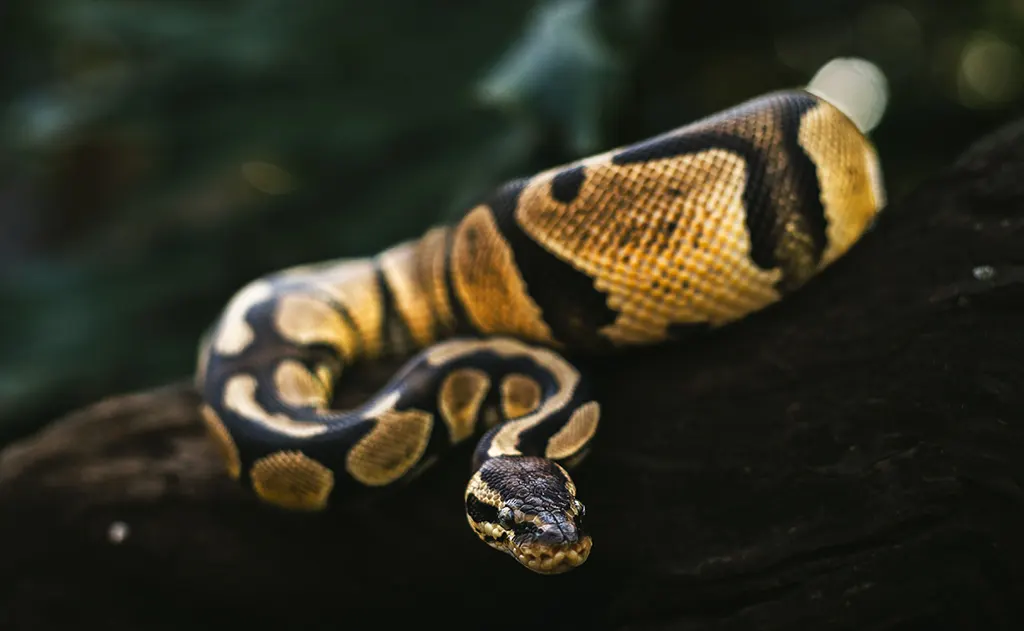
A ball python that looks thick, heavy, or impressively muscular is not necessarily a healthy ball python. In captivity, gradual weight gain can be easy to miss—especially when a snake continues eating reliably and appears active during handling.
The challenge is that a ball python’s weight alone cannot tell you whether it is overweight. Age, sex, body length, frame, reproductive status, recent meals, and individual growth patterns all influence the number on the scale. A better assessment combines regular weighing with a careful look at body shape and changes over time.
This guide explains how to recognize possible signs of excess body fat, use a practical ball python body condition guide, interpret weight records, and make feeding adjustments without putting your snake on an unsafe crash diet.
Why a Bigger Ball Python Is Not Always a Healthier Ball Python
Ball pythons (Python regius) naturally have a stout body shape. Their thick build can make it difficult for new keepers to distinguish normal proportions from excess fat. A large snake may be healthy for its individual frame, while a smaller snake can still carry more body fat than is ideal.
The problem often starts with good intentions. A keeper may feed more frequently because the snake eagerly accepts food, offer larger prey to encourage faster growth, or assume that a heavier animal is thriving.
However, eating readily does not prove that a snake needs more food. Captive feeding schedules should account for growth stage, prey size, body condition, and the individual animal—not just appetite.
Power feeding, or deliberately feeding more often or more heavily to accelerate growth, is not a reliable shortcut to better health. Excessive energy intake can contribute to unwanted fat accumulation, while an overly aggressive reduction in food can create different nutritional problems.
Snake nutrition research also has limitations. Studies have examined the body composition of captive snakes, including pythons, but there is not enough evidence to establish one universal ideal weight for every ball python. Kölle et al., Chemical Composition of Snakes(2022).
The goal is not to make your snake as heavy as possible—or as lean as possible. It is to maintain an appropriate body condition for that individual.
How to Tell If Your Ball Python Is Overweight: A Visual Body Condition Guide
Start by observing your snake when it is resting on a flat surface. Look at its body from above and from the side, and pay attention to the outline, the spine, the skin between the scales, and the transition from the body to the tail.
The following four-level guide is a practical visual screening tool, not a formally validated diagnostic scale. It can help you identify changes worth discussing with a reptile veterinarian.
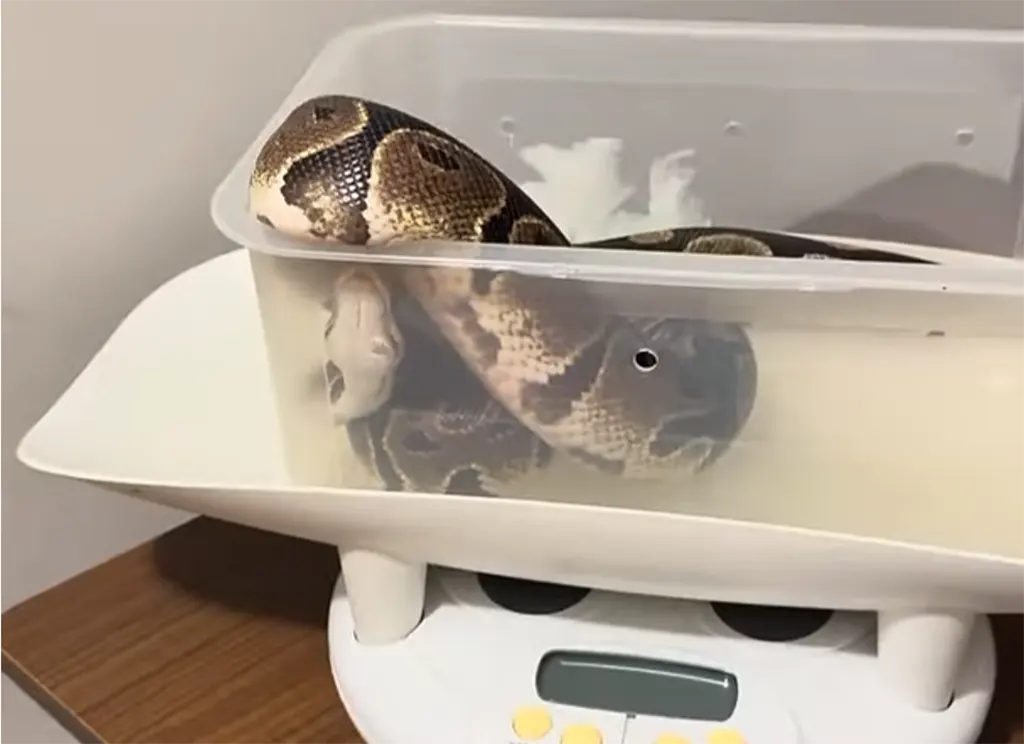
Image credit: YouTube / [WILDEXOTICSANIMALREFUGE]
1. Underweight or Too Thin
Possible signs include:
- The spine is sharply prominent rather than forming a gentle ridge.
- The body appears unusually narrow or angular.
- The sides look sunken rather than smoothly rounded.
- The muscles and body contours appear reduced.
A prominent spine can suggest inadequate body reserves, but it does not identify the cause. Parasites, chronic illness, husbandry problems, and feeding difficulties may also contribute to poor condition.
If your ball python is losing weight unexpectedly, refusing food alongside other signs of illness, or becoming noticeably thinner, arrange a veterinary examination rather than simply offering larger meals.
2. Healthy Body Condition
A ball python in suitable condition generally has a well-filled body with a smooth, rounded outline and a gentle ridge along the spine.
Look for these features:
- The body is rounded without appearing excessively bulging.
- The spine can be identified but is not sharply protruding.
- There are no obvious rolls of fat around the body or tail base.
- The skin between the scales does not remain conspicuously stretched open.
- The body transitions gradually toward the tail rather than ending in an abrupt, thick mass.
Body shape varies naturally, so do not expect every healthy ball python to look exactly the same. Use the overall outline and the snake’s condition over time rather than judging a single photograph.
3. Possibly Overweight
A ball python may be carrying excess fat when several of the following signs appear together:
- The body looks unusually broad or rounded for its length.
- The spine is difficult to distinguish because the back appears very full.
- Soft-looking folds or rolls develop around the body, particularly when the snake bends.
- The skin between the scales becomes visibly stretched.
- The tail base and area around the cloaca look unusually thick.
- The body appears less tapered toward the tail than it used to.
One sign by itself is not conclusive. A snake naturally forms folds when coiled, and skin may spread between scales during normal movement. Look for persistent changes that remain apparent when the snake is relaxed and extended.
If you suspect your snake is overweight, compare current photographs with older ones taken from similar angles. This can be more informative than relying on memory.
4. Markedly Obese or Severely Overconditioned
More concerning signs include pronounced fat rolls, a persistently segmented appearance, extensive skin stretching between scales, and a very thick tail base with little visible taper.
An extremely rounded body may also make the spine difficult to identify. However, body shape alone cannot determine how much fat is present internally or whether organs have been affected.
A ball python with these features should be assessed by a qualified reptile veterinarian. Do not attempt to correct marked obesity by suddenly withholding food for an extended period or imposing an arbitrary fasting schedule.
Ball Python Weight Chart: What Is a Healthy Weight?
One of the most common questions keepers ask is, “How much should my ball python weigh?”
The honest answer is that there is no single weight that defines a healthy ball python at every age. Two snakes of the same age can differ in sex, length, build, growth history, and reproductive status. A weight that is appropriate for one animal may not be appropriate for another.
For that reason, use the chart below as a body-condition and weight-tracking guide, rather than treating it as a universal weight-by-age chart.
| Life stage or situation | What to record | How to interpret it |
|---|---|---|
| Hatchling or juvenile | Weight, length when practical, feeding history, and growth trend | Evaluate steady development and overall condition, not a target weight alone. |
| Growing juvenile | Weight at consistent intervals, prey size, feeding interval, and body shape | Look for gradual growth without a rapid increase in visible fat. |
| Subadult | Weight trend, body proportions, and changes in feeding response | Reassess whether the current prey size and feeding frequency remain appropriate. |
| Adult | Weight, body condition, and any long-term changes | Stable weight with appropriate body condition may be more useful than pursuing further growth. |
| Suspected overweight snake | Serial weights, photographs, body condition, and feeding records | Ask a reptile veterinarian to help establish an appropriate target and adjustment plan. |
How to Build a Useful Ball Python Weight Chart
A simple spreadsheet or notebook is often enough. Include the following information:
- Date: Record the weighing date.
- Weight: Use grams and the same scale whenever possible.
- Length: Measure periodically if you can do so safely and consistently.
- Last meal: Record the date and prey type and weight.
- Body condition: Note whether the snake appears lean, appropriately conditioned, or possibly overweight.
- Other observations: Record shedding, feeding refusals, unusual activity, or veterinary findings.
Weigh under comparable conditions whenever possible. A recent meal, the contents of the digestive tract, and normal waste elimination can affect the reading. A single measurement should not be treated as proof of fat gain or loss.
For the most meaningful comparison, review the trend across multiple measurements alongside photographs and body condition. Merck Veterinary Manual guidance on reptile clinical procedures also notes that serial weight measurements can help assess growth and changes in health, while body weight interpreted alongside body length and conformation provides a better assessment of condition.
See Merck Veterinary Manual: Clinical Procedures for Reptiles.
Where Does Excess Fat Accumulate in a Ball Python?
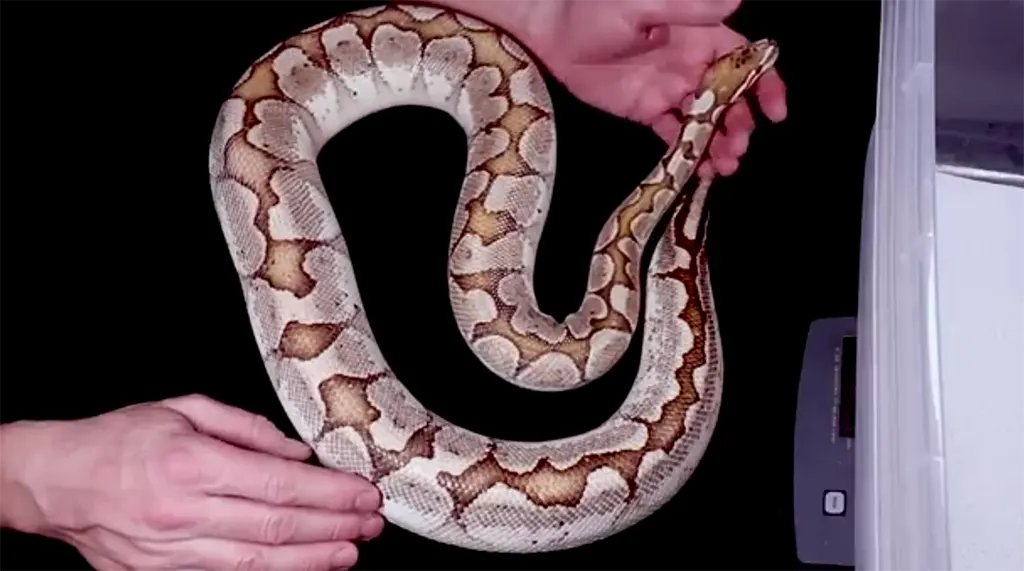
Image credit: YouTube / [Chris Hardwick]
Visual clues can appear in several areas, although they do not all have the same diagnostic value.
Tail Base and Cloacal Area
A thick tail base can be normal, but a persistently bulky transition between the body and tail may support concerns about excess body fat—particularly when the rest of the body also appears overconditioned.
Compare the overall taper rather than judging this area in isolation.
Body Folds and Skin Between Scales
Visible skin between scales may become more obvious when the snake bends or coils. If the skin remains conspicuously stretched and the body has a consistently segmented appearance, excess body condition is one possible explanation.
Normal bending also creates folds, so avoid diagnosing obesity from a single curled-up pose.
Neck and Head-to-Body Transition
Some overweight snakes develop a thickened appearance behind the head or around the neck. However, natural anatomy and viewing angle can make this area look broader than expected.
New swelling, asymmetry, or a localized lump should not automatically be attributed to fat. These changes warrant veterinary assessment, especially if they develop suddenly.
Internal Fat Stores
An important distinction is that not all body fat is visible from the outside. Research on snake body composition has documented variation in fat content and fat storage among snakes. In snakes, fat bodies within the body cavity are important storage sites; their appearance cannot be reliably assessed by looking at the animal externally.
This is one reason a visual guide can help identify concerns but cannot replace a veterinary examination when obesity or internal disease is suspected.
Ball Python Obesity: Potential Health Risks
Excess body fat is a welfare concern because it may affect normal movement and overall condition. However, the precise risks and their frequency in pet ball pythons are not as well quantified as they are in some commonly studied mammals.
Potential concerns include the following.
Reduced mobility. A markedly overconditioned snake may have more difficulty moving comfortably through its enclosure, climbing over enrichment, or positioning its body normally.
Inappropriate feeding and growth patterns. Repeatedly offering food beyond the animal’s needs can encourage excessive weight gain. Feeding practices should support appropriate condition rather than rapid growth for its own sake.
Possible metabolic or organ-related problems. Hepatic lipidosis, or abnormal fat accumulation in the liver, has been reported in a black-headed python. This is evidence that the condition can occur in snakes, but it is not proof that every overweight ball python will develop liver disease. Species differences matter, and direct evidence specific to ball pythons is limited. See the veterinary case report indexed by PubMed.
More difficult health monitoring. Excessive fat can make it harder for keepers to assess body contours and notice changes in condition. This reinforces the value of consistent records and veterinary checks.
Do not assume that every health problem in a heavy snake is caused by obesity. Lethargy, swelling, breathing problems, abnormal waste, and appetite changes can have multiple causes and need to be assessed in context.
How to Help an Overweight Ball Python Lose Weight Safely
If your ball python appears overweight, focus on a measured husbandry review rather than trying to force rapid weight loss.
Step 1: Confirm the Concern
Review your snake’s weight history and take clear photographs from above and from the side. Compare the body outline when the snake is relaxed, not just when it is tightly coiled.
If the snake is markedly obese, has unexplained weight changes, or shows other signs of illness, book a reptile-veterinary appointment before making substantial feeding changes.
Step 2: Review Prey Size
Check the weight and size of the prey you offer. Prey should be appropriate for the individual snake and should not be selected solely to make the snake grow faster.
The Merck Veterinary Manual notes that prey size is generally proportional to snake size and should not be much larger in diameter than the snake’s head, although individual species and feeding circumstances matter.
Avoid automatically moving to larger prey because your snake readily accepts its current meals. Appetite alone is not a reliable measure of nutritional need.
Step 3: Reassess Feeding Frequency
Look at the entire feeding routine: prey size, feeding intervals, the snake’s life stage, and its current body condition. A schedule suitable for a growing juvenile may not be suitable for an adult.
If the snake is overweight, ask a qualified reptile veterinarian to help determine whether the prey size, feeding interval, or both should be adjusted. There is no single safe weight-loss schedule for every ball python.
Do not use prolonged fasting, drastic reductions, or repeated skipped meals as a do-it-yourself weight-loss method. Snakes naturally tolerate periods without food, but that does not make every fasting plan appropriate for an overweight pet.
Step 4: Encourage Normal Movement
Review the enclosure to make sure your ball python has room to stretch out, move between secure hides, and explore appropriate enrichment.
Provide stable branches, low climbing opportunities, or other secure structures where suitable for the snake and enclosure. Check that all features are sturdy and cannot fall or trap the animal.
Do not force exercise by repeatedly handling a reluctant snake, placing it in unfamiliar environments, or making it climb unsafe structures. The goal is to support normal voluntary movement, not to create a strenuous workout.
Step 5: Track Changes and Adjust Gradually
Keep recording weight, body condition, feeding details, and photographs. Review trends rather than reacting to every small fluctuation.
If your snake is losing weight unexpectedly, becomes weak, develops abnormal behavior, or stops eating and shows other concerning signs, contact a reptile veterinarian. If body condition does not improve despite a sensible feeding and husbandry review, seek professional guidance rather than making increasingly drastic changes.
The appropriate goal is gradual improvement in body condition while preserving normal health—not reaching a particular number on the scale as quickly as possible.
Common Mistakes When Managing Ball Python Weight
Mistake 1: Treating a weight chart as a diagnosis. Weight ranges found online can provide context, but they may not account for individual size, sex, length, or body condition.
Mistake 2: Feeding more because the snake always seems hungry. A strong feeding response does not necessarily mean the animal needs a larger meal or a shorter interval.
Mistake 3: Assuming every fold means obesity. Normal movement and coiling can create folds. Look for persistent patterns and consider the whole body.
Mistake 4: Trying to produce rapid weight loss. Severe food restriction without veterinary guidance can be inappropriate and may obscure an underlying problem.
Mistake 5: Ignoring enclosure conditions. Temperature, humidity, access to secure hides, and other husbandry factors influence a snake’s behavior and feeding. Review the full care setup rather than focusing only on food.
Frequently Asked Questions
What is a healthy weight for an adult ball python?
There is no single healthy weight for all adult ball pythons. Sex, length, frame, and individual history all matter. Assess weight together with body condition and changes over time, and ask a reptile veterinarian to evaluate your snake if you are uncertain.
How can I tell if my ball python is fat or just naturally thick?
Look at the whole body. A healthy ball python generally has a smooth, rounded outline with a gentle spinal ridge and a gradual taper toward the tail. Persistent fat rolls, excessive skin stretching, and an unusually thick tail base may suggest excess body condition, especially when several signs occur together.
Are fat folds on a ball python always a sign of obesity?
No. Folds can appear naturally when a snake coils or bends. Folds that are prominent even when the snake is relaxed, particularly alongside other signs of excess body condition, deserve closer evaluation.
How often should I weigh my ball python?
There is no one ideal interval for every snake. The important thing is to use a consistent method and record measurements at intervals appropriate to the animal’s life stage and health. More frequent monitoring may be useful when a veterinarian is evaluating an unexplained change or guiding a weight-management plan.
Should I stop feeding an overweight ball python?
Do not start a prolonged fast or abruptly stop feeding as a weight-loss strategy without veterinary guidance. Review prey size and feeding frequency with a qualified reptile veterinarian, especially if your snake is markedly overweight or has other health concerns.
Can an overweight ball python develop liver problems?
Liver-related disease, including hepatic lipidosis, has been reported in snakes. However, evidence from another python species should not be presented as a precise estimate of risk for ball pythons. A veterinarian can determine whether testing is appropriate for an individual animal.
How do I help my ball python lose weight?
Begin by confirming its body condition, reviewing prey size and feeding frequency, and improving opportunities for safe voluntary movement. Track weight and body shape consistently. For a markedly overweight snake, get an individualized plan from a reptile veterinarian rather than pursuing rapid weight loss.
Conclusion: Focus on Body Condition, Not Just the Number
A healthy ball python is not necessarily the heaviest snake or the fastest-growing one. The most useful approach combines consistent weight records, visual body condition checks, appropriate feeding, and suitable enclosure conditions.
If your snake has a rounded but well-defined body, a gentle spinal ridge, and no persistent signs of excessive fat, its weight may be appropriate for its individual build. If you notice pronounced folds, stretched skin between scales, a very thick tail base, or unexplained changes in weight, investigate rather than guessing.
When in doubt, a qualified reptile veterinarian can help assess body condition and create a feeding plan suited to your snake.
Professional References
- Merck Veterinary Manual — Nutrition in Snakes. Veterinary guidance on prey selection, prey size, and feeding practices.
- Merck Veterinary Manual — Clinical Procedures for Reptiles. Guidance on serial weight measurements and assessing body condition in relation to body length and conformation.
- Kölle, P., Böswald, L. F., Brenner, A., & Kienzle, E. (2022). Chemical composition of snakes. PLOS ONE, 17(6), e0266850. Research on the body composition of captive snakes, including pythons, boas, and colubrids.
- Simpson, M. (2006). Hepatic lipidosis in a black-headed python (Aspidites melanocephalus). Veterinary Clinics of North America: Exotic Animal Practice, 9(3), 589–598. A species-specific case report that provides context for liver disease in snakes.
- Arbor View Animal Hospital — Reptile Care. Veterinary resource for reptile care; consult a qualified reptile veterinarian for individualized advice.
Ball Python Body Condition Checklist: Is Your Snake Too Thin, Healthy, or Overweight?
Use this checklist to assess your ball python’s body condition. Observe your snake when it is relaxed and gently stretched out, rather than tightly coiled. Check its body from above and from the side.
No single feature can confirm obesity or underweight condition. Look at the overall pattern of signs, and remember that body shape naturally varies between individual snakes.
Step 1: Check Your Ball Python’s Body Shape
For each feature, check the description that best matches your snake.
1. Overall body shape
- Too thin: The body looks narrow or angular, with noticeably sunken sides.
- Healthy: The body has a smooth, rounded outline without looking sharply angular or excessively bulging.
- Possibly overweight: The body looks excessively broad or rounded, with persistent bulges or rolls.
2. Spine and back
- Too thin: The spine is sharply prominent, with little visible fullness around it.
- Healthy: The spine forms a gentle ridge that is not sharply protruding.
- Possibly overweight: The back looks unusually full, and the spinal ridge is difficult to distinguish.
3. Skin between the scales
- Too thin: The skin does not appear excessively stretched, but the body may look angular or lack normal fullness.
- Healthy: The scales generally meet naturally, with no persistent, conspicuous stretching between them.
- Possibly overweight: The skin between the scales appears persistently stretched or unusually wide, especially when the snake is relaxed.
4. Body folds
- Too thin: The body appears narrow, with little visible fullness.
- Healthy: The body bends smoothly, and folds appear mainly during normal coiling or movement.
- Possibly overweight: Pronounced rolls or folds remain noticeable even when the snake is relaxed and extended.
5. Tail base and taper
- Too thin: The body tapers sharply toward a very narrow tail base.
- Healthy: The body transitions gradually toward the tail, with a natural taper.
- Possibly overweight: The tail base looks unusually bulky, and the body has little visible taper toward the tail.
Step 2: Review Your Observations
Count the features you checked in each category.
- Too thin: _____
- Healthy: _____
- Possibly overweight: _____
Step 3: Understand What Your Results May Mean
Mostly “Healthy” observations
Your snake’s visible body condition may be appropriate. Continue monitoring its body shape, weight trend, and feeding routine. A checklist cannot confirm that an animal is healthy in every respect.
Several “Too thin” observations
Your ball python may be underconditioned. Unexpected weight loss, a sharply prominent spine, or a persistently narrow body warrants closer attention. Review its feeding history and husbandry, and consult a qualified reptile veterinarian to investigate possible causes.
Several “Possibly overweight” observations
Your ball python may be carrying excess body fat, particularly if multiple signs are present together. Review prey size and feeding frequency, and seek veterinary guidance before making substantial dietary changes.
Mixed results or uncertainty
Do not force your snake into a category based on a single feature. Natural body shape, posture, recent meals, and individual anatomy can affect appearance. Compare photographs taken from similar angles over time, review weight records, and ask a reptile veterinarian for an assessment if you remain unsure.
Important Reminder
This checklist is a practical visual screening aid, not a scientifically validated body condition scoring system. It does not provide a definitive diagnosis, and the number of checked boxes should not be used as a clinical score. A ball python’s weight must be interpreted alongside its length, body shape, growth history, and overall health.
If your snake has unexplained weight loss, weakness, unusual swelling, breathing difficulties, or other signs of illness, contact a qualified reptile veterinarian rather than relying on this checklist alone.
Ready to Assess Your Ball Python?
We’ve condensed the key visual condition standards and health checks from this guide into a printable Ball Python Healthy Weight Checklist (PDF).
It includes the 4-level body shape guide, a warning-spot inspection checklist, and a weight-tracking log—perfect for keeping near your enclosure.
Disclaimer: This content is for informational purposes only and is not a substitute for professional veterinary advice, diagnosis, or treatment. Always consult a qualified reptile veterinarian regarding your ball python’s health, body condition, and feeding plan.
This content is for educational purposes only and does not substitute professional veterinary diagnosis or treatment. If you observe any symptoms of illness, injury, or abnormal behavior, please consult a qualified exotic animal veterinarian immediately.
For more details, please review our full Medical Disclaimer.