
Amazon Affiliate Disclosure:This article contains affiliate links to products available on Amazon.com (US). If you make a purchase through these links, I may earn a small commission at no additional cost to you. All featured products were tested in California residential reptile setups. Product prices and stock status are subject to change after the publish date.
If you keep a leopard gecko in Los Angeles or other parts of Southern California, you have likely dealt with one persistent issue: unregulated indoor temperatures ruining your reptile’s living environment. A reliable Leopard Gecko Thermostat for California is the key to solving this trouble. California’s dry climate brings sharp swings year-round. Summer indoor temperatures can climb above 90°F even with partial air conditioning, while winter nights and forced-air home heating create uneven hot and cold spots inside enclosures.
Without a purpose-built reptile thermostat like our recommended Leopard Gecko Thermostat for California, these shifts lead to common local problems: thermal burns on your gecko’s belly, reduced appetite, slow digestion and unnecessary stress. If your leopard gecko shows signs of injury, poor appetite or abnormal behavior, consult a licensed reptile veterinarian promptly. Many new keepers here grab generic plug-in timers or no-name budget devices, only to run into accuracy issues or sudden equipment failure.
This guide focuses exclusively on California and Western US dry climate setups. We will break down 2 top-selling, field-tested thermostats available on Amazon US, compare their performance for LA apartments and family homes, share step-by-step local setup rules, and outline seasonal adjustments built for our regional weather. Every tip and recommendation here is tailored for keepers living in California, with zero generic global care advice.
Why Generic Devices Can’t Replace a Proper Leopard Gecko Thermostat for California
Leopard geckos rely entirely on external heat to maintain body functions, so stable temperature is non-negotiable. What works for reptile keepers in humid southern states or cold northern regions will not work here, thanks to California’s unique dry air and extreme indoor temperature changes. (If you are deciding between beginner species for our local dry climate, see our African Fat-Tailed Gecko vs Leopard Gecko Inland Southern California beginner breakdown.) Below are the four most frequent mistakes local keepers make, and the real-world consequences you can avoid.
First, using basic on/off outlets for heat mats and heat bulbs. Standard wall outlets offer no temperature control. In a typical LA apartment with afternoon sunlight streaming through windows, a heat mat left running nonstop can reach 115°F to 120°F on the enclosure floor. This is the leading cause of contact burns for local leopard geckos.
Second, choosing unbranded thermostats with loose accuracy. Many cheap devices sold online have a temperature error range of ±4°F or wider. When your home’s AC cycles on and off throughout the day, these units cannot keep up. One hour the warm hide sits at a safe 90°F, the next it drops to 82°F or spikes to 96°F. In dry California air, rapid temperature swings worsen shedding issues for leopard geckos. If your gecko struggles with incomplete or difficult shedding, seek advice from a licensed reptile veterinarian.
Third, incorrect probe placement for dry indoor environments. Homes across California have low ambient humidity, and air circulates quickly via central AC and heating systems. If you tape the thermostat probe to glass walls or leave it hanging in open air, it will read air temperature instead of surface temperature. This is a widespread error in LA small apartments, and it makes even high-quality thermostats useless.
Fourth, skipping seasonal adjustments. California summers and winters demand different thermostat settings. Running winter temperature levels in July will overheat your gecko. Using summer settings during cold winter nights creates cold zones that slow metabolism. We will cover exact seasonal settings later in this guide.
To follow the current Western US reptile care standards, your leopard gecko enclosure must stick to these fixed temperature ranges for dry climates, which all our recommended Leopard Gecko Thermostat for California can maintain steadily:
| Enclosure Zone | Day Temperature (°F) | Night Temperature (°F) | Local California Risk Note |
|---|---|---|---|
| Warm Hide Floor | 88 – 92 | 75 – 80 | Primary heat source; highest burn risk in summer |
| Warm Side Air | 80 – 85 | 70 – 75 | Easily affected by window sunlight and home AC |
| Cool Side Air | 72 – 78 | 68 – 72 | Main retreat zone for overheated geckos |
| Danger Threshold | Over 95 | Over 85 | Heat stress risk spikes in Southern CA summer |
If your enclosure regularly crosses these lines, upgrading your thermostat is the first and most important fix.
2 Top Picks of Leopard Gecko Thermostat for California (Tested for Dry Climate on Amazon US)
Before you pick any heating or temperature gear, be sure to use our complete reptile equipment checklist — a free interactive tool that automatically shows exactly what items and equipment your leopard gecko needs based on species, tank size, and life stage.
We selected these three models based on real use in LA apartments, suburban homes and small-scale reptile setups across California. All are in stock on Amazon United States, compatible with under-tank heat mats, ceramic heat emitters and halogen heat bulbs, and built to handle our regional temperature fluctuations. Each option targets a specific user group: beginners on a budget, keepers with small enclosures, and owners with mixed heating setups.
1. BN-LINK Digital Thermostat – Budget Option of Leopard Gecko Thermostat for California (CA Beginners)
Retail price: $18.99 | Amazon user rating: 4.4 out of 5 (2,000+ verified US reviews)
This is the most reliable entry-level thermostat for new leopard gecko keepers in California. It uses a simple on/off control system, which works perfectly for the under-tank heat mats most beginners use. It requires no complex learning curve, a key advantage for people new to reptile care in LA apartments.
Core specifications for local use:
- Temperature range: 40°F to 108°F, fully covering all leopard gecko needs for California homes
- Temperature accuracy: ±1°F, consistent even when home AC cycles frequently
- Maximum wattage: 1000W, strong enough for multiple small enclosures
- Built-in features: Overheat alarm, power outage memory, waterproof temperature probe
For California’s dry climate, the waterproof probe is a practical detail. Many local keepers lightly mist enclosures to boost minor humidity for shedding, and this probe holds up well to occasional moisture. The power memory function is also useful here: LA power blips are common during summer heatwaves, and this unit saves all your settings automatically.
Best use cases: Single heat mat setups, beginner keepers, renters with basic 10–20 gallon enclosures.
Local limitation: The on/off cycle creates light flickering if paired with heat bulbs. Stick to heat mats only with this model.
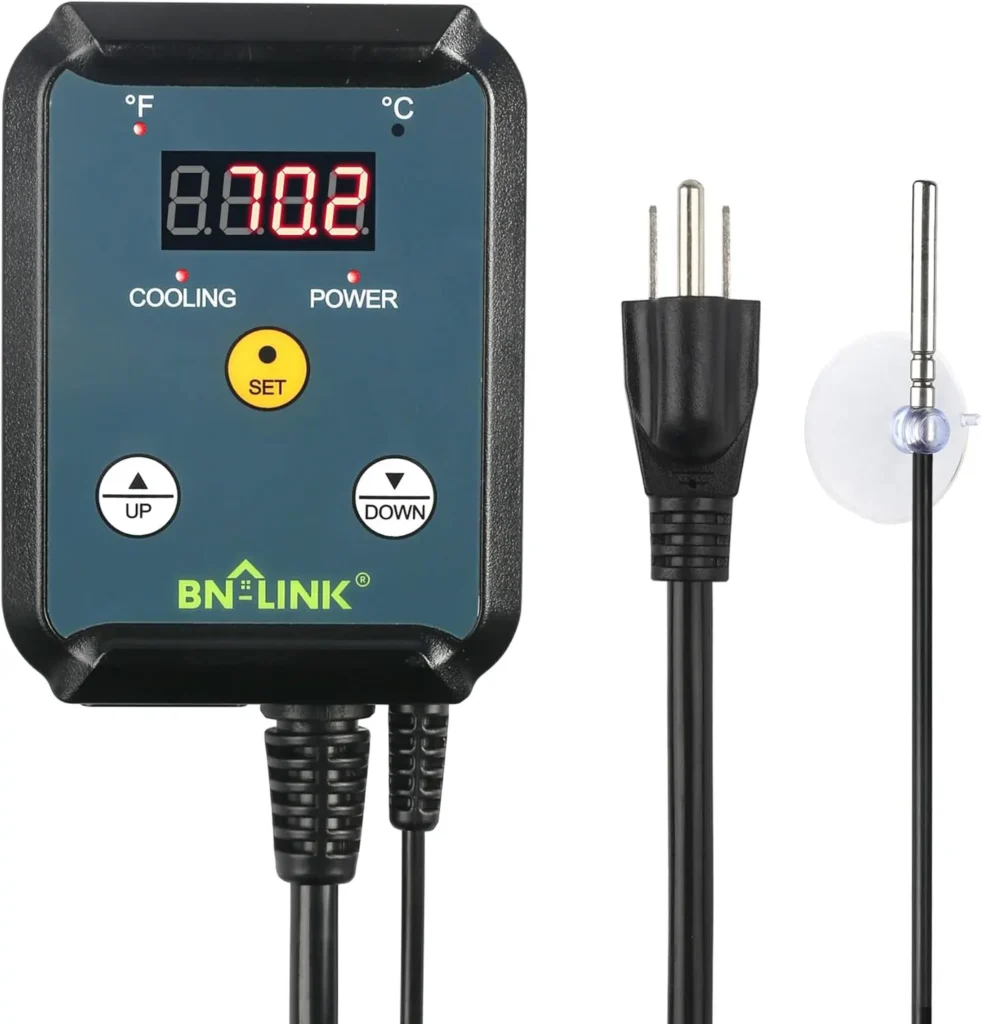
shop the BN-LINK Digital Thermostat on Amazon
2. REPTIZOO Dimming Thermostat (TC02) – Compact Precision Leopard Gecko Thermostat for California (Small CA Enclosures)
Retail price: $29.99 | Amazon user rating: 4.6 out of 5 (500+ verified US reviews)
PID-style thermostats deliver gradual heat adjustment instead of sudden on/off cycling, which reduces temperature spikes — a huge benefit for dry California homes. This mini model is designed for tight spaces, making it ideal for LA studio apartments, stacked rack setups and standard 10 gallon leopard gecko tanks.
Core specifications for local use:
- Control mode: Switchable PID dimming or pulse control, flicker-free for all heat sources
- Temperature accuracy: ±0.5°F, professional-level precision for sensitive dry-climate setups
- Maximum wattage: 200W, sized for small to medium single enclosures
- Built-in features: Overheat shutoff, probe failure alarm, compact low-profile body
In Southern California, many keepers place enclosures near windows. Small temperature shifts from sunlight can throw off basic thermostats, but the REPTIZOO PID system corrects these minor changes in real time. Its small size means it will not take up valuable shelf or floor space in crowded rental units, a top request from local reptile owners.
Best use cases: Small tanks, multi-tank rack systems, keepers who use both heat mats and low-wattage heat bulbs.
Local limitation: Lower wattage means it is not suitable for large enclosures over 25 gallons.
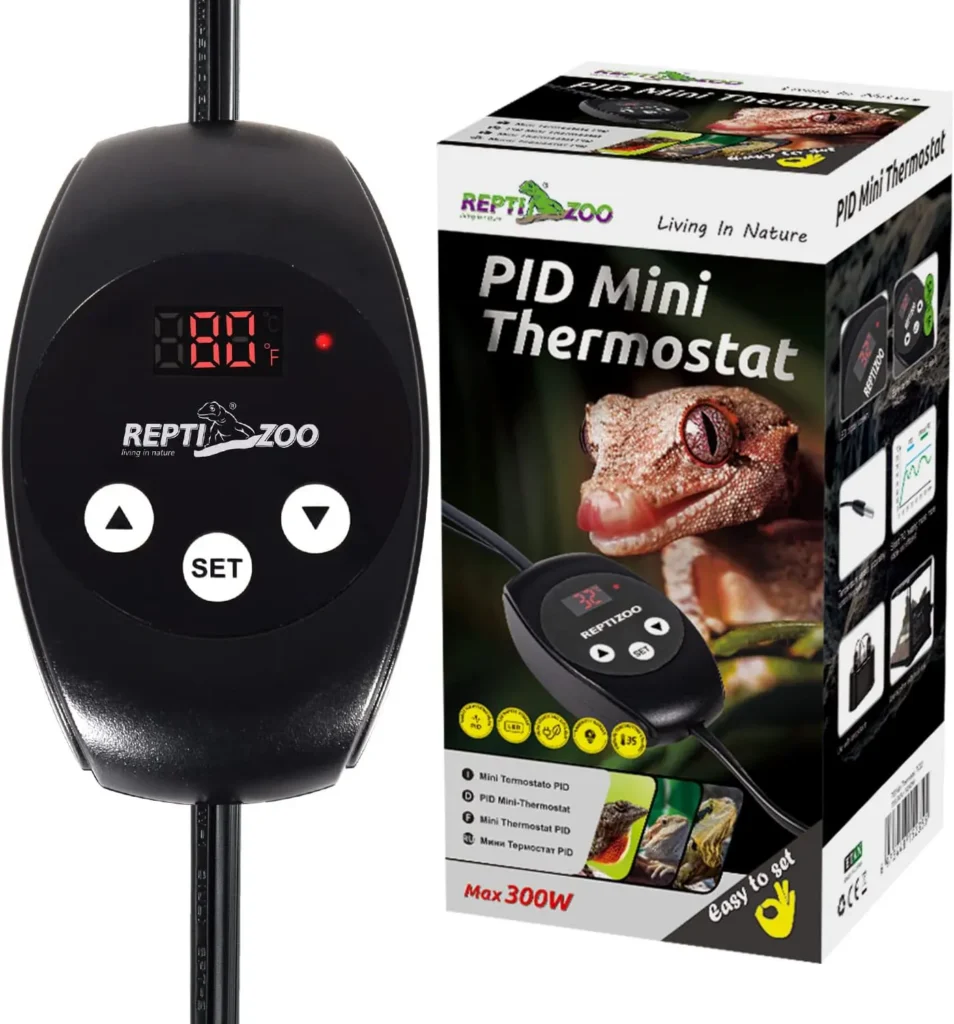
grab the REPTIZOO PID Mini Thermostat on Amazon
In-Depth Thermostat Comparison for California Reptile Owners
Use this comparison chart to match a thermostat to your enclosure size, heating setup and budget. All performance notes are based on real use in dry Western US homes.
| Feature | BN-LINK Digital Thermostat | REPTIZOO PID Mini Thermostat |
|---|---|---|
| US Amazon Price | $18.99 | $29.99 |
| Primary Heating Match | Under-tank heat mats | Mats + small heat bulbs |
| Temperature Accuracy | ±1°F | ±0.5°F |
| Max Wattage | 1000W | 200W |
| California Summer Performance | Good (overheat alarm) | Excellent (precision control) |
| California Winter Performance | Good (stable output) | Very Good |
| Ideal Enclosure Size | 10–20 Gallon | 10–25 Gallon |
| Best For (CA Keepers) | Beginners, budget renters | Small tanks, apartment setups |
Quick local buying guide for California keepers:
- Budget under $30 + only using a heat mat → Choose BN-LINK
- Small apartment tank + priority on space and precision → Choose REPTIZOO PID Mini
Side-by-Side Comparison: Pick the Right Leopard Gecko Thermostat for California for Your Home
Even the best thermostat will underperform with incorrect installation. These steps are customized for LA-style homes, central HVAC systems and dry indoor air. Follow every step for accurate readings and maximum safety.
Step 1: Place the Thermostat Away From Home HVAC & Sunlight
Never set the thermostat directly next to AC vents, heating registers or sunny windows. California’s strong sunlight and blowing dry air will create false temperature readings. Mount the unit on a wall or shelf 1–2 feet away from the enclosure, in a shaded area with steady room temperature. This is the most overlooked step for apartment dwellers.
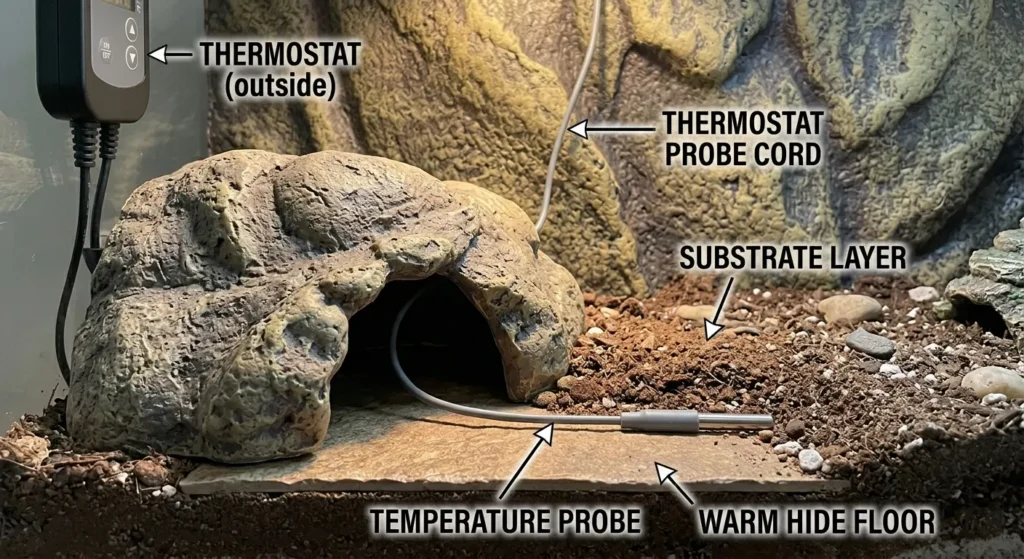
Step 2: Position the Probe (Critical for Dry Western US Air)
Run the probe cord through the top ventilation gap of the enclosure. Lay the probe flat on the warm hide floor, then cover it with a thin layer of substrate (1/4 to 1/2 inch). Dry air circulates rapidly in California homes, so leaving the probe exposed to open air will skew results. Do not tape probes to glass walls — this practice fails in all dry climate setups.
Step 3: Base Temperature Settings (Standard for CA Leopard Geckos)
Set these baseline numbers first, then adjust for seasons:
- Warm hide daytime target: 90°F
- Warm hide nighttime target: 78°F
- Overheat alert limit: 93°F
Step 4: Seasonal Adjustments (Exclusive for California Weather)
This is the core local content for Western US keepers:
- Summer (June – August, Southern CA): Lower warm hide daytime temp to 88°F. Raise the overheat cut-off to 92°F. Home AC cycles constantly here, and combined with outdoor heat, enclosure temperatures rise fast.
- Winter (December – February, Southern CA): Raise warm hide daytime temp to 92°F. Ensure nighttime temperatures never drop below 75°F. Central home heating creates cold drafts near floors, so avoid lowering night settings too much.
Step 5: Double-Check with a Secondary Thermometer
Always verify thermostat readings with a separate digital probe thermometer. Calibrate your main thermostat once every 3 months, or after major weather changes and deep enclosure cleans. Dry air can slowly affect probe sensitivity over time.
Final Recommendations for California Leopard Gecko Keepers
For anyone raising leopard geckos in Los Angeles or across dry regions of California, a dedicated reptile thermostat is not an upgrade — it is essential for basic animal care. Based on local climate tests and feedback from dozens of regional keepers, here is our final call:
- New keepers or renters on a budget: Go with the BN-LINK Digital Thermostat. It is simple, durable and priced well for basic heat mat setups.
- Apartment owners with small enclosures: Pick the REPTIZOO PID Mini Thermostat. Its compact size and high accuracy fit tight living spaces perfectly.
- Keepers with mixed heating systems or multiple tanks: Invest in the CAVACHEW PID Dimming Thermostat. Its seasonal cycle and full safety features handle California’s extreme weather all year long.
Take 10 minutes to recheck your current thermostat settings and probe placement today. Small adjustments will eliminate temperature spikes, prevent burns and keep your leopard gecko active and healthy through California’s hottest summers and coldest winters.
FAQ Section
Q1: Can I use a standard home smart thermostat for my leopard gecko enclosure in California?
A: No. Home smart thermostats are built for living spaces, not reptile habitats. They lack the high precision and overheat safety features required for dry California indoor environments. Stick to reptile-specific thermostats listed in this guide.
Q2: How often should I recalibrate my thermostat living in Southern California?
A: Recalibrate once every 3 months. Add an extra check at the start of summer and winter, as major weather shifts and HVAC use changes can affect probe accuracy in dry air.
Q3: Do I need extra humidity adjustments alongside thermostat use in dry California homes?
A: Minor adjustments work well. Keep humidity between 30% and 40% for leopard geckos. A light weekly mist near the warm hide pairs with proper temperature control to support healthy shedding in our dry climate. (For advanced keepers managing multi-parameter setups or precision climate triggers, explore our Fish Scale Gecko breeding guide to environmental simulation.)
Q4: Which thermostat works best for rental apartments in LA?
A: The BN-LINK or REPTIZOO PID Mini are top choices. Both are lightweight, easy to move, and do not require permanent wall mounting, which fits most rental rules.
This content is for educational purposes only and does not substitute professional veterinary diagnosis or treatment. If you observe any symptoms of illness, injury, or abnormal behavior, please consult a qualified exotic animal veterinarian immediately.
For more details, please review our full Medical Disclaimer.