
I Followed Every Tutorial. My Snake Still Couldn’t Shed.
Quick disclaimer before we go anywhere: Everything in this article is based on what I’ve learned as a hobbyist — trial, error, and a lot of conversations with my reptile vet. If your snake is sick, go see an ARAV-certified veterinarian. This guide is about enclosure setup, not medical advice.
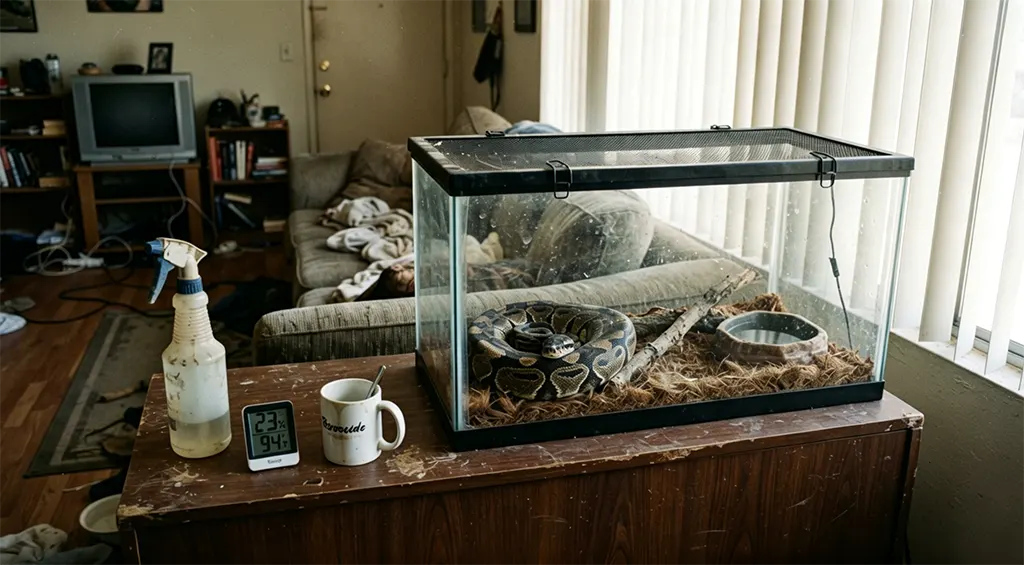
Alright. Let me set the scene. It’s July in Riverside. Outside, it’s 108°F and the air feels like it’s been microwaved. Inside my apartment, the AC is blasting, the humidity gauge reads 23%, and my ball python — a 1,200g male (a classic wild-type, though if you’re still shopping around, check out our beginner ball python morphs guide) I’d named Houdini because he apparently specialized in escaping — is sitting in his enclosure staring at me with dull, gray-blue eyes.
He was in blue phase. He was about to shed. And the humidity in his tank was hovering somewhere between “Sahara noon” and “the inside of a kiln.”
I’d done everything right. Or at least, everything the YouTube tutorials said was right. 12x12x12 glass tank with a screen top. Under-tank heating pad. A single water bowl. Zoo Med Eco Earth substrate, maybe two inches deep if I was generous. A digital hygrometer on the cool side that I checked obsessively.
45%. No matter what I did — spraying twice a day, soaking the substrate, adding a bigger water bowl — the number would climb to maybe 55% for twenty minutes, then plummet right back to the low 40s.
Houdini’s shed came out in patches. A strip around his eyes hung on for days. The tip of his tail went necrotic-looking and dry. I felt like I was watching a slow-motion disaster and I had no idea how to stop it.
I drove to three different reptile shops over two weeks. The first guy told me to get a bigger water bowl. The second told me to mist more. The third one — the one who actually had ball pythons in the back and clearly knew what he was talking about — looked at my setup description and said: “You’re in Riverside? In the summer? With a screen-top tank? You’re fighting a war you can’t win with that equipment.”
He was right. And the next two years of trial, error, and way too much money spent on failed setups taught me something that none of the standard tutorials mention: if you’re keeping ball pythons in a genuinely dry climate — and I’m talking ambient humidity consistently below 30%, which covers most of inland Southern California, parts of Arizona, Nevada, and Central Texas — then maintaining a high-humidity setup takes real equipment. But if you’re set on a ball python, the low humidity fix isn’t about adding more water. It’s about completely rethinking how your enclosure traps moisture.
This is that guide. No fluff. No “just mist more.” The actual hardware and setup logic that works when the air outside your apartment is actively trying to desiccate everything in it.
Part 1: Why the Standard Ball Python Enclosure Setup Fails in Dry Climates
Before we fix anything, you need to understand why your current setup is hemorrhaging humidity. It’s not your fault. The problem is that most ball python care guides were written by keepers in Florida, Louisiana, or the Gulf Coast — places where ambient humidity sits at 60-80% naturally. Those keepers don’t even think about humidity. Their problem is the opposite: too much of it.
If you’re in inland Southern California, you’re fighting a completely different battle. Here’s what’s working against you.
Screen-Top Tanks Are Humidity Killers
This is the single biggest mistake I see in dry-climate setups. A screen top on a glass tank is basically a giant exhaust vent. Every drop of moisture that evaporates from your substrate, your water bowl, or your misting session goes straight up through that mesh and into your apartment’s HVAC system.
In Florida, where ambient air is already saturated, a screen top loses maybe 10-15% humidity compared to a sealed enclosure. In Riverside in July, where the ambient air is bone dry and your AC is constantly cycling, you’re losing 40-60% of your moisture output through that screen. It’s not a small leak. It’s a canyon.
Under-Tank Heating Pads Don’t Help the Microclimate
UTH pads heat from the bottom up. They warm the substrate directly beneath them, but they don’t meaningfully raise the air temperature inside the enclosure. And here’s the thing about physics: warm air holds more moisture. If your air temp stays low because you’re only heating the floor, your humidity ceiling stays low too.
More critically, UTH pads create a sharp thermal gradient between the bottom (hot) and the rest of the enclosure (cool). Ball pythons need to thermoregulate across a gradient, but that gradient should be horizontal — hot side to cold side — not vertical. A UTH pad in a dry climate gives you a hot floor with cool, dry air above it. The snake can’t effectively use that thermal profile.
Spray-and-Pray Is Not a Strategy
I’ll be honest — I spent the first six months with Houdini doing the spray-and-pray routine. Mist the tank in the morning. Mist again at night. Check the gauge. Watch it climb. Watch it crash. Repeat.
Here’s what spray-and-pray actually does: it wets the surface of your substrate for about 15-20 minutes, then all that water evaporates into your apartment’s dry air. You’re not raising your enclosure’s humidity baseline. You’re just creating temporary spikes that don’t last long enough to matter for a ball python that needs consistent 50-60% around the clock — and 70-80% during blue phase.
The experienced keepers in the herp community will tell you the same thing: misting is a supplement, not a solution. In dry climates especially, if your enclosure can’t hold humidity between mistings, misting is just a waste of time.
Thin Substrate Dries Out Before It Can Work
Two inches of coconut husk or cypress mulch in a dry climate is like bringing a cup of water on a hike through Death Valley. It’s not enough mass to retain moisture for any meaningful period. The top layer dries out within hours of misting, and the bottom layer was never moist enough to matter.
You need volume. Deep substrate isn’t a luxury for burrowing species — it’s the moisture battery that keeps your humidity stable between interventions. We’ll get into exactly how deep in Part 2.
Part 2: Hardware Upgrade — The Three Changes That Actually Matter
Okay, enough about what’s broken. Here’s what actually fixed this for me — three hardware changes that, combined, took my enclosure from a humidity sieve to something stable. I wish someone had handed me this list two years earlier. Skip any one of them and you’ll still be fighting the same battle, trust me.
Change 1: Switch to a PVC Enclosure
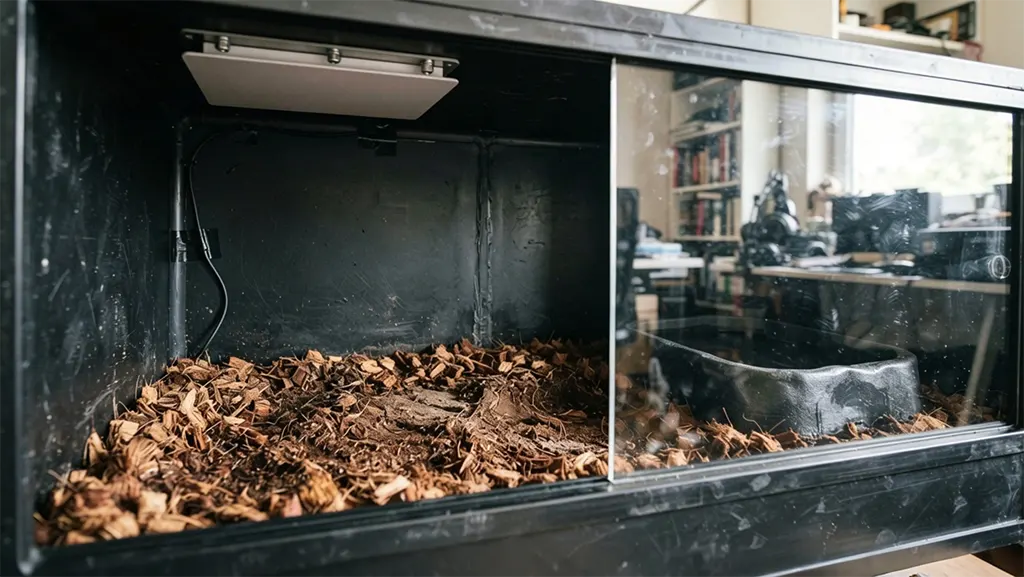
If you take one thing away from this entire guide, let it be this: in a dry climate, a [PVC enclosure] is not optional. It’s the foundation.
Here’s why PVC matters for ball python enclosure setup in dry climate conditions. PVC (polyvinyl chloride) is a solid, non-porous plastic. Unlike wood or glass-with-silicone-seams, PVC panels are thick, insulated, and when manufactured properly, they seal tightly at every joint. There are no gaps. There is no screen. There is no mesh.
The result is an enclosure that holds humidity with minimal effort. Where a screen-top glass tank might lose 50% of its moisture output to evaporation through the top, a well-sealed PVC enclosure retains nearly all of it. The insulation properties also mean your heat source doesn’t have to work as hard — less energy, more stable temps, and critically, less convective air movement that strips moisture from your substrate.
What to look for:
- Solid PVC construction, not PVC-coated wood or MDF. You want the real stuff.
- Sealed ventilation ports that you can adjust or close partially. You still need some air exchange — ball pythons need fresh air — but the ability to dial it back during dry months is huge.
- Front-opening design with a gasket seal. Side-opening works too. The point is that the door seals tight when closed.
- Appropriate size: for an adult ball python, 36x18x12 inches minimum. For a larger female, 48x18x18 is better. Don’t go bigger than necessary — more volume means more air to humidify.
I switched Houdini from a 40-gallon glass breeder with a screen top to a 4-gallon… just kidding. A 40-gallon PVC with adjustable vents. The difference was immediate and dramatic. Humidity went from a constant battle in the low 40s to sitting at a stable 55-60% with almost zero effort. That one change did more than every spray bottle I’d ever used.
For those doing Southern California reptile keeping in apartments, PVC enclosures are also lighter than glass and won’t shatter. Small wins.
Change 2: Radiant Heat Panel (RHP) Over Heat Lamp or UTH
This one surprised me. I’d been running a ceramic heat emitter (CHE) on a dome lamp for over a year. It worked — kept the hot side at 88-90°F — but I didn’t realize what it was doing to my humidity until I switched.
Heat lamps, especially CHEs, blast intense directional heat into a small area. That heat creates convection currents — hot air rises, cool air rushes in to replace it. In a dry climate, those convection currents are constantly pulling dry air across your substrate and out through any vent or gap. You’re essentially running a convection dryer inside your snake’s enclosure.
A radiant heat panel (RHP) works fundamentally differently. It mounts to the ceiling of the enclosure and radiates infrared heat downward and outward, warming surfaces rather than air. There’s minimal convection. The heat is even across the panel — no hot spots. And critically, because it’s not driving air movement, it’s not stripping moisture from your substrate.
I ran a side-by-side test in my own setup: same substrate depth, same water bowl, same ambient room conditions. CHE on the left enclosure, RHP on the right. The CHE enclosure lost about 12-15% more humidity over a 6-hour period. In a dry climate, that gap is the difference between 50% and 38%.
Setup notes:
- RHP must be used with a thermostat. Always. No exceptions. An unregulated RHP can overheat.
- Mount it on the ceiling of the hot side, covering roughly one-third to one-half of the enclosure floor space. This creates your 88-92°F (31-33°C) hot zone.
- The cold side should sit at 75-78°F (24-26°C). If your ambient room temp stays in that range, the cold side doesn’t need supplemental heat.
- Use a digital thermostat with a probe placed on the substrate surface directly under the RHP. Set your target to 90°F and let the thermostat cycle the panel.
Change 3: Deep Substrate — Coconut Husk Blend, 3-4 Inches Minimum
Now for the substrate part. This one’s huge, and it’s the one most people skip because they think “dirt is dirt.” PVC keeps moisture from escaping. RHP heats without stripping it. But none of that matters if your substrate can’t actually hold the moisture in the first place.
The substrate’s job in a humidity management system is simple: it acts as a moisture reservoir. When you mist or add water, the substrate absorbs and holds that moisture, then slowly releases it through evaporation. The deeper the substrate, the larger the reservoir, and the longer it takes to dry out.
In a dry climate, two inches of substrate dries to the core within 24-36 hours after misting. Three to four inches takes 4-5 days. That’s the difference between misting every day and misting twice a week.
Best substrate for humidity retention in dry climates:
- Coconut husk chips mixed with coconut coir (peat) — This is the gold standard. The husk chunks provide structure and air pockets, while the finer coir holds moisture like a sponge. A 60/40 husk-to-coir ratio works well. Many keepers call this “coconut husk humidity retention” setup and it’s the backbone of dry climate ball python keeping.
- Cypress mulch as a secondary option — also excellent at moisture retention, though harder to find in some areas.
- Avoid paper towel, newspaper, reptile carpet, or bare-bottom setups in dry climates. These have zero moisture-holding capacity and will make your life miserable.
Depth matters: 3-4 inches minimum. I know that sounds like a lot. It’s not. That depth is what gives you the thermal and humidity mass to maintain a stable microenvironment. Your ball python will also appreciate the ability to burrow — they’re ambush predators by nature and many of them will create depressions or tunnels in deep substrate.
Quick side note on brands — I’m not going to recommend specific products here because availability changes and I don’t want you driving to a pet store that doesn’t carry something. Just look for “coconut husk chips” and “coconut coir brick” at any decent reptile supply store or online. They’re cheap. A $15 bag of husk chips and a $8 coir brick will last you months.
Oh, and one thing I almost forgot — don’t buy the pre-mixed “forest floor” type substrates that claim to be ready to use right out of the bag. They’re usually too dry and too thin for what we need here. I wasted $25 on one of those before realizing I was just paying a markup for something I could mix myself in five minutes.
Preparation tip: hydrate your coconut husk/coir mix before loading it. Dump the dry substrate in a tub, add warm water, and let it soak for 20-30 minutes until it’s moist but not dripping. Squeeze a handful — a few drops should come out, but it shouldn’t stream. Then load it into the enclosure. This gives you an immediate humidity buffer from day one.
Part 3: Microenvironment Reconstruction — The Details That Separate Stable from Unstable
You’ve got the hardware right. PVC. RHP. Deep substrate. Congratulations — you’re now at the same starting line as keepers in humid climates. But in dry climates, you need to go one step further: you need to engineer microenvironments within the enclosure.
This is where ball python low humidity fix goes from “adequate” to “bulletproof.”
The Moisture Hide Box
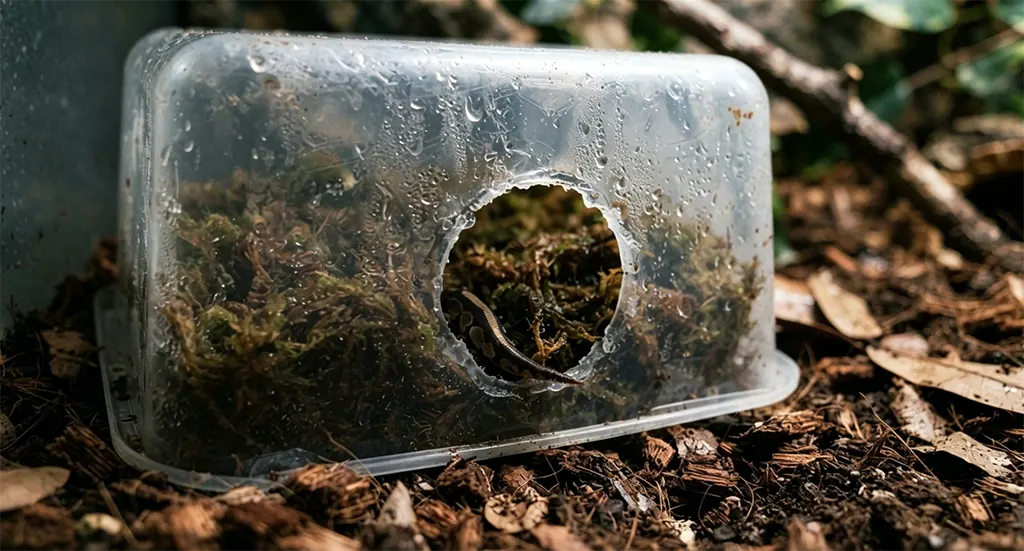
If you only do one thing from this entire microenvironment section, do this one. A moisture hide is just a small enclosed box inside the enclosure — usually plastic with a hole cut in the side — filled with moist sphagnum moss. Sounds janky, right? That’s what I thought too. Your snake crawls inside and is surrounded by humidity near 80-90%.
Why this matters: ball pythons spend most of their time in hides. If their hide is humid, they’re spending 70-80% of their day in a high-humidity microenvironment even if the ambient enclosure humidity is only 55%. This is how you prevent stuck shed and support ball python dehydration prevention without turning the entire enclosure into a swamp. If you’re not sure what your local climate demands of your setup, this regional climate guide for ball python enclosures breaks down the right equipment for every US climate zone.
How to build one:
- Take a small plastic container (a deli cup works for juveniles, a shoebox-sized container for adults).
- Cut a hole in the side just big enough for your snake to slide through.
- Fill it with damp sphagnum moss — moist, not soaking.
- Place it on the warm side of the enclosure, under or near the RHP’s coverage area. The warmth will help maintain evaporation.
- Re-moisten the moss every 5-7 days. In blue phase, check it more frequently.
I made Houdini a moisture hide out of an old Tupperware container. He moved in immediately. Within a week, his shed quality went from patchy disasters to clean, one-piece sheds. The moisture hide was the one change that made the most difference — bigger than the RHP, bigger than the substrate depth — in terms of direct impact on shed quality.
Humidity Gradient — Yes, That’s a Thing
Most keepers think about temperature gradients (hot side to cold side). In dry climates, you should also think about a humidity gradient.
Here’s how to create one:
- Warm side: slightly higher humidity. The moisture hide lives here. The RHP creates gentle evaporation from the substrate surface. Misting focuses here.
- Cool side: slightly lower humidity. This gives your snake a drier area to retreat to if they want it. Ball pythons will sometimes seek drier spots before a shed to prevent the old skin from sticking.
You don’t need a second hygrometer for this — but if you want to dial it in precisely, placing probes on both sides will tell you where your gradient sits. In my setup, the warm side typically reads 58-62% and the cool side reads 50-55%. That 5-8% difference is enough to give the snake options without creating a problem.
One more thing before we move on — and I feel weirdly passionate about this because I argued with someone online about it for like three hours one night. You do NOT need a second heat source for the cold side in most apartments. If your room stays above 72°F at night, the cold side of your enclosure will naturally sit in the 75-78°F range just from ambient room temperature plus whatever heat bleeds over from the warm side. I see people buying double heat setups all the time and it’s unnecessary. You’re not heating two zones. You’re heating one zone and letting the other side just… be room temperature. Save your money. Buy more coconut husk.
Blue Phase (Pre-Shed) Protocol
When your ball python goes into blue — eyes go milky blue-gray, belly scales take on a pinkish tint, overall color dulls — humidity needs to jump to 70-80%. This is non-negotiable for clean sheds.
Here’s what I do when I see blue phase starting:
- Soak the substrate lightly — not dripping, but more moisture than usual. Pour about a cup of warm water along the warm-side substrate and let it wick through.
- Pack the moisture hide — extra sphagnum moss, thoroughly dampened.
- Close ventilation ports partially — if your PVC enclosure has adjustable vents, close them halfway. You want reduced air exchange during this window.
- Add a temporary humid hide if the snake is large or the enclosure is big — a second moisture hide on the cool side gives more coverage.
- Monitor daily. Check the snake’s eye caps and tail tip. If you see the old skin starting to stick, my vet recommended a shallow soak in lukewarm water (80-82°F) for 15-20 minutes to help loosen things up — and that’s worked for me every time. But look, if stuck shed persists beyond a few days or you’re seeing anything that looks off — redness, swelling, discharge — that’s past the point of DIY fixes. Find an ARAV-certified vet (Association of Reptilian and Amphibian Veterinarians). I keep a list on my fridge, honestly. You should too.
This protocol takes about five minutes and has completely eliminated stuck shed issues for me and every snake I’ve housed since.
Part 4: Troubleshooting — Where People Still Screw Up
Even with the right hardware, people still run into problems. Here are the ones I’ve seen most often, including the ones I created myself.
“I Added a Bigger Water Bowl and Nothing Changed”
A bigger water bowl helps. But in a PVC enclosure with RHP and deep substrate, the water bowl is a supplement, not the primary humidity source. If your humidity is still low after upgrading the bowl, your issue is almost certainly enclosure sealing (check door gaskets and vent gaps) or substrate depth. The water bowl contributes maybe 5-8% humidity in a well-sealed PVC setup. If you’re sitting at 35%, a bigger bowl won’t bridge that gap.
“My PVC Enclosure Has Mold Growing on the Walls”
This happens when ventilation is too restricted and moisture has nowhere to go. Ball pythons need fresh air exchange — you can’t seal an enclosure completely and expect healthy results.
Fix: open the vents a bit more. Aim for 50-60% ambient humidity with good airflow, not 75% in a stagnant box. If you already have visible mold, clean the enclosure with a dilute chlorhexidine solution (reptile-safe), let it dry completely, and reassess your ventilation. Mold on enclosure walls is a sign of poor air exchange, not “too much humidity.”
“I’m Worried About Respiratory Infections from High Humidity”
This is a real concern, but it’s usually based on a misunderstanding. RI in ball pythons is caused by a combination of factors: temperatures that are too low (below 75°F at the cold side), poor ventilation, and/or prolonged exposure to humidity above 80% at room temperature (cool, wet conditions — the exact environment where bacteria and fungi thrive).
A well-managed enclosure at 50-60% with proper temperatures and adequate ventilation does not cause RI. The danger zone is when you have high humidity AND low temps AND poor airflow all at once. That’s a swamp. Your setup should never get there if you’re following the hardware recommendations above.
If your snake is wheezing, open-mouth breathing, or has mucus bubbling at the nose — stop adjusting your enclosure and call a vet. I’m talking an ARAV-certified reptile vet, not the guy at the pet store. Respiratory signs in ball pythons don’t get better on their own and they don’t get better from humidity tweaks. I learned this the hard way when a juvenile I was babysitting started making clicking sounds. Spent two weeks “monitoring it” before my vet told me I’d already waited too long. Don’t be me on that one.
And keep in mind that not every respiratory infection is bacterial. Serpentoviruses cause very similar signs, and no amount of humidity tuning will clear them — our guide to serpentovirus in ball pythons explains what testing and quarantine actually involve.
“How Do I Know If My Snake Is Dehydrated?”
Signs of dehydration in ball pythons include: wrinkled or pruned-looking skin (especially along the spine), sunken eyes, lethargy, and of course, stuck shed. If you notice these signs and your humidity is dialed in, the issue might be that the snake isn’t drinking enough. Make sure the water bowl is fresh, clean, and accessible. Some ball pythons prefer to drink from moving water — a small drip system or gently dripping water from a syringe near their head can trigger drinking response. If dehydration signs persist despite your husbandry being dialed in, that’s when you call your reptile vet. Not to panic — just to rule out anything going on internally that you can’t see from the outside.
Frequently Asked Questions
What humidity level does a ball python need in a dry climate?
Baseline humidity for a ball python should be 50-60% year-round, with increases to 70-80% during blue phase (pre-shed). In dry climates where ambient humidity regularly drops below 30%, maintaining even the baseline requires a sealed PVC enclosure, radiant heat panel, and deep coconut husk substrate. A moisture hide with damp sphagnum moss provides a localized high-humidity retreat that prevents stuck shed even when room conditions are extremely dry.
Can I use a glass tank with a solid top instead of PVC?
A glass tank with a solid glass or plastic top (no screen) will perform significantly better than a screen-top tank. However, glass still conducts heat and moisture far more readily than PVC insulation. In very dry climates, you’ll find yourself fighting harder to maintain stable humidity. Most experienced keepers doing Southern California reptile keeping in arid inland areas consider PVC enclosure humidity control a non-negotiable upgrade. If budget is a concern, at minimum replace the screen top with a solid lid and seal any gaps.
Is a radiant heat panel really better than a heat lamp for ball pythons?
In dry climates, yes. Radiant heat panels provide even, consistent surface heating without creating convection currents that strip moisture from your substrate. Heat lamps (including ceramic heat emitters) drive convective air movement that accelerates evaporation and dries out your enclosure. The RHP also eliminates hot spots and creates a better horizontal temperature gradient. Always use a thermostat with any heat source.
How deep should the substrate be for a ball python in a dry climate?
Minimum 3-4 inches (7.5-10 cm). In dry climates, shallow substrate dries out too quickly to function as a moisture reservoir. A coconut husk and coconut coir blend at 60/40 ratio, pre-hydrated before loading, provides the best combination of moisture retention and structure. Pre-moisten the substrate before adding it to the enclosure — this gives you an immediate humidity buffer while the microenvironment stabilizes.
How do I prevent my ball python from getting stuck shed in a dry climate?
The most effective approach is a moisture hide — a sealed container filled with damp sphagnum moss placed on the warm side of the enclosure. This creates a microenvironment at 80-90% humidity that the snake can access 24/7. During blue phase, increase overall enclosure humidity to 70-80% by moistening substrate, closing ventilation ports partially, and packing the moisture hide. If stuck shed persists for more than a week or you see concerning signs, consult an ARAV-certified reptile veterinarian.
Quick Reference: Ball Python Dry Climate Cheat Sheet
Temperature Targets
| Zone | Target |
|---|---|
| Hot side surface | 88-92°F (31-33°C) |
| Cold side ambient | 75-78°F (24-26°C) |
| Night drop (acceptable) | Down to 72°F (22°C) minimum |
Humidity Targets
| Condition | Target |
|---|---|
| Baseline (year-round) | 50-60% |
| Blue phase (pre-shed) | 70-80% |
| Moisture hide interior | 80-90% |
Hardware Checklist
| Component | Specification |
|---|---|
| Enclosure | Solid PVC, front-opening, adjustable vents, 36x18x12 minimum (adult) |
| Heat source | Radiant Heat Panel (RHP) with digital thermostat, probe on substrate surface |
| Substrate | Coconut husk/coir blend, 60/40, 3-4 inches deep, pre-hydrated |
| Moisture hide | Sealed container + damp sphagnum moss, warm side |
| Water bowl | Large enough for soaking, cleaned weekly |
| Hygrometer | Digital, calibrated, checked weekly |
Dry Climate Maintenance Schedule
| Task | Frequency |
|---|---|
| Mist warm side substrate | Every 3-5 days (blue phase: every 1-2 days) |
| Check moisture hide moss | Every 5-7 days, re-dampen as needed |
| Clean water bowl | Weekly minimum |
| Full substrate change | Every 4-6 weeks or if mold/odor detected |
| Calibrate hygrometer | Monthly |
| Check thermostat function | Monthly |
When to Stop DIY-ing and Call the Vet
- Stuck shed lasting more than 7-10 days despite humidity correction
- Signs of respiratory distress: open-mouth breathing, wheezing, nasal discharge
- Persistent dehydration signs despite proper husbandry
- Any wounds, burns, or abnormal swellings
Point Being
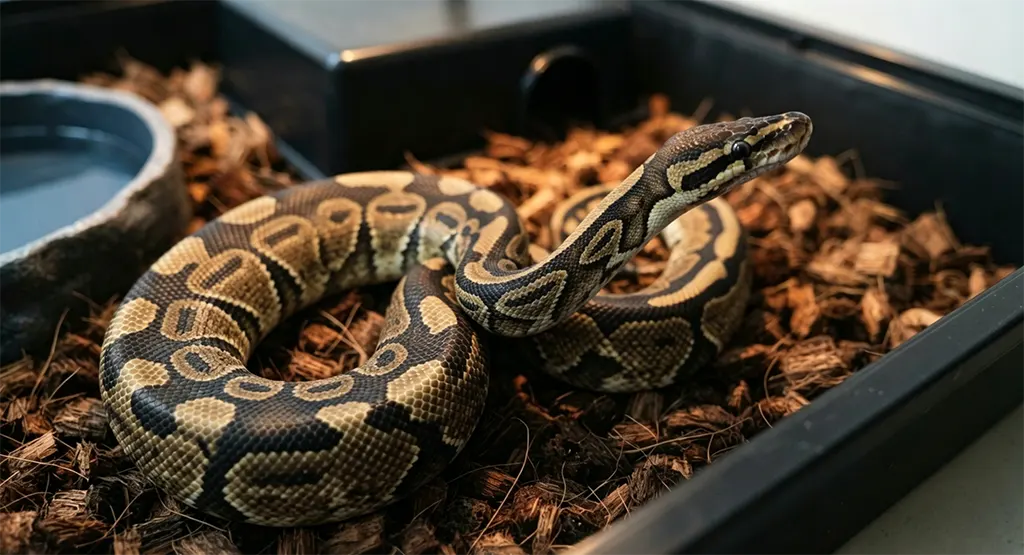
Look, here’s what I want you to take away from all of this: keeping ball pythons in dry climates is not harder than keeping them anywhere else. It just requires different equipment. The standard tutorials weren’t written for you. They were written for keepers who live in zip codes where the air already does half the work.
Once I stopped fighting the ambient conditions and started engineering the microenvironment — PVC to seal it, RHP to heat it without stripping it, deep substrate to store moisture, and a moisture hide to give the snake a humid sanctuary — everything changed. Houdini started shedding in clean, one-piece slides. His eyes stayed bright. His appetite stayed consistent. He stopped being a maintenance burden and became the pet I’d originally wanted. That’s also when handling stops being scary and starts being the payoff — if you’re nervous about picking your snake up, or dealing with a skittish one, this guide to how to hold a ball python safely walks through reading defensive body language, building trust session by session, and the simple habits that prevent nearly all bites.
It took me about two years and way too many failed setups to figure this out. You don’t have to make the same mistakes. Get the hardware right, build the microenvironments, and respect the difference between “adequate” and “stable.” Your ball python will tell you which one they’re living in every time they shed. If you’re just starting out and trying to budget for the full dry-climate setup — PVC enclosure, RHP, substrate, gauges, the works — this 2026 ball python setup cost guide breaks down every line item with real prices for three budget tiers, so you know what you’re actually getting into before you start buying.
This content is for educational purposes only and does not substitute professional veterinary diagnosis or treatment. If you observe any symptoms of illness, injury, or abnormal behavior, please consult a qualified exotic animal veterinarian immediately.
For more details, please review our full Medical Disclaimer.
Pingback: Why Is My Ball Python Not Eating? 7 Fixes That Work