
A bearded dragon enclosure is a machine for manufacturing weather. Get the weather wrong and the failure shows up weeks later: metabolic bone disease from a UVB bulb that silently died, respiratory infection in a sealed Florida bedroom, chronic dehydration in a Phoenix apartment, a dragon that will not eat through a Boston January. This guide treats the hardware as non-negotiable, then adjusts that hardware for the three US climate zones that break most setups: the arid Southwest, the cold Northeast and Midwest, and the humid Gulf Coast. Every number below is measured, not guessed.
1. The hard floor: a 4x2x2 bearded dragon enclosure and Ferguson Zone math
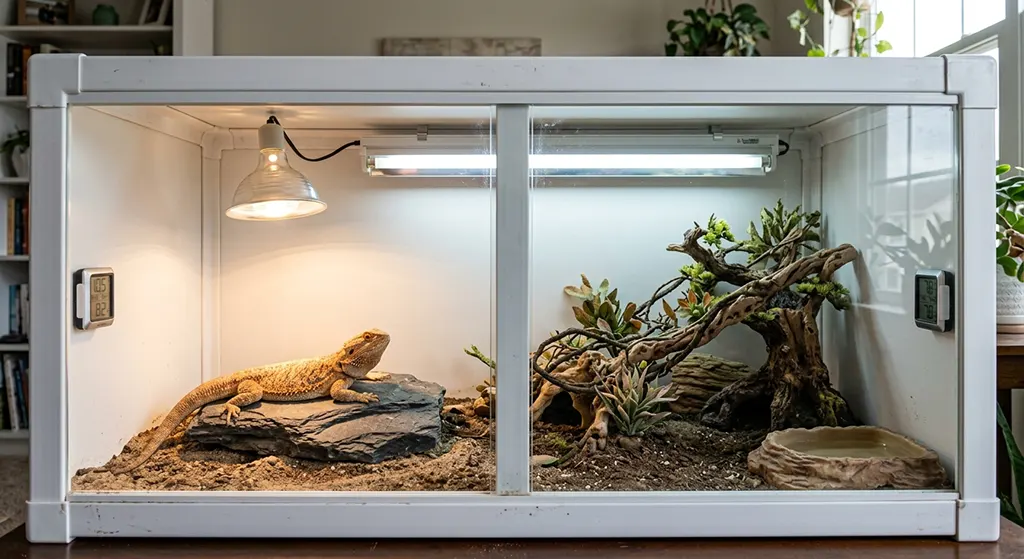
Enclosure size: the 120 gallon bearded dragon tank is a minimum, not a goal
An adult central bearded dragon (Pogona vitticeps) needs a 4x2x2 bearded dragon enclosure: 48 inches long, 24 inches deep, 24 inches tall, roughly 120 gallons of volume. That is the adult floor used by modern vet-reviewed husbandry standards, including ReptiFiles and care sheets aligned with Advancing Herpetological Husbandry. Anything shorter cannot hold a real thermal gradient: one end at a 100-plus-degree basking surface, the other 20 or more degrees cooler, with the dragon choosing its position all day. The old 40 gallon breeder is a juvenile tank at best.
Two design points matter as much as the dimensions:
- Front-opening wood or PVC is the default. Rigid PVC holds heat and humidity far better than glass, weighs less, and kills the reflective panels that make some dragons threat-display at their own reflection.
- Top-opening tanks train a dragon to expect a descending shadow. Every time the lid moves, a shape comes down from above. In the wild that shape is a raptor. Reaching in from above triggers the same predator response at every feeding and cleaning for a decade. Front doors remove it.
The 4x2x2 standard is for central dragons. Rankin’s dragons (Pogona henrylawsoni) top out around 10 to 12 inches and use a smaller footprint; the two species are not interchangeable in hardware planning our Rankin’s dragon vs central bearded dragon comparison.
Ferguson Zone bearded dragon UVB: the formula, not the bulb marketing
Bearded dragons are open-habitat sun baskers. In the Ferguson Zone system, built from wild UV exposure measurements, they sit in the Zone 3 to 4 overlap: regular baskers that will also sit out in hard midday sun. The captive target this produces:
- UVI 3.0 to 5.0 at the basking surface, measured at the level of the dragon’s back
- Peak UVI never above 7.0, the eye and skin damage band
- A gradient that falls toward the cool end, so the dragon can leave the UV field instead of being trapped in it
Only a linear T5 HO (high output) tube with a real aluminum reflector hits that target in a 24 inch tall enclosure. Coil compact bulbs and old T8 tubes do not. Searching “bearded dragon basking temp T5 HO” tables returns dozens of charts; the two workhorse tubes behind those charts are the Arcadia T5 HO 12% Desert D3+ and the Zoo Med ReptiSun 10.0 T5 HO. The Arcadia T5 HO 14% Dragon lamp is a specialist tool, not a universal upgrade. The general framework of matching UVB output and distance to species needs is covered in the VCA Hospitals reptile lighting and heating guide.
Distance from the tube to the dragon’s back at the basking point:
| Bulb | No screen between bulb and dragon | Through mesh screen |
|---|---|---|
| Arcadia T5 HO 12% or Zoo Med ReptiSun 10.0 T5 HO | 12 to 18 inches | 10 to 14 inches |
| Arcadia T5 HO 14% Dragon | Do not use at standard distances | 18 to 24 inches, only in tall enclosures and through dense mesh |
Two notes on this table. First, published distance charts vary by a few inches across ReptiFiles, Arcadia’s own Solarmeter-measured data, and Zoo Med documentation, because reflector design and tube age change output. Arcadia labels both its 12% and 14% T5 lamps under the Ferguson Zones 3 to 4 heading on its official charts. Always verify with a Solarmeter 6.5 and the manufacturer’s current distance chart; the table is the starting point, not a substitute for measurement.
Second, the screen. A standard mesh lid blocks roughly 30% to 50% of UVB output; Zoo Med’s own fixture literature warns that fine mesh blocks up to 50%. A setup that reads UVI 4.5 above the lid can read UVI 2.5 below it, which is a metabolic bone disease setup running invisibly for months. Mount the fixture inside the enclosure when the cabinet allows, or size bulb and distance for the screened path. Glass and plastic block UVB almost completely; a tube behind a glass panel might as well be unplugged. If you’re setting up your first dragon and noticing appetite drops within the first week, the mesh-UVB mismatch is a top culprit—this baby bearded dragon UVB and mesh top troubleshooting guide walks through the exact distance math.
Run UVB on the same timer as the daytime lights, span roughly half to two thirds of the enclosure length starting at the warm end, and replace the tube every 12 months even if it still lights. UVB output dies long before visible light does.
The temperature gradient: five numbers, all measured
Daytime heat must come from an overhead white-light source: a halogen flood or a plain incandescent flood bulb in a ceramic socket, run through a dimming thermostat. These produce the infrared-A and infrared-B wavelengths that warm tissue the way sun does. Colored “basking” bulbs are not acceptable daytime heat.
| Zone | Target |
|---|---|
| Basking surface, adult | 100 to 108°F (38 to 42°C) |
| Basking surface, juvenile under 12 months | 105 to 110°F (40 to 43°C) |
| Warm side ambient air | 85 to 90°F (29 to 32°C) |
| Cool side ambient air | 75 to 85°F (24 to 29°C) |
| Night drop, active season | 65 to 75°F (18 to 24°C) |
Basking numbers are surface temperatures, not air. Point an infrared temp gun at the actual rock or slate the dragon sits on. Ambient numbers come from digital probes at dragon height on each end. Stick-on dial strips read the glass, not the habitat. Heat rocks are banned outright: unregulated surface temperatures cause the ventral burns reptile clinics treat routinely. These baseline targets align with the Merck Veterinary Manual reptile husbandry guidelines.
2. The three US climate disasters and the field fixes
A correct bearded dragon tank setup assumes a neutral room. Most American rooms are not neutral.
| Region | Typical room problem | What it does to the dragon | Core hardware fix |
|---|---|---|---|
| Southwest (AZ, NV, inland SoCal) | Indoor baseline 80 to 90°F all summer; room RH under 20% | Basking surface runs past 115°F; chronic dehydration, stuck shed, dry eyes | Lower wattage, dimming thermostat, shallow water and local shed humidity |
| Northeast / Midwest (NY, MA, IL and similar) | Winter nights plunge under 60°F near windows; forced-air heat dries to desert levels | Cold gut, suppressed immunity, sleep disruption if owners add red lamps | DHP or CHE on a thermostat after dark, zero light emitted |
| Gulf Coast (FL, TX, LA) | Summer RH holds above 60% for days or weeks | Respiratory infection, CANV/nid fungal skin disease | Dehumidify the room, ventilate the tank, dry the substrate |
If you want to plug in your room temperature and humidity and see exactly how your enclosure numbers shift, our reptile environment calculator maps the impact for each climate zone.
Southwest: the basking spot that quietly hits 115°F
In Phoenix or Las Vegas the air conditioner fights a losing battle in the room that holds the enclosure. A 100W halogen sized for a 72°F room becomes a different appliance when that room sits at 86°F at 4 p.m. Keepers mapping these setups record basking surfaces of 115°F and higher, and 115°F of sustained surface heat is the band where overheating stops being theoretical: gaping, flat-body panic, a dragon searching for a cool end that no longer exists, then heatstroke. Juveniles, already targeted at 105 to 110°F, have almost no margin.
Fixes for the hot zone:
- Downsize the basking wattage for summer. Two 50W halogen floods on a dimmer give finer control than one 150W spot.
- Run the basking bulb through a dimming or proportional thermostat with the probe fixed to the basking surface. A thermostat is a ceiling; it cannot rescue an undersized bulb, but it stops a hot room from cooking a dragon.
- Confirm the cool end actually holds 75 to 85°F at the afternoon peak. If the whole tank reads 90°F, the gradient has collapsed. Move the enclosure off the exterior wall, close the blinds, or cool the room.
- Check the surface with a temp gun at the hottest hour, not in the morning. A slate that reads 104°F at 8 a.m. can read 118°F at 4 p.m.
The dry side of the Southwest climate is its own failure. Relative humidity below 20% for weeks produces the cases reptile-savvy clinics see every summer: retained shed constricting toes and tail tips, unshed caps over the eyes, concentrated urates. Target 30 to 40%. Keep a shallow, tip-proof water dish on the cool end year round. During an active shed, add a humid hide packed with damp sphagnum moss or paper towels, and offer a 10 to 15 minute soak in 85 to 90°F water two or three times across the shed. A light morning mist of the cool end, dry by noon, helps. Do not soak an arid enclosure end to end.
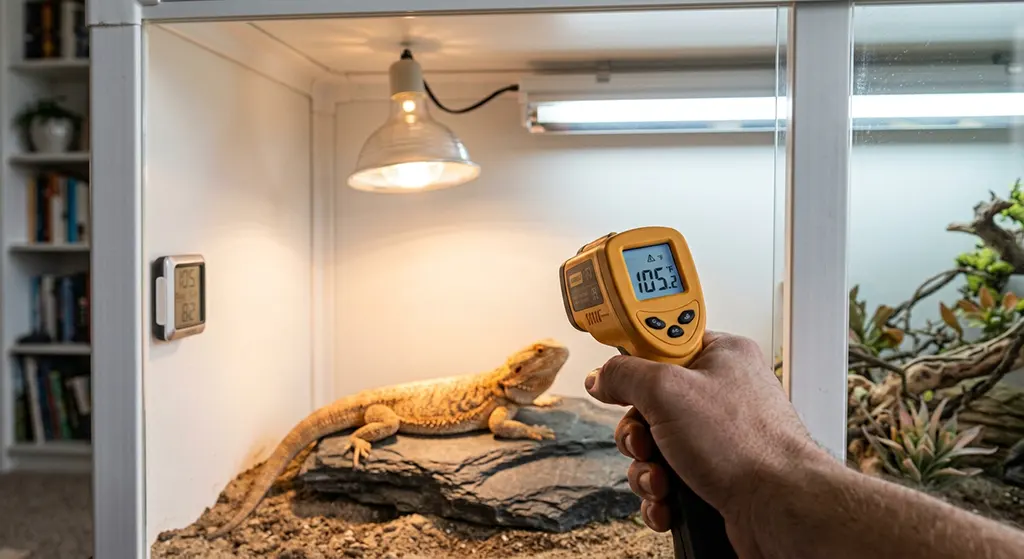
Northeast and Midwest: the 3 a.m. temperature crash
The pattern in Boston, Chicago, or upstate New York is seasonal and predictable. The house thermostat drops to 68°F, the enclosure sits near a drafty window or exterior wall, and by the small hours the air around the tank is under 60°F. Forced-air central heating dries out whatever humidity remains, so the same winter room is both too cold at night and too dry for clean sheds.
Active-season nighttime temperatures should drop to 65 to 75°F. The drop is normal and healthy; diurnal lizards sleep better with it. When the room pulls the enclosure below 65°F overnight, add night time heat. This is the night time heat bearded dragon keepers in the Northeast actually need, and two lightless sources do the job:
- A deep heat projector (DHP) emits infrared-A and infrared-B with virtually no visible light, warming tissue rather than just the air. It pairs with a dimming or proportional thermostat and is the current preferred night source for a 4x2x2.
- A ceramic heat emitter (CHE) is cheaper, purely surface-radiant heat, no light. Run it on a pulse-proportional thermostat (pulsing suits a bulb that emits no light; never put a light-emitting bulb on a pulse stat) in a porcelain socket rated above the wattage.
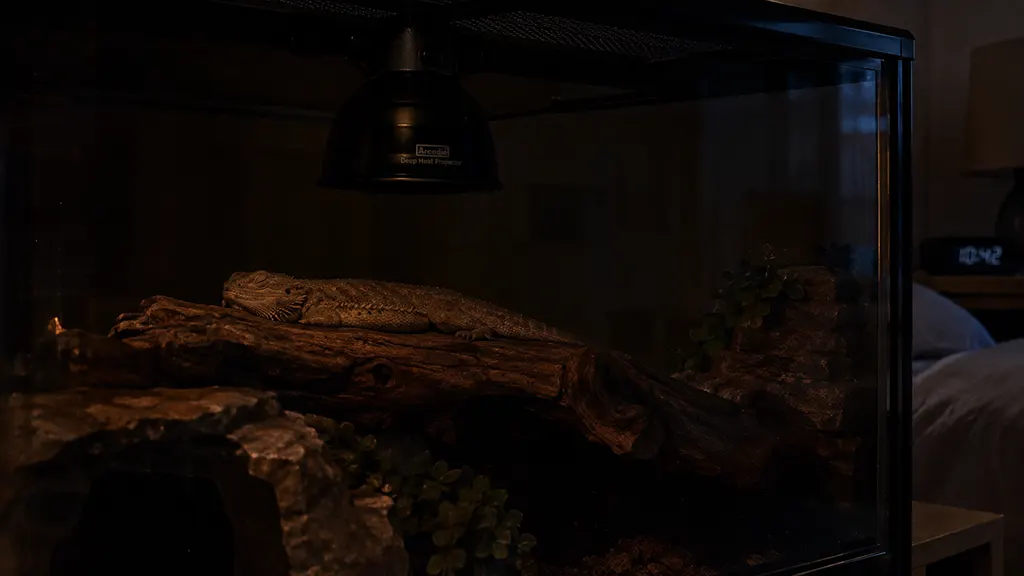
What must leave the setup is the traditional red “infrared” night lamp, along with its blue and purple siblings. This is not style preference. Bearded dragons carry color vision with photoreceptors that read red wavelengths; the bulb looks dim to a human and looks like a lit dusk to the dragon. Reptile rescues and clinics repeatedly tie red overnight lamps to fragmented sleep and altered behavior. They are heat sources that defeat the dark cycle. Retire it. Wire the DHP or CHE to the thermostat, set the probe to read ambient air on the warm end, and hold 65 to 75°F with zero visible light after the daytime lamps cut out.
Keep active-season numbers separate from dormancy. A healthy dragon entering brumation is deliberately cooled to a different, lower set of parameters with its own feeding and hydration schedule. Brumation conditions are different from the 65 to 75°F active night drop, so do not confuse the two when planning for winter complete bearded dragon brumation guide. The forced-air dryness gets the same shed-support tools as the Southwest: water dish, humid hide during sheds, warm soaks for stuck toes.
Gulf Coast: humidity above 60% is a respiratory and fungal event
Florida, Texas, and Louisiana keepers fight the opposite war. Summer ambient relative humidity sits at 60 to 80%, and an enclosure reads within a few points of the room around it. A water bowl under the basking lamp, damp substrate, a sealed lid, or a closet location pushes tank humidity higher and holds it there.
Sustained humidity above roughly 55% is the condition reptile veterinarians generally associate with two serious diagnoses in this species:
- Respiratory infection (RI): watch for bubbles or clear-to-discolored mucus at the nostrils, clicking or wheezing, open-mouth breathing at rest, a head held up and stretched while sleeping, and appetite loss. A desert lizard’s respiratory tract does not clear warm, stagnant, moisture-loaded air well.
- Nid fungal disease, long called yellow fungus disease and historically reported as CANV (Chrysosporium anamorph of Nannizziopsis vriesii). Taxonomy was revised in the 2010s: the old CANV grouping was split into Nannizziopsis, Paranannizziopsis, and Ophidiomyces, with Nannizziopsis guarroi the species most often isolated from bearded dragons. Clinics and labs still use “CANV complex” as shorthand, which makes “CANV/nid fungal disease” the practical term to search. Signs are yellow to brown crusted or ulcerated patches, often starting on the face, belly, limbs, or around the vent, and the infection is contagious between reptiles. A peer-reviewed PubMed study documents the prevalence and clinical presentation of this pathogen in captive bearded dragons.
Either set of signs means a reptile veterinarian, not a home protocol. Find one through the Association of Reptile and Amphibian Veterinarians directory at https://arav.org/find-a-vet/.
The hardware fix is an air-movement and moisture-removal campaign:
- Dry the room first. A room dehumidifier, or running the air conditioning (AC dehumidifies as it cools), controls the ambient humidity the enclosure inherits. Hold the room under 50% and the tank follows.
- Ventilate the tank. Cross-flow vents, back and side vents on a PVC cabinet, or a small low-voltage extraction fan pulling air through a vent prevent the stagnant humid pocket that sealed-lid glass tanks create.
- Control the water dish. Move it off the warm end, refill daily, and remove it overnight in a persistently humid room; water still comes from soaks and moist greens.
- Dry the substrate. Wet mulch and perpetually damp bioactive soil grow mold in Houston weather. Drop back to tile for the humid months if a bioactive build will not dry out.
- Knock down spikes with reusable desiccant packs or a rechargeable dehumidifying box near the intake.
- Read humidity with a digital probe, and treat readings above 55% sustained for more than 48 hours as an emergency correction, not a trend to watch.
3. Substrate: tile, paper towels, or Australian desert soil
The substrate argument is really an argument about which dragon lives in the tank and who is keeping it. Impaction is real, but the modern vet-reviewed consensus is consistent: loose substrate injures dragons already failing on temperatures, hydration, or calcium, and most of those dragons are young. Choose substrate for the animal in front of you.
| Substrate | Best for | The case for it | The cost and the trap |
|---|---|---|---|
| Unglazed ceramic or slate tile | Beginners; any adult; humid climates | Zero impaction risk, wipes clean, stores basking heat and radiates it as belly warmth, files nails | Looks sterile, no digging; butt tiles edge to edge or seal grout so crickets cannot vanish |
| Paper towels or unprinted paper | Hatchlings, juveniles, quarantined arrivals, sick or medicated dragons | Full stool monitoring, daily changes, nothing ingestible | Not a permanent habitat |
| Bioactive Australian desert soil blend (about 70% organic topsoil, 30% washed play sand, optional clay for structure) with arid isopods and springtails | Healthy adults 12 to 18 months plus, with keepers who already have one successful year on tile | Natural digging and burrowing, a cleanup crew processes waste, closest match to the fine-sand habitat wild data describes | Weeks to cycle, needs real drainage and ventilation, cannot be sterilized for a sick dragon, turns fungal in Gulf humidity |
| Calcium sand, pure fine play sand alone, walnut shell, reptile carpet | Nobody | None | Calcium sand sets like cement in the gut; walnut is sharp and indigestible; carpet harbors bacteria and tears claws |
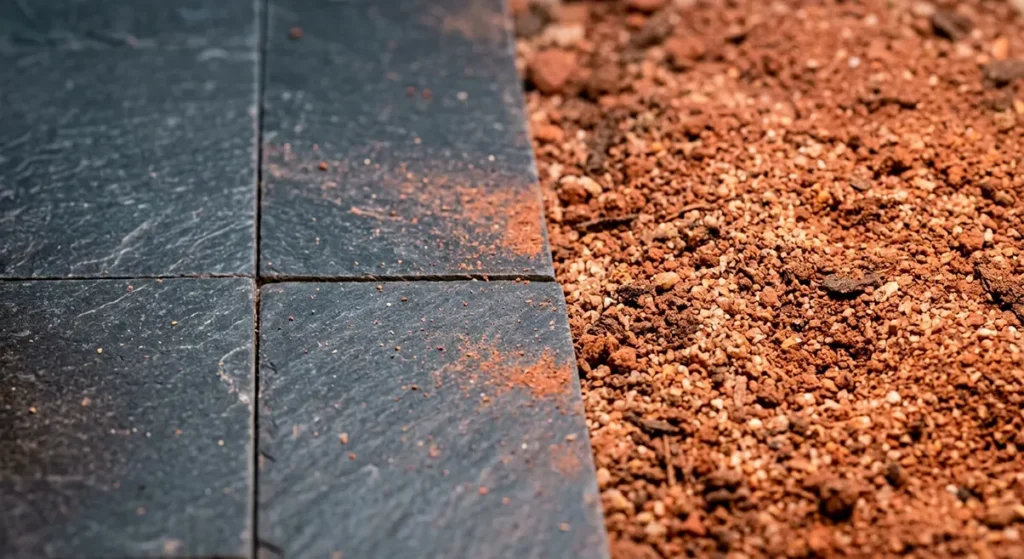
The hard rule is the age rule. Loose particulate substrate is off the table for hatchlings and juveniles. Young dragons lunge-feed, miss, and swallow whatever sits under the cricket, and their gut transit is not the adult machine. Keep non-particulate tile or paper until the dragon is reliably eating, growing, and passing normal waste as an adult, then consider a desert soil build only with temperatures already verified and calcium dialed in. That is the bearded dragon substrate tile vs bioactive decision in one sentence: tile is the safer default, bioactive is an advanced upgrade for a healthy adult in a dry, well-ventilated 4x2x2.
4. The hardware list and the 72 hour test
Before you shop, know that the dragon itself is usually the smallest line item in your first-year budget — morph selection can range from $40 for a normal to $1,000+ for rare combos. Our bearded dragon morph prices guide covers every tier and what you actually get for the money. Buy categories by their spec, not the brand on the box. Generic versions of every item exist; the parameters are what separate a working enclosure from a vet bill.
- 4x2x2 front-opening PVC enclosure: 48x24x24 interior, tight seams, cross-ventilation option, lamp-safe top or internal mounts .
- T5 HO fixture with reflector: roughly half to two thirds of 48 inches, rated for an Arcadia 12%/14% or ReptiSun 10.0 tube, with internal mounting hardware.
- Dimming or proportional thermostat for the daytime halogen and any DHP: continuous modulation, probe fixed to the basking surface. Basic on/off stats are too coarse for light-emitting heat.
- Deep heat projector, 50W to 80W depending on enclosure and room, on the dimming or proportional stat for lightless night warmth.
- Ceramic heat emitter as a budget night backup, on a pulse-proportional stat, in a socket rated above its wattage with a bulb guard.
- Infrared temp gun for surface readings on slate, hammock, and every reachable branch. Choosing and cross-checking measurement gear is covered here reptile equipment setup checklist.
- Dual-probe digital thermometer/hygrometer: one probe per end, with min/max memory so a night crash is on record by morning.
Run the complete system empty for 48 to 72 hours before the dragon comes home. Map the tank at the hours your climate is worst: 4 p.m. in a Southwest August, 3 a.m. in a Northeast January, noon in a Gulf Coast July. Log basking surface from the gun, both ambient probes, and humidity. Adjust wattage, distance, and venting until the five temperature numbers and the 30 to 40% humidity band hold at those extremes. A bearded dragon is not the test instrument. The tank gets tested first.
Frequently Asked Questions
What size enclosure does an adult bearded dragon need?
A 4x2x2 bearded dragon enclosure, 48 inches long, 24 inches deep, and 24 inches tall, about 120 gallons, is the adult minimum for a central bearded dragon (Pogona vitticeps). That length is required to hold a true hot-to-cool gradient. A 40 gallon breeder works only for juveniles. Choose a front-opening PVC or wood cabinet over a top-opening glass tank to reduce heat loss and predator-style approach stress.
What Ferguson zone and UVI does a bearded dragon need?
Bearded dragons fall in the Ferguson Zone 3 to 4 overlap for UVB. Target a UV index of 3.0 to 5.0 at the basking surface, measured at the dragon’s back height, with a gradient that fades toward the cool end. Peak UVI should never go above 7.0. A linear T5 HO tube with a reflector is the practical way to hit that range in a 4x2x2; verify readings with a Solarmeter 6.5 when possible.
How far should a T5 HO UVB bulb be from the basking spot?
For an Arcadia T5 HO 12% or Zoo Med ReptiSun 10.0 T5 HO, place the tube 12 to 18 inches from the basking surface with no screen between bulb and dragon, or 10 to 14 inches when the light passes through mesh. The Arcadia T5 HO 14% is for tall enclosures only, at 18 to 24 inches through dense mesh. Charts vary by reflector and bulb age, so always confirm with a Solarmeter 6.5 and the manufacturer’s current distance chart.
What temperature should a bearded dragon basking spot be?
Measure the surface, not the air, with an infrared temp gun. Adults need a basking surface of 100 to 108°F (38 to 42°C); juveniles under 12 months run hotter at 105 to 110°F (40 to 43°C). Hold warm side ambient air at 85 to 90°F and the cool side at 75 to 85°F, using a white-light halogen or incandescent flood on a dimming thermostat. Surface readings around 115°F and above risk overheating.
Do bearded dragons need heat at night?
During the active season, let the enclosure drop to 65 to 75°F (18 to 24°C). If a Northeast or Midwest winter room pulls the tank below 65°F overnight, add a deep heat projector or ceramic heat emitter on a thermostat; both emit no visible light. The active-season night drop is not the same protocol as brumation, which uses deliberately lower temperatures and a separate schedule.
Are red infrared night heat lamps safe for bearded dragons?
No. Bearded dragons have color vision that detects red wavelengths, so a red night bulb does not give them darkness; it disrupts the sleep cycle the way a dim light left on would for a human. Blue and purple night lamps have the same problem. Use only lightless nighttime heat, a DHP or CHE run through a thermostat, and keep the dark phase fully dark.
What humidity is correct, and how do I fix a tank on the Gulf Coast?
Hold 30 to 40% relative humidity. Readings sustained above 55% promote respiratory infection and CANV/nid fungal disease, the condition also called yellow fungus disease. In Florida, Texas, or Louisiana, dehumidify or air-condition the room, add cross-ventilation or a small extraction fan, move the water dish off the warm end, and dry or replace damp substrate. Bubbling nostrils, open-mouth breathing, or yellow-brown skin crusts warrant a reptile veterinarian; use the ARAV Find-A-Vet directory.
Should I use tile or bioactive substrate?
Tile is the default for new keepers, juveniles, and humid climates: it cannot be eaten, cleans in minutes, and radiates belly heat. Paper towels are correct for hatchlings, quarantine, and sick animals. A bioactive Australian desert soil blend suits only healthy adults with experienced keepers, a dry well-ventilated 4x2x2, and an established cleanup crew. Keep all loose substrate away from juveniles to prevent impaction.
Does a mesh screen top block UVB?
Yes. Standard enclosure mesh blocks roughly 30% to 50% of UVB output, and fine mesh blocks the most. Either mount the T5 HO fixture inside the enclosure or calculate the distance as a through-screen path (10 to 14 inches for a 12% or 10.0 tube) and verify with a Solarmeter 6.5. Glass and plastic block UVB almost entirely, so never put a glass or plastic panel between the bulb and the dragon.
This content is for educational purposes only and does not substitute professional veterinary diagnosis or treatment. If you observe any symptoms of illness, injury, or abnormal behavior, please consult a qualified exotic animal veterinarian immediately.
For more details, please review our full Medical Disclaimer.