
It usually starts the same way every September and October. You walk past the enclosure one evening and your bearded dragon, the same lizard that used to sprint to the glass the second you opened the cricket tub, is curled in the far corner of the hide. Eyes shut. Not basking. The salad bowl is full and untouched. You nudge the food dish. Nothing. You pick them up and they feel limp and cool, and for about ten awful seconds you are convinced they are dying.
If this sounds like your week, take a breath. What you are almost certainly looking at is bearded dragon brumation, the seasonal slowdown that most adult dragons drift into as the days shorten. It is normal, it is usually harmless in a healthy adult, and it is also the single thing that panics new keepers more than anything else in the first year of ownership. A bearded dragon not eating and sleeping through a chilly October afternoon is usually answering a seasonal cue, not a medical emergency.
Read the keeper forums every October, and this story appears over and over. Someone brings home their first dragon, an adult, and it does fine all summer, then mid-October the animal goes from charging the feeding tongs to lying in the back of its hide like a discarded sock. Four months into reptile keeping, the owner is completely convinced they have killed it.
The night that follows has a predictable script: 1 a.m., forum tabs stacked open, prodding the dragon, holding it up to the lamp, reading threads about impaction and parasites, one click away from an emergency-vet bill they cannot really afford—a financial reality rarely factored into initial species selection. What settles most of these people down is dumb and simple. They dig out a kitchen scale, weigh the dragon, write the number on an index card taped to the stand, and weigh again a week later. Four grams down. A few more two weeks after that. The animal is not crashing. It is sleeping.
Long-time keepers and reptile-savvy clinic staff tell some version of this story every autumn, and the index-card weight log is the part worth stealing. It gets its own emphasis later in this guide, because it is the one thing that reliably talks a panicking new keeper off the ledge.
Early brumation signs look nearly identical to some genuinely serious illnesses. A dragon sleeping a lot and turning down food might be entering a perfectly natural winter rest. It might also have parasites, a respiratory infection, or a husbandry problem that needs fixing today. Telling those two situations apart is the entire point of this guide.
This article walks through what brumation actually is, the staged signs to expect, the brumation vs illness bearded dragon decision table you can use tonight, the strict rule for baby dragons, and a week-by-week temperature, light, feeding, and hydration protocol. It also covers when to let your dragon sleep and when to pick up the phone and call a reptile vet.
What Brumation Actually Is
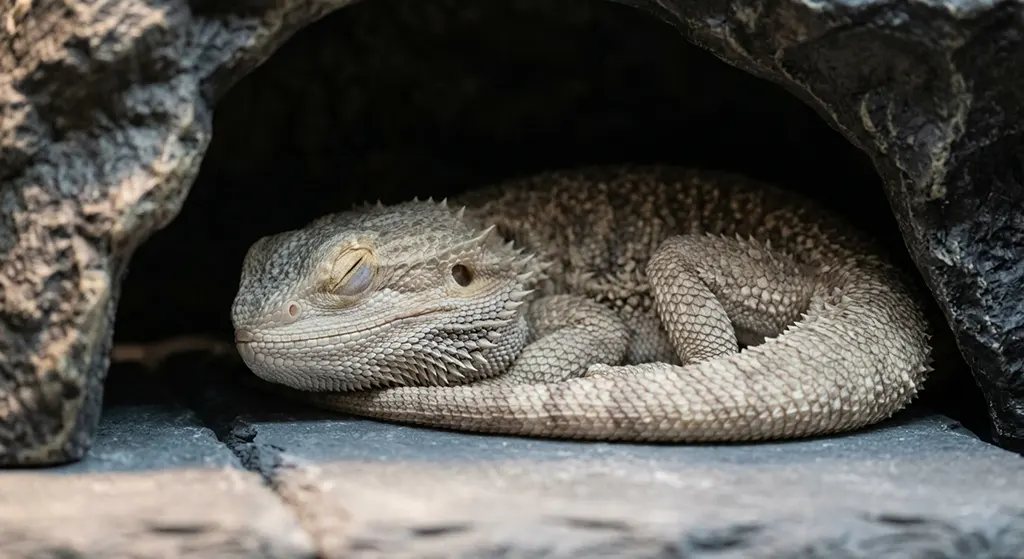
Brumation is the reptile version of hibernation, with a few important differences. The Merck Veterinary Manual has a full clinical overview of the physiology and common complications. Mammals that hibernate tend to sleep deeply and live off fat reserves. Brumating reptiles do something a little looser. Their metabolism, heart rate, and digestion slow dramatically, their body temperature drifts toward the coolest part of their environment, and they can sit still for days. But they are not unconscious. Most will shift position, occasionally open an eye, or rouse for a few hours every week or two to drink and then settle back down.
In the wild, central bearded dragons (Pogona vitticeps) retreat into burrows and rock crevices during the cooler, drier Australian winter, waiting out the stretch when food and water are scarce. That instinct survives intact in captivity. Even a captive-bred dragon born in a pet shop and raised under artificial lights can wind down in autumn, because the trigger is not some memory of the outback. It is the combination of falling temperature, shortening daylight (the photoperiod), and shifting barometric pressure around them.
A few points that new keepers consistently get wrong:
- Brumation is optional for a captive dragon. Plenty of healthy adults never brumate at all, especially when kept on stable, warm, long-day schedules year-round. Others brumate every single year like clockwork. Some sleep for two weeks, some for three or four months. Individual variation is enormous, and none of these patterns is, by itself, proof of a problem.
- You do not need to force or induce it. For a pet dragon you are not breeding, there is no reason to deliberately chill the tank. If the body wants to shut down, the seasonal cues are usually enough.
- It is not a disease. A healthy adult that brumates normally is doing exactly what its biology is wired to do. The danger is never brumation itself. The danger is a sick dragon being mistaken for a brumating one and left untreated for months.
The “Australian calendar” explanation is wrong. You will sometimes read that captive dragons follow it and go dormant in the Northern Hemisphere summer. That is not how this works. A dragon raised in a US living room has no way to sense Australian seasons. Captive brumation tracks the local cues around the enclosure, which for most American keepers means late autumn into winter. Summer dormancy in reptiles is a real phenomenon, but it is a different state called aestivation, triggered by extreme heat and drought rather than cold and short days. If your dragon is sluggish and hiding in the middle of July, do not call it brumation. Check for overheating, check the gradient, and treat it as a possible husbandry or health problem. The takeaway for both odd-timing situations is the same: the month on the calendar is never the deciding factor. Weight trend and hydration are.
The Five Stages of Brumation
Brumation does not arrive overnight. In a typical adult it unfolds gradually over two to four weeks, which is one of the things that distinguishes it from illness. Illness tends to crash in over hours or a couple of days; brumation creeps in. These are the bearded dragon brumation signs most keepers see, roughly in order.
Stage 1: The appetite fades. The first and most reliable signal is food. A dragon that normally attacks feeders starts to skip them. The greens sit longer before getting eaten. Insects get a look and a pass. This builds over days to a couple of weeks until they are barely eating or refusing outright. A dragon going into brumation is supposed to stop eating, because a slowed gut cannot process a meal. Resist the very common new-keeper reflex to force-feed at this point. Food trapped in a dormant digestive tract can rot and cause serious, sometimes fatal, problems.
Stage 2: Basking drops off and sleep climbs. They spend less time under the heat lamp and more time in the cool end or buried in the hide. They sleep later in the morning, nap longer in the afternoon, and the active window of the day shrinks. Many dragons dig or rearrange substrate at this point, hollowing out a sleeping spot.
Stage 3: They pick a spot and settle. The hide becomes headquarters. They may block the entrance with substrate, press into a back corner, or bury themselves almost completely. Coming out goes from a daily routine to an occasional event. Color often fades a little; a settling dragon tends to look paler or slightly greyer than usual, with a light, normal-colored beard. Note that a dark or black beard on a motionless dragon is not part of this pattern and points toward stress or pain.
Stage 4: Deep rest with brief stirrings. This is the long middle stretch. They may not move for days at a time, then rouse for an hour, shift to a different position, maybe take a little water, and go back down. These partial wakings are normal and do not mean brumation is over. Breathing is slow but present; watch the flank for thirty seconds and you will see gentle movement.
Stage 5: Waking up. As daylight and temperature climb back toward spring, the dragon emerges for longer stretches, opens its eyes and tracks movement, drifts back toward the basking spot, and eventually shows interest in food. Appetite usually returns over several days to a week rather than snapping back instantly.
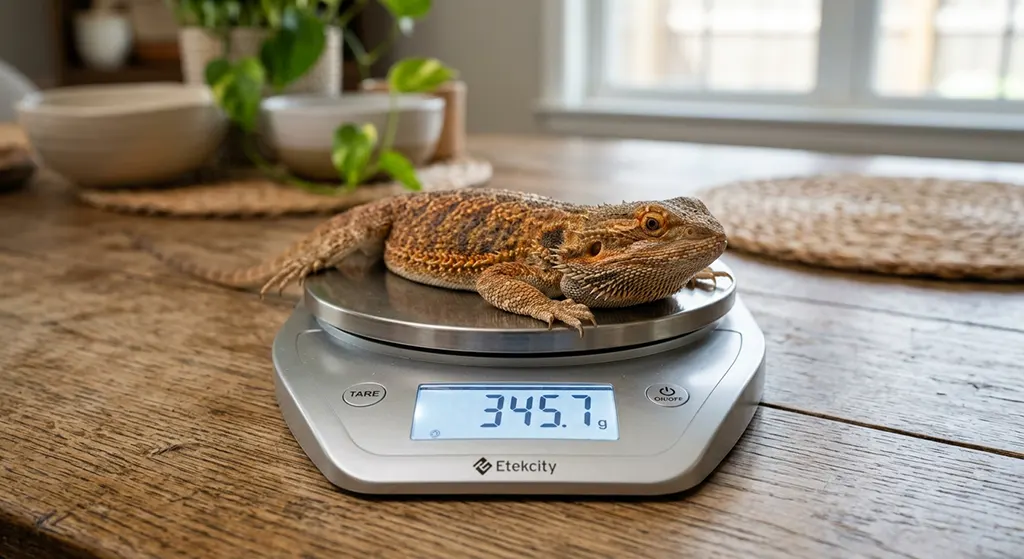
The single most important habit across all of these stages is one keepers love to skip: weighing. Before the dragon goes fully down, record a baseline weight in grams on a small digital scale. Then weigh every one to two weeks through the whole brumation period and write the numbers down.
That weight trend is your golden diagnostic. A healthy brumating adult loses a small, steady amount as it burns stored energy, generally between 5% and 10% of its pre-brumation body weight over the entire rest period. A 480-gram dragon drifting down to around 455 grams over a few months is doing fine. The hard line is 10%. Published metabolic studies on bearded dragon brumation, available through PubMed , generally support this range for healthy adults. If total weight loss crosses 10% of baseline, or if the loss is rapid rather than gradual, that is no longer consistent with normal brumation. Stop waiting and get the dragon to a reptile vet, because parasites, dehydration, or an underlying illness are now on the table.
Brumation vs Illness: How to Tell the Difference
Behavior alone is never enough to make the call. Lethargy, food refusal, and long sleep are the shared symptoms of brumation and of several serious conditions, including internal parasites (coccidia, pinworms, and especially cryptosporidium), respiratory infection, mouth rot, impaction, and metabolic bone disease. The difference is in the details and, above all, in the body condition trend.
Run through this table any time you are unsure. The more rows that land in the illness column, the faster you should be on the phone.
| What You Are Seeing | Normal Brumation | Illness (See a Vet) |
|---|---|---|
| Timing | Late autumn to winter, gradual onset over 2 to 4 weeks | Any season, or sudden onset over hours to a couple of days |
| Age | Almost always an adult, roughly 12 months or older | Any age; under 12 months is never normal |
| Responsiveness | Slow, but wakes when gently handled; may open an eye or shift | Unresponsive, limp, or distressed; will not rouse |
| Appetite | Refuses food on purpose as part of the wind-down | Refuses food along with other symptoms or sudden weight loss |
| Weight | Small, steady loss of 5 to 10% over the whole period | Loss exceeding 10%, or fast loss; visible thinning over the spine and hips |
| Eyes | Closed but clear; open when disturbed | Sunken, dull, half-open, glassy, or crusted with discharge |
| Beard and color | Normal or slightly pale | Sustained black or very dark beard on a lethargic dragon |
| Breathing | Slow but steady and silent | Open-mouth breathing, wheezing, clicking, bubbles or mucus |
| Nostrils and mouth | Clean and dry | Mucus, discharge, swelling, or cheese-like material in the mouth |
| Droppings | Rare or absent; when present, normal-looking | Bloody, watery, foul-smelling, or containing undigested material |
| Skin and body | Normal tone, no swellings | Wrinkled, tenting skin, visible swelling, soft or bowed limbs, tremors |
| Posture | Relaxed, pliable, shifts occasionally | Twisted, tense, unusually flaccid, or unable to lift the head |
A handful of quick tests sit on top of that table.
The handling test. Gently pick the dragon up and hold it in your warm hands for thirty to sixty seconds. A brumating dragon almost always responds in some small way: a slow shift, a slight tightening of the grip, an eye that opens partway. Even deep in dormancy the body keeps a little muscle tone, so the limbs give gently when moved rather than flopping freely. A dragon that shows zero response to a full minute of warm handling, or one that feels completely limp with no resistance at all, is an emergency, not a deep sleeper. (True post-death stiffness, rigor mortis, sets in within hours and is a rigid lock rather than a soft give, but do not run that experiment at home. No response means call a vet.)
The breathing check. Watch the chest and throat for a full thirty seconds. Slow, quiet, even movement is brumation. Open-mouth breathing, gaping with no obvious overheating cause, wheezing, clicking, or any bubble of fluid at the nostrils is a respiratory infection until proven otherwise and needs urgent care.
The dehydration check. Two home signs matter most. Sunken or dull eyes that sit slightly recessed, and a skin tent test: gently pinch the skin along the flank between the front and back leg, then let go. Hydrated skin snaps back immediately. Skin that stays tented for a second or two before flattening means dehydration. We cover hydration in detail below, because it is the one thing you actively manage while the dragon sleeps. If eyes stay shut or develop discharge, that is not brumation — see our bearded dragon eye issues guide.
The gut-feeling check. Experienced keepers learn their dragon’s baseline. If something feels off that you cannot put into words, that is worth a phone call. A short conversation with a reptile-savvy practice is cheap, and they would far rather talk you through a false alarm than see a dragon that waited weeks too long.
The single clearest differentiator that every reliable source agrees on: a brumating dragon maintains weight and body condition, while a sick dragon deteriorates. That is why the scale matters more than any symptom list. If weight is stable or drifting gently down within that 5 to 10% band and the physical exam is clean, let them sleep. If weight is falling past 10% or any illness-row symptom appears, the season does not matter.
One thing worth doing before dormancy, ideally in late summer or early autumn, is a wellness visit and a fecal parasite test with a reptile vet. A parasite load that causes no symptoms during active months can explode during the immune-slow brumation window, and a dragon sleeping off a heavy burden loses weight steadily rather than waking up well in spring. To find a qualified practice, use the ARAV Find-A-Vet directory; the Association of Reptilian and Amphibian Veterinarians lists vets who have specifically committed to reptile and amphibian medicine, which is a far better bet than a general dog-and-cat clinic. If you are trying to tell two species apart, note that the smaller Rankin’s dragon (Pogona henrylawsoni) brumates along broadly similar lines, though care details differ; Rankin’s dragon vs central bearded dragon comparison covers how to tell the species apart and where their care diverges.
Baby Bearded Dragon Brumation: The Hard Rule
This is the section to read twice if your dragon is young. Bearded dragons under about 12 months old should not brumate, and you should actively prevent it if one tries.
The reason is reserves. Brumation is a months-long fast funded by stored fat and calcium. An adult that has finished growing can carry enough of a buffer to live off its own stores through winter. A baby or juvenile is still in its fastest growth phase. Young dragons are built to eat constantly; they put nearly every meal into bone, muscle, and length and carry very little in the way of spare fat. A juvenile that shuts down and stops eating for weeks does not have the reserves to do it safely. The two biggest risks are severe malnutrition and metabolic bone disease (MBD), because the calcium and UVB-driven vitamin D3 cycle that builds a young dragon’s skeleton runs on a steady intake that brumation switches off. Bowed limbs, rubbery jaws, tremors, and stunted growth are all possible outcomes, and some of the damage is permanent.
So if a dragon under a year old starts showing brumation-like signs (lots of sleep, refusing food, hiding), do not read it as a cute early first winter. Treat it as a problem until a vet says otherwise. The most common causes are actually husbandry, not instinct:
- Temperatures too low, so the baby cannot thermoregulate or digest
- A UVB bulb that is old, too weak, or too far away (UVB tubes should be replaced on schedule, usually every 6 to 12 months depending on type, even if they still light up)
- An enclosure that is too small to hold a proper hot-to-cool gradient
- Stress from cohabitation, a new home, or harassment from feeders left in overnight
- Genuine illness, especially parasites
Note: If your baby dragon has already stopped eating and you’re not sure whether it’s brumation or something else, this baby bearded dragon not eating guide walks through the day-by-day breakdown and when to panic vs. when to wait.
What to do instead of letting a juvenile sleep: keep the basking temperatures and photoperiod at normal active-season levels rather than dropping them, offer small, frequent, well-dusted feeders and fresh greens, double-check the temperatures with a reliable thermometer and confirm the UVB output, and book an appointment with a reptile vet if the lethargy and appetite loss run more than a day or two. For the younger age groups especially, err on the side of the vet visit. A baby can decline fast, and it has almost no margin. If the complex seasonal care and strict juvenile monitoring of bearded dragons feel overwhelming, explore our blue-tongued skink selection guide for new keepers to evaluate easier beginner reptile options.
The Brumation Care Protocol: Temperature, Light, Food, and Water
If your dragon is a healthy adult over 12 months, at a good weight, and showing a clean gradual wind-down in autumn, you can let the cycle run. Your job shifts from feeding and entertaining to monitoring and protecting. Below is the conservative, keeper-friendly protocol, which deliberately keeps conditions a little warmer and brighter than the deepest-cool method some breeders use. For a pet dragon that is not being bred, the gentle approach is safer and easier to get right.
Temperature and Lighting: Cool It Down, Never Off
The single biggest mistake new keepers make is swinging from full summer conditions to a cold, dark tank overnight. The second biggest is going fully dark and fully cold in the name of “real winter.” Do not do either. You reduce heat and light gradually, and you never remove them completely. The correct bearded dragon brumation temperature sits in a mild, deliberately gentle band rather than at anything close to a true winter chill.
Target conditions during the brumation period:
- Daytime ambient temperature: ease down to roughly 70 to 75°F on the warm side, with the cool end naturally lower.
- Nighttime temperature: allow a drop to roughly 65 to 68°F.
- Photoperiod (lights-on hours): shorten gradually from the active-season 12 to 14 hours down to about 8 to 10 hours of light per day.
- Never eliminate heat and light entirely. Keep a gentle light cycle and a safe minimum warmth so the dragon never experiences a dangerous chill. A lightless heat source, such as a ceramic heat emitter on a thermostat, can hold the night floor if the room gets cold.
Why keep the lights on at all? A total blackout is not required for dormancy, and a little daily light maintains the body’s basic rhythm and the seasonal signal telling the dragon what time of year it is. Going completely dark and cold also removes your margin for error if the room temperature plummets or a piece of equipment fails mid-winter.
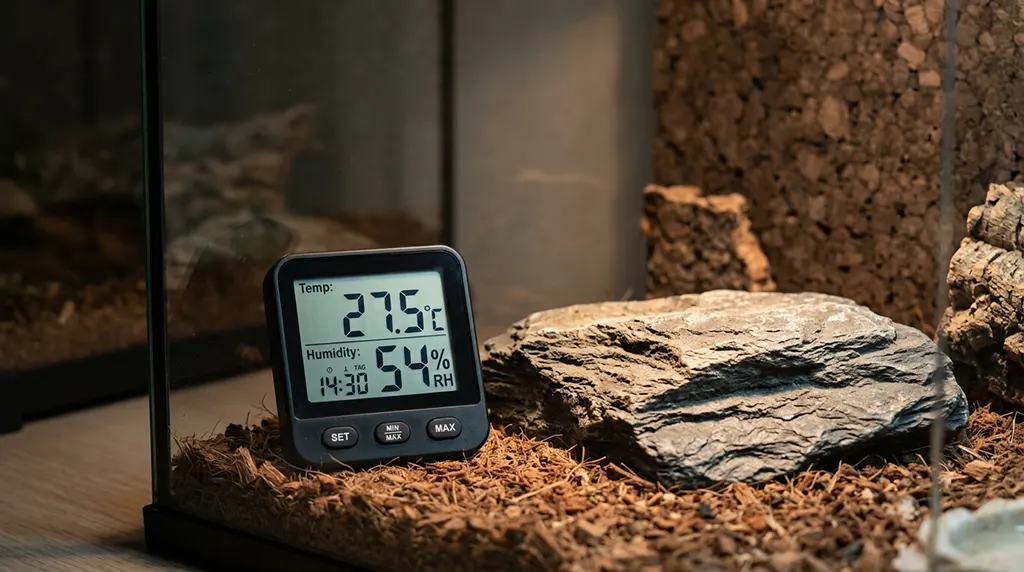
Measure, do not guess. A cheap analog stick-on dial is not good enough for decisions this important. Use a reliable digital thermometer and hygrometer combo (or a temp gun for surface readings) to check both the warm and cool ends and the humidity, which you want to keep around 30 to 40%; brumating dragons are more prone to respiratory trouble in damp, stagnant air. A plug-in light timer makes the shortened photoperiod automatic so you do not have to remember it every evening.
reptile equipment checklist walks through choosing and placing temperature gauges if you are setting this up for the first time.
Feeding: Stop on Purpose, and Clear the Gut
Food during brumation is the one input you actively remove. Once a healthy adult has clearly wound down and is sleeping in earnest, stop offering food. The gut has to be empty before deep rest, because a digestive system running at brumation speed cannot move a meal through. Undigested food sitting in a cooled dragon can spoil and lead to impaction or systemic infection.
Most dragons handle the gut-clear themselves. Appetite disappears first, then they wait for a final bowel movement before settling in for real. You can support that sequence:
- As appetite drops, taper off insects first; greens digest faster and can be offered briefly at the start of the wind-down.
- Give a warm soak to help stimulate that last bowel movement before they fully settle.
- Wait for the final dropping before you drop the light and heat schedule to brumation levels.
- Remove every live feeder from the enclosure. Never leave crickets or dubia in with a sleeping dragon. Hungry feeders will bite an immobile lizard, and a dragon that cannot move cannot defend itself.
- Do not try to wake a sleeping dragon to feed it. If your dragon rouses on its own, comes out alert, and actively begs for food, offering a small meal is fine; the rule is never to tempt or force a fully dormant animal.
After brumation ends, bring food back slowly. Offer water first, then a light first meal once they are alert and basking normally, and expect appetite to build over several days.
If you keep other species through the same seasonal shift, the logic of matching food to activity level applies there too; seasonal leopard gecko feeding guide covers how leopard gecko feeding changes with the seasons.
Hydration: No Food, but Never No Water
This is where keepers most often cause harm by doing too little. A brumating dragon eats nothing, but it still loses moisture, and dehydration is the most common manageable problem of the dormancy months.
- Keep a shallow water dish in the enclosure at all times, refreshed regularly. Most sleeping dragons will not drink from it, but when they rouse for one of those brief wake-ups, water needs to be right there.
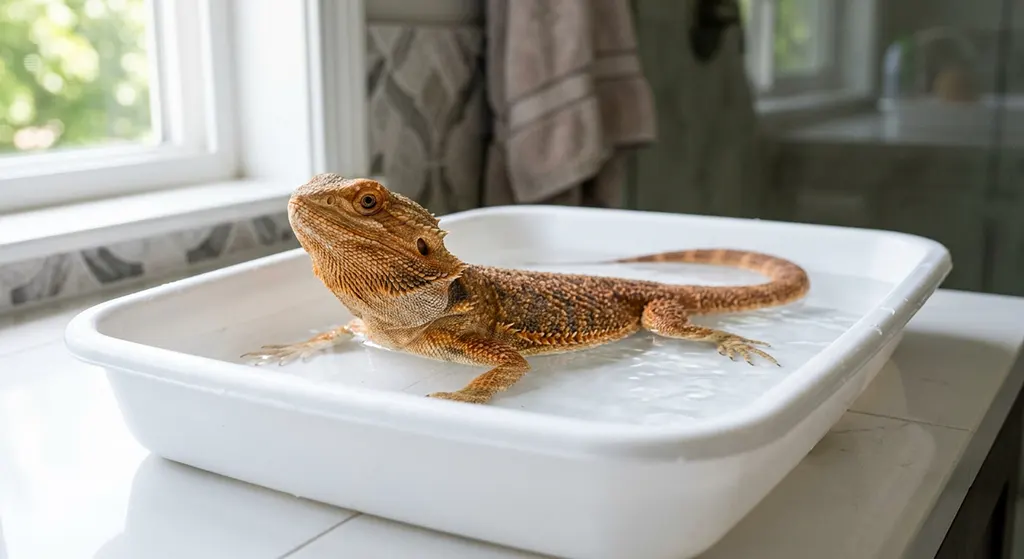
- Give a warm soak every 1 to 2 weeks. Use lukewarm water around 80 to 85°F (27 to 29°C), shallow enough that it reaches about the elbows or shoulders and never over the head, for roughly 5 to 10 minutes. This is deliberately cooler than the roughly 85 to 100°F water used for an active-season bath; a slow-reacting, dormant lizard cannot move away if the water runs too warm, so err on the cooler side until it is fully awake. Stay with the dragon the entire time; a deeply sleepy lizard in water is a drowning risk, so short and supervised beats long and unattended. Most dragons will sip bath water even when they ignore their standing dish, and the warmth also stimulates the gut, so the hydration benefit is real even for a lizard that seems to just sit there. A dedicated shallow soak tub makes this clean and easy.
- Pat them dry and return them to a warm enclosure afterward so they do not chill.
Watch the dehydration signals every time you check on them: sunken or recessed eyes, and skin that tents and stays raised when pinched instead of snapping back. Loose, wrinkly skin along the flanks is a later sign. If you see any of these, soak more frequently and, if they do not improve quickly, call a reptile vet rather than assuming it is normal brumation.
A Week-by-Week Plan
For keepers who want a checklist rather than principles, here is the practical timeline.
Late summer to early autumn (prep): Schedule a wellness exam and fecal test if you have not recently. Confirm the dragon is a healthy adult at a good weight. Buy or locate a digital scale, a thermometer/hygrometer, and a light timer. Record a baseline weight.
Weeks 1 to 2 of the wind-down: As appetite fades, taper insects and let the gut clear. Offer a warm soak to encourage the last bowel movement. Begin shortening the photoperiod by roughly 30 to 60 minutes every few days, stepping down from 12 to 14 hours toward 8 to 10. Ease the daytime temperature down toward the 70 to 75°F range. Remove live feeders once eating has stopped.
Deep brumation (the long stretch): Hold lights at 8 to 10 hours and temperatures at roughly 70 to 75°F daytime and 65 to 68°F nighttime, never going fully dark or fully cold. Keep the shallow water dish in place. Soak every 1 to 2 weeks in lukewarm water for 5 to 10 minutes, supervised. Weigh every 1 to 2 weeks and log it. Do quick visual welfare checks every few days: confirm breathing, confirm they have not toppled into a bad position, and scan for discharge, swelling, or a black beard. Keep handling to those brief checks; do not disturb or try to wake them.
Waking up (late winter to spring): As the dragon begins emerging on its own, lengthen the photoperiod back toward 12 to 14 hours and restore normal basking temperatures over several days. Offer fresh water immediately and a warm soak on day one or two. Offer a small first meal once they are alert and basking, then rebuild feeding gradually as appetite returns over the next week. Do a final weight check and compare it to baseline.
Regional Timing Across the US
When your dragon starts winding down depends heavily on where you live, because the seasonal cues are local.
In the Northeast and upper Midwest, autumn arrives fast. Daylight collapses through September and October, indoor heating has usually not kicked in yet during the cool evenings, and room temperatures can dip early. Dragons in New England, the Great Lakes region, and similar cold-winter climates often begin showing bearded dragon sleeping a lot signs as early as late September or October, and the brumation stretch can run long. The risk here is an unexpectedly cold room in that shoulder season before the heat comes on, so keep an eye on nighttime temps and add a thermostatted heat source if the room falls below the safe floor.
In the South and Southwest, including Arizona, Texas, Florida, and southern California, the warm weather hangs on. Daylight still shortens, but ambient temperatures stay mild well into November or December, so the trigger is delayed and often milder. Dragons in Phoenix or Houston may not wind down until late autumn or even early winter, and some barely slow at all. The southern wrinkle is the opposite hazard: a late-summer or early-fall heatwave can push an enclosure too hot and produce summer sluggishness that is really heat stress or aestivation behavior, not brumation. Make sure the cool end stays cool and the gradient still works during warm spells.
The broad lesson is the same everywhere. Watch your dragon and your actual enclosure readings rather than the date on a calendar. Northern keepers should be ready early; southern keepers should stay alert to both a late start and the risk of overheating. A solid hide on the cool side, good temperature monitoring, and a steady water supply cover both situations. If you’re not sure your active-season hardware is properly calibrated for where you live — from Southwest heat management to Northeast night heating to Gulf Coast humidity fixes — our US regional bearded dragon tank setup guide walks through every climate zone.
When Brumation Ends, and When It Should Not
Most brumation runs a few weeks to around three or four months. You do not need to force an ending; as the days lengthen and warm up, healthy dragons wake themselves. Signs of natural emergence include spending more time out of the hide, open and alert eyes that track movement, voluntary trips to the basking spot, and renewed curiosity about the room. When that happens, support the ramp-up described above rather than dumping them straight back into a full feeding schedule.
What about a dragon that sleeps longer than expected? A small number of healthy adults brumate for four months or occasionally longer. Duration alone is not automatically a problem if weight is stable, the dragon rouses normally when checked, hydration looks good, and there are no physical symptoms. But past roughly four months it is worth a check-in with a reptile vet to confirm everything is fine, especially if it is a first brumation or much longer than the dragon’s usual pattern.
Red Flags That Mean Call a Vet Now
Some signs are not part of brumation at any stage. If you see any of the following, stop monitoring and seek care from a reptile or exotic specialist; the ARAV Find-A-Vet directory is the fastest way to locate one, and board-certified zoological medicine specialists and university teaching hospitals are also strong options for serious cases. For a quick reference on normal vs. concerning brumation signs, the VCA Hospitals brumation guide is a solid owner-level overview from a reputable hospital network.
- Weight loss beyond 10% of the pre-brumation baseline, or any rapid drop, which can point to parasites or internal disease
- Open-mouth breathing, gaping, wheezing, or clicking, which are classic signs of a respiratory infection that can progress to pneumonia
- Mucus, bubbles, or discharge from the nose, mouth, or eyes
- Sunken, dull, or unresponsive eyes, or a dragon that will not rouse even when held and warmed
- A sustained black or dark beard on a lethargic dragon
- Bloody, watery, or foul-smelling droppings, or no stool for more than a couple of weeks alongside other symptoms
- Visible swelling, soft or deformed limbs, tremors, or an inability to lift the head (possible MBD or neurological disease)
- A dragon under 12 months old showing brumation-like behavior
- Zero response to gentle handling and warming, or any sudden collapse
For a fast crash, sudden unresponsiveness, or obvious breathing distress, treat it as an emergency and call an exotic emergency clinic the same day rather than waiting for a routine appointment. When you call, give them the baseline weight, the current weight, the enclosure temperatures, and when the behavior changed; those few numbers help a reptile vet sort brumation from illness on the spot.
Frequently Asked Questions
How long does bearded dragon brumation last?
Most adult bearded dragons brumate for a few weeks to around three or four months, with some healthy individuals going slightly longer. The duration varies a lot by individual, age, and local climate. Length by itself is not the key number. Weight and condition are. If your dragon stays within the 5 to 10% weight-loss band, rouses normally when checked, and shows no discharge or breathing problems, a long sleep is usually fine. Past roughly four months, or if anything looks off, a check-in with a reptile vet is sensible.
Is my bearded dragon brumating or sick?
A brumating dragon is a healthy adult in autumn or winter that slows down gradually over two to four weeks, still responds when gently handled, has clean eyes, nose, and mouth, and maintains weight within about a 10% loss. A sick dragon can crash suddenly, fail to rouse, lose weight fast, show open-mouth breathing or discharge, have sunken eyes or a black beard, or be under a year old. The most reliable test is the scale: brumating dragons hold their condition while sick dragons deteriorate. When in doubt, weigh the dragon and call a reptile vet.
Should I feed my bearded dragon during brumation?
No. Once a healthy adult has wound down and is sleeping in earnest, stop offering food. A brumating dragon’s digestion nearly stops, and undigested food can rot in the gut and cause serious or fatal impaction. Let the gut clear before deep rest, remove all live feeders from the tank, and never force or tempt a fully dormant dragon to eat. If your dragon wakes on its own, comes out fully alert, and actively begs, a small meal is fine. Water, however, must always be available.
Do baby bearded dragons brumate?
Bearded dragons under about 12 months old should not be allowed to brumate. Juveniles are still growing fast and lack the fat and calcium reserves to survive a long fast safely, so shutting down can lead to severe malnutrition and metabolic bone disease. If a young dragon becomes very sleepy and stops eating, treat it as a warning sign. Check temperatures and UVB, keep the enclosure at normal active-season conditions, offer small frequent meals, and contact a reptile vet promptly rather than assuming it is a normal first winter.
What temperature should a bearded dragon be at during brumation?
During brumation, keep the daytime ambient temperature around 70 to 75°F and allow nighttime to drop to roughly 65 to 68°F, while shortening the light cycle from 12 to 14 hours down to about 8 to 10 hours. Lower heat and light gradually over a couple of weeks rather than all at once, and never remove heat and light completely; maintain a safe minimum warmth and a daily light period, with a thermostatted lightless heat source for cold rooms. Always verify temperatures with a reliable digital thermometer.
Why is my bearded dragon sleeping so much and not eating?
In late autumn or winter, a healthy adult dragon that gradually sleeps more, basks less, and refuses food is most likely entering brumation, which is normal. The same behavior in summer, in a young dragon, or appearing suddenly can instead mean temperatures too low, a failing UVB bulb, dehydration, parasites, or a respiratory infection. Check the season, the age, the enclosure temperatures, and above all the weight trend. Stable weight and clean physical signs point to brumation; weight loss or red-flag symptoms point to a vet visit.
Do I turn the heat and lights completely off during brumation?
No. You reduce both gradually, you do not eliminate them. Shorten daylight to about 8 to 10 hours and ease temperatures down to the 70 to 75°F daytime range, but keep a daily light period and a safe warmth floor so the dragon never experiences a dangerous chill. A plug-in timer and a thermostatted heat source make this easy and protect you if room temperatures drop unexpectedly.
How do I keep my brumating bearded dragon hydrated?
Leave a shallow fresh water dish in the enclosure at all times, and give a supervised warm soak every 1 to 2 weeks using lukewarm water around 80 to 85°F (27 to 29°C), shallow enough to reach the elbows, for about 5 to 10 minutes. Most dragons will sip water during a soak even when they ignore their dish, and the warmth stimulates the gut, which is where the hydration benefit comes from. Watch for sunken eyes and skin that tents when pinched, which signal dehydration. If those signs appear and do not improve with soaking, contact a reptile vet.
How much weight loss is normal during brumation?
A healthy adult typically loses between 5% and 10% of its pre-brumation body weight over the whole rest period, drawn from stored energy. Record a baseline weight before the dragon settles and then weigh every 1 to 2 weeks. Loss beyond 10% of baseline, or any rapid decline, is outside normal brumation and warrants an immediate vet visit to rule out parasites, dehydration, or other illness, regardless of the time of year.
When should I wake my bearded dragon or take it to the vet?
You generally do not force a dragon to wake; healthy adults rouse on their own as daylight and warmth return. Seek veterinary care instead of waiting if weight loss passes 10%, the dragon shows open-mouth breathing or discharge, will not respond to gentle handling, has sunken eyes or a sustained black beard, produces bloody or watery droppings, or is under 12 months old. A sudden collapse or obvious breathing distress is an emergency; use the ARAV Find-A-Vet directory to reach a reptile specialist quickly.
This content is for educational purposes only and does not substitute professional veterinary diagnosis or treatment. If you observe any symptoms of illness, injury, or abnormal behavior, please consult a qualified exotic animal veterinarian immediately.
For more details, please review our full Medical Disclaimer.