
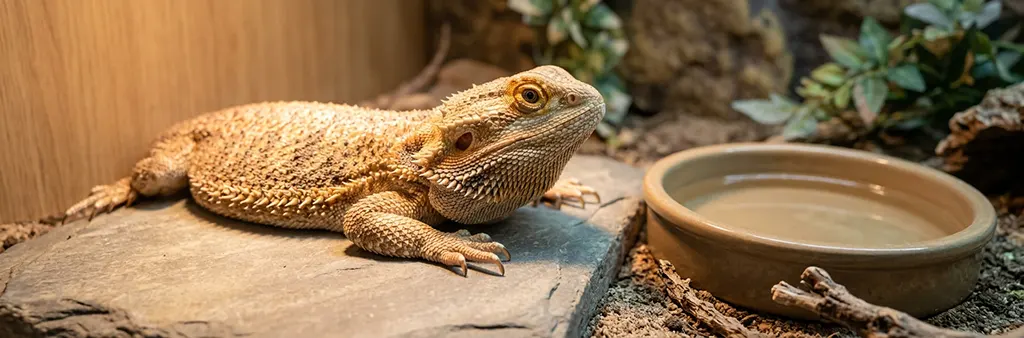
You walk past your bearded dragon’s enclosure and your stomach drops: your dragon is sitting there with both eyes squeezed shut — or worse, just one eye closed while the other looks fine. If you’ve found yourself frantically searching “bearded dragon won’t open eyes” at midnight, take a breath. You’re in the right place.
Here’s the reassuring truth upfront: closed eyes in bearded dragons are one of the most common concerns owners report, and the cause ranges from completely harmless (normal brumation behavior, a bit of loose substrate, an incoming shed) to genuinely urgent (infection, Vitamin A deficiency, injury). The challenge is telling the difference — and that’s exactly what this guide will walk you through, step by step.
By the end of this article, you’ll know how to distinguish healthy brumation from illness, how to safely examine and rinse your dragon’s eyes at home, which environmental mistakes (especially lighting) cause eye problems in the first place, and precisely when it’s time to book an appointment with a reptile veterinarian.
Quick disclaimer: This guide is educational and based on widely accepted reptile husbandry and veterinary guidance. It is not a substitute for an examination by a qualified veterinarian. For anything beyond minor, clearly explainable eye closure, consult a vet — ideally a member of the Association of Reptile and Amphibian Veterinarians (ARAV), whose ARAV member directory can help you find a reptile-experienced vet near you.
First Things First: Why Do Bearded Dragons Close Their Eyes?
Before we dive into diagnosis, it helps to understand the full menu of possibilities. A bearded dragon keeping its eyes closed generally falls into one of these categories:
- Brumation or pre-brumation behavior — normal seasonal slowdown
- Environmental irritation — loose substrate, dust, low humidity, or stuck shed around the eyelids
- Lighting problems — damage from improper UVB bulbs (photo-keratoconjunctivitis)
- Eye infection — bacterial or fungal conjunctivitis
- Vitamin A deficiency (hypovitaminosis A) — affecting the glands and tissues around the eye
- Physical injury — scratches from cage mates, feeder insects, or sharp décor
- Systemic illness — parasites, respiratory infection, or other disease causing lethargy and eye closure
Notice something? Only one of those seven is harmless. That’s why the “wait and see” approach needs structure. Let’s start with the most common benign explanation — brumation — because it’s also the one most often confused with illness.
Brumation vs. Illness: The Core Difference Every Owner Must Understand
What Is Brumation, Exactly?
Brumation is the reptile equivalent of hibernation — a seasonal period of dormancy that most adult bearded dragons (typically over a year old) enter during the cooler months, often starting in autumn or winter even in heated indoor environments. For the full week-by-week protocol and signs timeline, see our complete bearded dragon brumation guide. Triggered by changes in daylight length, temperature, and internal biological rhythms, a brumating dragon will:
- Sleep for long stretches, sometimes days or weeks
- Hide in a corner, burrow, or retreat to a cool, dark spot
- Refuse food or eat very little
- Keep its eyes closed most of the time — yes, this is normal
- Show little interest in interaction
The key phrase is “eyes stuck shut during brumation is common.” Many brumating dragons keep their eyes closed for the majority of the day, opening them only briefly when disturbed or handled. The eyes themselves look healthy: no swelling, no discharge, no crusting, symmetrical.
The Golden Rule: Weight Tells the Truth
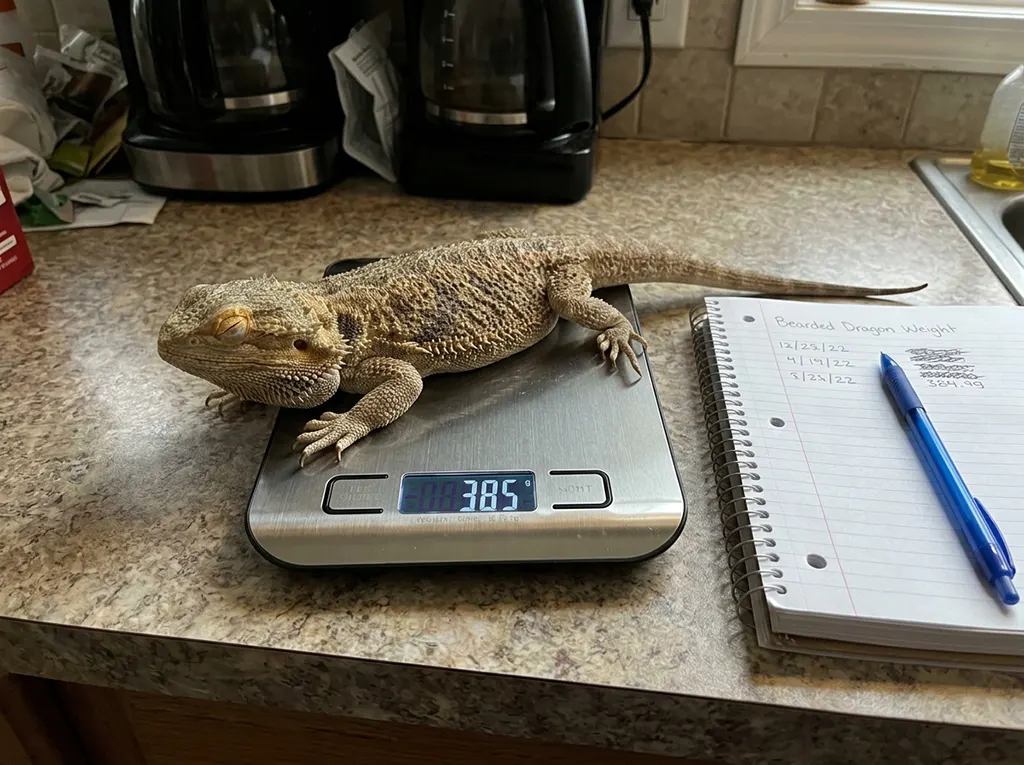
If you remember only one diagnostic tool from this entire article, make it this one: a kitchen scale.
During healthy brumation, a bearded dragon’s metabolism slows dramatically. Because it isn’t burning much energy, weight remains relatively stable — a healthy brumating dragon loses little to no weight over weeks of dormancy.
Illness is the opposite. A sick dragon — whether from parasites, infection, or organ disease — typically shows measurable, progressive weight loss, often accompanied by visible muscle wasting along the tail base and hips (the fat pads on the head may also appear sunken).
If you have a baby dragon under a year old that’s lethargic, closed-eyed, and not eating, weight loss is especially urgent — our baby bearded dragon not eating troubleshooting guide walks through the most common causes for juveniles.
Action step: Weigh your dragon weekly during any period of lethargy and record the numbers. Stable weight + closed eyes + seasonal timing strongly suggests brumation. Dropping weight + closed eyes = call the vet.
Brumation vs. Illness: Side-by-Side Comparison
| Sign | Healthy Brumation | Likely Illness |
|---|---|---|
| Weight | Stable over weeks | Progressive loss |
| Eyes when opened | Clear, bright, normal | Swollen, cloudy, sunken, or crusted |
| Discharge | None | Mucus, pus, or crusty buildup |
| Symmetry | Both eyes look identical | One eye swollen or held shut asymmetrically |
| Body condition | Full tail base, plump fat pads | Thinning tail, sunken fat pads |
| Responsiveness | Wakes when handled, opens eyes briefly | Unresponsive or extremely weak even when disturbed |
| Appetite pattern | Gradual decrease, then refusal | Sudden refusal plus other symptoms |
| Breathing | Normal | Open-mouth breathing, wheezing, mucus around nose/mouth |
| Droppings | Infrequent but normal-looking | Diarrhea, foul smell, or no droppings despite eating |
| Timing | Autumn/winter onset, gradual | Any time of year, often sudden |
One Critical Warning About Brumation
Brumation is normal — but only healthy, well-nourished adult dragons should brumate. Juveniles (under ~12 months), underweight dragons, or dragons with known health issues should not be allowed to slip into deep dormancy without veterinary input, because brumation can mask or worsen underlying disease. If a young or thin dragon is shutting down with closed eyes, treat it as a potential illness, not brumation, until a vet says otherwise. Buying from a reputable breeder with health documentation matters from day one — our bearded dragon morph prices and buyer guide covers what to look for and what different quality levels cost.
Also worth knowing: many reptile vets recommend a fecal parasite check before brumation season. Parasite loads can explode while a dragon’s immune system is idling, turning “normal brumation” into a medical emergency by spring.
Bearded Dragon Eye Problems: A Diagnostic Breakdown
If the brumation box isn’t checked — wrong season, wrong body condition, or something just looks off about the eye itself — it’s time to work through the medical causes. Here are the big ones, from most to least common.
1. Eye Infections (Conjunctivitis and Beyond)
Eye infections are among the most frequent genuine medical causes of a bearded dragon’s closed eyes. They typically develop after minor trauma (a scratch, a bit of substrate) lets bacteria or fungi in, or secondary to poor habitat hygiene.
Symptoms to look for:
- Swollen eyelids — one or both eyes look puffy, sometimes dramatically so
- Discharge — clear fluid in early stages; cloudy, yellow, or greenish mucus/pus as infection progresses
- Crusting — dried discharge gluing the eyelids together, especially after sleep
- Redness or visible inflammation of the conjunctiva (the tissue around the eye)
- Rubbing behavior — the dragon scratches at its face against décor or the floor
- Keeping one eye closed while the other stays open is a classic early sign — a very common search query, “why is my bearded dragon keeping one eye closed,” often lands here
What NOT to do: Do not use human eye drops, antibiotic ointments, or leftover medications from other pets. Reptile eyes are different, and the wrong medication can make things worse. A reptile vet will typically prescribe a reptile-appropriate topical antibiotic after examining the eye — and severe cases can progress to retrobulbar abscesses (infection behind the eye), which require professional drainage and systemic treatment.
2. Vitamin A Deficiency (Hypovitaminosis A)
This is the cause most owners have never heard of — and one of the most important. Vitamin A is essential for maintaining the epithelial tissues of the eye and its associated glands. When a bearded dragon’s diet is chronically low in Vitamin A, those tissues undergo changes (veterinarians call it squamous metaplasia) that cause the tear ducts and glands around the eye to swell and malfunction. The Merck Veterinary Manual reptile husbandry reference covers Vitamin A nutrition and other key husbandry factors in clinical detail.
Classic signs of bearded dragon vitamin A deficiency eyes:
- Swollen eyelids, often both eyes symmetrically
- Eyes held shut or partially shut for long periods
- A thickened, white or yellowish discharge
- Frequent, recurring “eye infections” that don’t fully resolve
- Sometimes accompanied by other deficiency signs: lethargy, poor appetite, respiratory issues
Diets at risk: Dragons fed mostly on a narrow rotation of low-Vitamin-A feeder insects (e.g., mostly crickets and mealworms with minimal gut-loading) and few or no appropriate vegetables are the typical candidates.
The supplementation trap — read this carefully: Vitamin A is a double-edged sword. Preformed Vitamin A (retinol), the form in most reptile multivitamins and cod liver oil, is fat-soluble and accumulates in the body. Overdosing causes hypervitaminosis A, a genuinely dangerous condition involving skin sloughing, swelling, and organ damage — and ironically, swollen eyes can appear in both deficiency and overdose.
The safer nutritional strategy:
- Prioritize beta-carotene from food. Beta-carotene (found in orange and dark leafy vegetables like squash, carrots in moderation, collard greens, and dandelion greens) converts to Vitamin A in the body as needed, with a much wider safety margin than preformed retinol.
- Gut-load feeder insects with nutritious vegetables 24–48 hours before feeding.
- Use a quality reptile multivitamin at conservative, label-directed frequencies — more is not better.
- Never give concentrated Vitamin A injections or heavy supplementation without a vet’s diagnosis. If you suspect deficiency, the correct move is a vet visit, not a megadose.
3. Substrate Irritation and Foreign Bodies
Sometimes the answer is embarrassingly simple: something got in the eye. Loose substrates — sand, wood chips, crushed walnut shells, dusty eco-earth — can lodge particles under the eyelid. Dragons also frequently get irritants in their eyes from digging, or from misting systems spraying them directly.
Signs:
- Sudden onset, often one eye
- Blinking, squinting, face-rubbing against surfaces
- Mild watery discharge (the eye trying to flush itself)
- Eye otherwise looks normal once the particle is out
This is one of the few causes where gentle home flushing (covered in the home care section below) is appropriate as a first response — with a hard time limit: if the eye isn’t back to normal within 24–48 hours, it’s vet time.
Prevention note: Many experienced keepers and vets recommend solid substrates (reptile carpet, tile, slate, paper towel) — especially for juveniles — precisely because loose substrate causes both eye irritation and impaction risk.
4. Stuck Shed Around the Eyes
Bearded dragons shed their skin in patches, and retained shed around the eyelids can physically pull the lids shut or irritate the eye underneath. You’ll usually see it: dull, flaky, whitish skin clinging around the eye while the rest of the dragon may be mid-shed elsewhere.
Safe approach: Raise ambient humidity support (a humid hide or a warm bath — supervised, shallow, lukewarm water around 85–92°F / 29–33°C) and let the shed soften and release on its own over several days. Never peel or pull retained shed near the eye — the skin of the eyelid is delicate and tears easily.
If shed around the eye doesn’t resolve with humidity support within about a week, or the eye underneath looks inflamed, see a vet.
5. Lighting Damage: Photo-Keratoconjunctivitis
Here’s a cause that surprises many owners: the wrong UVB bulb can literally burn your dragon’s eyes.
Compact fluorescent (coil/spiral) UVB bulbs have a documented history in the reptile-keeping community of causing photo-keratoconjunctivitis — essentially a UV burn to the cornea and conjunctiva, similar to welder’s flash or snow blindness. The problems with these bulbs include uneven UV output, UV “hot spots” at close range, and units producing inappropriate UV wavelengths. Affected dragons typically present with both eyes closed, squinting, light sensitivity, and sometimes swollen lids, often within days of a new bulb being installed.
The fix and the standard:
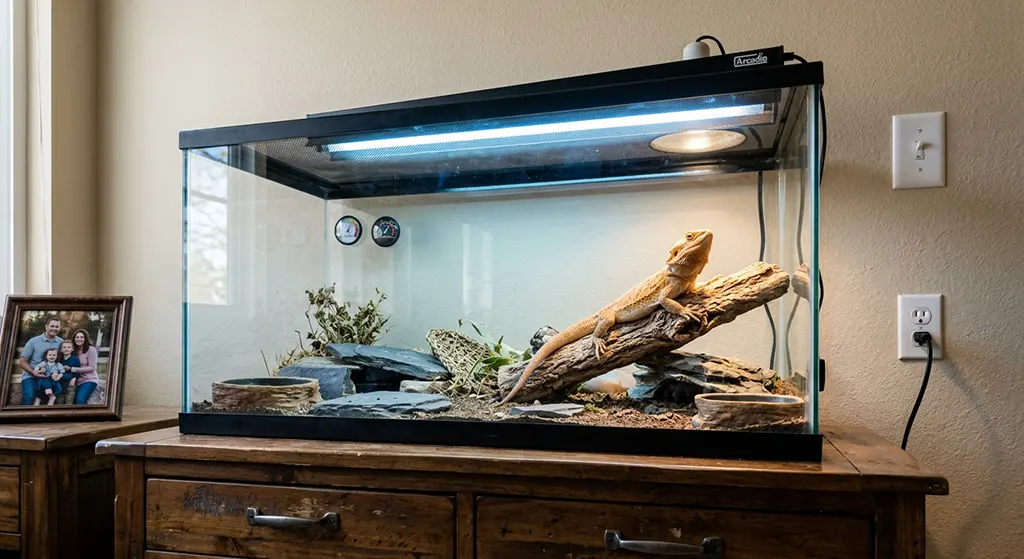
- Use a linear T5 High Output fluorescent UVB tube (commonly 10.0/12.0 strength depending on brand and mounting distance) spanning a significant portion of the enclosure, mounted at the manufacturer-recommended distance, with a gradient so the dragon can move out of the UV zone.
- Replace UVB tubes on schedule — output degrades long before the bulb visibly burns out (typically every 6–12 months depending on the product; follow the manufacturer’s guidance, and a UV meter is the gold standard if you want certainty).
- Avoid placing any UVB source where the dragon can bask within inches of it.
- If you suspect bulb burn: remove the suspect bulb immediately (provide heat separately), keep the enclosure lighting gentle, and see a vet — corneal injuries need professional assessment, and secondary infection is a real risk.
6. Injury and Trauma
Bearded dragons injure their eyes more often than you’d think:
- Cage mate scratches or bites (one of many reasons cohabitation is discouraged)
- Feeder insects left loose in the enclosure — crickets can and do nibble sleeping reptiles
- Sharp or poorly positioned décor, branches, or climbing falls
Signs: sudden single-eye closure, visible scratch or cloudiness on the cornea, swelling, holding the head tilted, reduced appetite.
Any suspected corneal injury is a vet visit — eyes are not a wait-and-see organ when there’s visible damage.
7. Systemic Illness
Finally, remember that eyes don’t exist in isolation. A dragon that is seriously unwell — from advanced parasites, respiratory infection, metabolic bone disease, or organ problems — will often present as lethargic with closed eyes long before other dramatic symptoms appear. If eye closure comes bundled with any of the following, skip home troubleshooting and go straight to the vet:
- Labored or open-mouth breathing, clicking sounds, mucus at the nose or mouth
- Bloated or visibly swollen body
- Twitching, tremors, or weakness in the limbs
- Black beard at rest with no social/thermal trigger
- Prolapse, vomiting, or blood in droppings
- Complete food refusal for more than a few days outside of brumation season in an adult
Temperature Check: Is Your Habitat Quietly Causing the Problem?
Before assuming disease, audit your temperatures — chronic low temperatures suppress the immune system, slow digestion, and cause exactly the “lethargic, eyes-closed, not eating” presentation that panics owners. Improper heat is one of the most common root causes of a sick-looking dragon.
Correct bearded dragon temperature parameters:
If you’re not sure your enclosure has the right gradient for your climate, our bearded dragon temperature and lighting setup guide breaks down exact numbers by region.
- Basking spot: 95–110°F (35–43°C) — measured with a digital probe or temp gun at the actual basking surface, not the air
- Cool end: 75–85°F (24–29°C) — the dragon must be able to escape the heat
- Nighttime: A drop is natural and non-critical unless temperatures fall below about 65°F (18°C) — below that, add a ceramic heat emitter (no light)
- Measure with real instruments: dial thermometers are notoriously inaccurate; use digital probes and an infrared temp gun
A dragon kept too cool day after day will eventually show real illness — but it will also look sick (closed eyes, lethargy, dark coloration, poor appetite) well before that. Fix the gradient first; if behavior normalizes within days as temperatures correct, you likely found your answer. If not, continue down the diagnostic path.
Safe Home Care: How to Clean and Flush a Bearded Dragon’s Eyes
For the benign, non-emergency causes — suspected debris, mild irritation, early crusting without swelling — gentle home care is reasonable. Here’s how to do it right, and where the limits are.
What You’ll Need
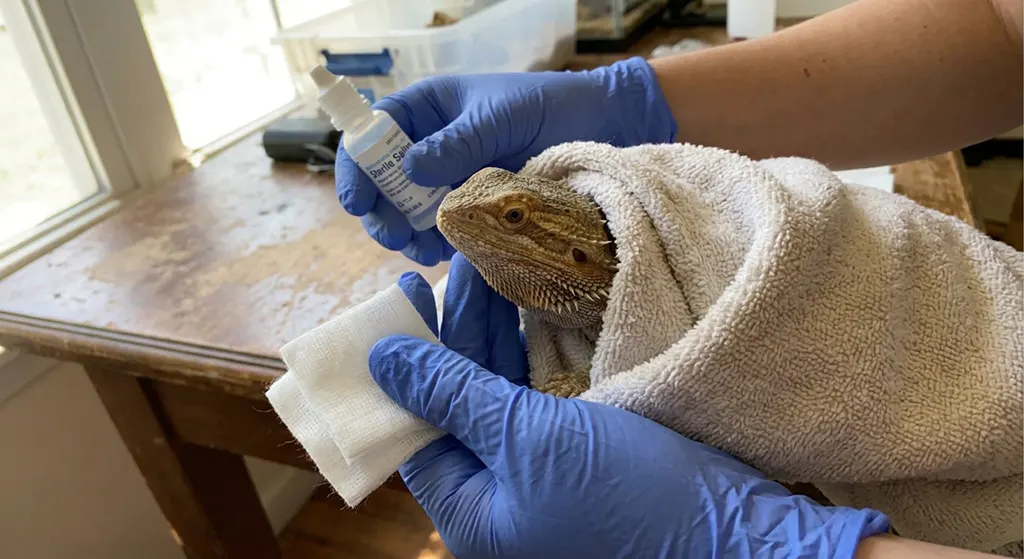
- Sterile saline solution (plain, preservative-free saline from a pharmacy — the kind sold for eyes or wound rinsing; not contact lens solution with additives)
- Clean gauze pads or cotton pads
- A small syringe (no needle) or a clean dropper
- Warm water for softening crusts
Step-by-Step: How to Clean Bearded Dragon Eyes
- Wash your hands thoroughly before and after. Reptiles carry Salmonella naturally; protect both of you.
- Restrain gently. Wrap the dragon loosely in a soft towel (“burrito” style) leaving the head free. Have a helper if possible.
- Soften any crusting first. Hold a saline-soaked warm (not hot) gauze pad against the closed eye for a few minutes. Never pry crusted lids apart dry.
- Flush. With the dragon’s head slightly tilted so runoff flows away from the other eye, gently irrigate the eye with sterile saline, letting it wash across the eye surface. Visible small debris often floats free with repeated gentle flushes.
- Wipe outward. Use a fresh pad for each wipe, moving away from the eye. One pad per eye to avoid cross-contamination.
- Let the dragon rest in a clean, warm enclosure with correct temperatures afterward.
The Hard Limits of Home Care
- Never use tap water for flushing (chlorine/contaminants), human eye drops, contact lens solution with preservatives, hydrogen peroxide, or any medication not prescribed for your dragon by a vet.
- Do not attempt to remove objects embedded in the eye surface — flush gently only; if debris doesn’t rinse free easily, stop.
- 24–48 hour rule: If gentle flushing doesn’t produce a clearly improving, fully open, normal-looking eye within a day or two — or if things worsen at any point — stop home treatment and see a vet.
- Never medicate without a diagnosis. As covered above, Vitamin A supplementation in particular is a minefield best navigated by a professional.
When to See a Vet (and Why ARAV Matters)
Let’s make the decision tree explicit. See a reptile veterinarian promptly if any of the following apply:
- Swollen eyelids (especially dramatic or rapidly worsening swelling)
- Any discharge that is cloudy, colored, or persistent
- Visible damage to the eye itself — cloudiness, scratch, ulcer, or a change in eye shape
- One eye closed for more than 48 hours without an obvious benign cause
- Eyes closed plus weight loss, appetite loss outside brumation season, or any breathing symptoms
- Suspected UVB bulb burn
- Symptoms in a juvenile, underweight, or previously ill dragon
- Suspected Vitamin A deficiency (swollen eyes on a poor diet) — diagnosis and safe supplementation need professional guidance
- Anything you’re simply unsure about. With eyes, caution is always the right call.
Why an ARAV member specifically? Reptile medicine is a specialty. General small-animal vets see few reptiles, and treatment protocols for reptiles differ substantially from dogs and cats. The Association of Reptile and Amphibian Veterinarians (ARAV) maintains a “Find a Vet” directory on its website (arav.org) — it’s the fastest way to locate a vet with genuine reptile experience in your area. When you call to book, mention the eye symptoms and the dragon’s husbandry details (temps, UVB bulb type and age, diet, supplements) — bring photos of the setup if you can. Vets can often spot a husbandry cause from a single photo.
Before the appointment: Do not start any medication or supplement. A vet may want to see the eye in its untreated state, and some treatments interfere with diagnostics.
Prevention: Keeping Your Dragon’s Eyes Healthy Year-Round
Most eye problems trace back to husbandry, which means most eye problems are preventable. Your maintenance checklist:
Lighting & Heating
- Linear T5 High Output UVB tube (10.0/12.0 as appropriate), correct mounting distance, replaced on schedule
- Basking spot 95–110°F (35–43°C), cool end 75–85°F (24–29°C), verified with digital instruments
- No compact/coil UVB bulbs; no colored “night lights” (dragons see them)
Diet & Supplementation
- Varied diet: gut-loaded insects (roaches, crickets, black soldier fly larvae, occasional worms) plus daily appropriate greens and vegetables
- Beta-carotene-rich vegetables regularly; calcium and multivitamin dusting per a conservative, label-based schedule
- Fresh water available; many dragons also hydrate through weekly supervised baths
Habitat Hygiene & Furnishing
- Consider solid substrates, especially for juveniles
- Remove uneaten feeder insects after feeding sessions
- Spot-clean daily; full enclosure clean regularly
- Smooth, stable décor; no sharp edges at climbing height
Routine Monitoring
- Weekly weigh-ins (this is your early-warning system for everything, not just eye issues)
- Weekly eye check: both eyes symmetrical, clear, open, no discharge
- Annual vet visit with a fecal parasite exam — ideally before brumation season
Frequently Asked Questions (FAQ)
Why is my bearded dragon keeping one eye closed?
A single closed eye usually points to a localized problem: debris or substrate in the eye, a minor scratch, stuck shed on one side, or an early infection. Start with a careful look for visible particles or retained shed and a gentle sterile saline flush. If the eye isn’t fully normal within 24–48 hours, or you see swelling or discharge at any point, see a reptile vet.
Is it normal for a bearded dragon’s eyes to be stuck shut during brumation?
Yes — it’s common. Brumating dragons sleep deeply for long stretches and often keep their eyes closed most of the day, opening them briefly when disturbed. The keys are context: seasonal timing, a healthy adult dragon, no swelling or discharge, and stable body weight across weekly weigh-ins. If any of those don’t fit, don’t assume brumation.
How do I tell brumation from illness in my bearded dragon?
Weight is the most reliable home indicator: healthy brumation = stable weight; illness = progressive weight loss. Add eye appearance (clear vs. swollen/discharge), responsiveness when disturbed, breathing quality, and droppings. The comparison table in this article walks through each sign side by side.
Can the wrong UVB bulb really damage my bearded dragon’s eyes?
Yes. Compact/coil UVB bulbs have been associated with photo-keratoconjunctivitis — a UV burn to the eye surface — typically appearing as both eyes closed and light sensitivity shortly after a bulb change. Switch to a properly mounted linear T5 High Output UVB tube, replace tubes on schedule, and see a vet if you suspect a burn.
What are the signs of Vitamin A deficiency in bearded dragons’ eyes?
Chronically swollen eyelids (often both eyes), thickened discharge, eyes held shut, and recurring eye problems that never fully resolve — usually alongside a narrow, vegetable-poor diet. Do not self-treat with high-dose Vitamin A; overdose (hypervitaminosis A) is dangerous. A vet can confirm the diagnosis and prescribe safe correction, while diet improvements (beta-carotene-rich vegetables, gut-loaded insects) address the root cause.
How do I clean my bearded dragon’s eyes safely at home?
Use plain sterile saline (no additives) on gauze pads and a needleless syringe or dropper. Soften crusts with a warm saline compress first, flush gently with the head tilted, wipe away from the eye with a fresh pad, and never use tap water, human eye drops, or peroxide. Limit home care to minor irritation, and stop for the vet if there’s no clear improvement within 24–48 hours.
My bearded dragon has a swollen eye — how urgent is it?
Treat swelling as urgent. Swollen eyes indicate infection, Vitamin A deficiency, abscess, or injury — none of which resolve reliably at home. Book a reptile vet (use the ARAV directory) within days, sooner if swelling is severe, spreading, or paired with appetite or behavior changes.
Should I stop my bearded dragon from brumating?
Healthy adults can brumate naturally — it’s normal biology. But juveniles, underweight dragons, and dragons with health issues shouldn’t brumate without veterinary guidance, and many vets recommend a pre-brumation fecal check. Keep temperatures and lighting correct during brumation season and continue weekly weigh-ins throughout.
Can I use human eye drops on my bearded dragon?
No. Human eye products aren’t formulated for reptile eyes and many contain ingredients that are harmful or mask symptoms a vet needs to see. Only use medications prescribed by a reptile veterinarian for your specific animal.
When is a closed eye an emergency versus a “watch it” situation?
Emergency (vet within 24–48 hours or sooner): swelling, colored discharge, visible eye damage, suspected bulb burn, symptoms in a juvenile or thin dragon, or closed eyes with weight loss or breathing issues. Watch-it territory: an adult in seasonal brumation with stable weight and clear eyes, or a single eye with suspected minor debris that resolves fully within 24–48 hours of gentle flushing.
The Bottom Line
A bearded dragon that won’t open its eyes is telling you something — your job is to figure out whether that something is “it’s winter and I’m sleepy” or “I need a doctor.” The framework is simple:
- Check the season and the scale. Autumn/winter onset, healthy adult, stable weight, clear symmetrical eyes? Brumation is the likely answer — keep monitoring weekly.
- Inspect the eyes themselves. Swelling, discharge, crusting, asymmetry, or cloudiness means a medical cause — infection, Vitamin A deficiency, injury, or lighting damage — and a vet visit.
- Audit the habitat. Confirm basking temperatures (95–110°F), a proper linear T5 UVB tube, solid substrate or low-debris setup, and a varied, well-supplemented diet.
- Home care has limits. Gentle saline flushing is appropriate for minor debris and nothing more — 24 to 48 hours without clear improvement means professional help.
- When in doubt, call an ARAV vet. Eyes are small, delicate, and irreplaceable. The cost of a precautionary exam is trivial compared to the cost of waiting too long.
Your dragon can’t tell you what’s wrong — but with a kitchen scale, a thermometer, and the checklist in this guide, you can read the signs it’s already giving you.
This content is for educational purposes only and does not substitute professional veterinary diagnosis or treatment. If you observe any symptoms of illness, injury, or abnormal behavior, please consult a qualified exotic animal veterinarian immediately.
For more details, please review our full Medical Disclaimer.