
Veterinary Disclaimer: This article is for informational purposes only and is not a substitute for professional veterinary advice, diagnosis, or treatment. Always consult a qualified exotics veterinarian about your snake’s health. Find one near you through the ARAV Find-a-Vet directory.
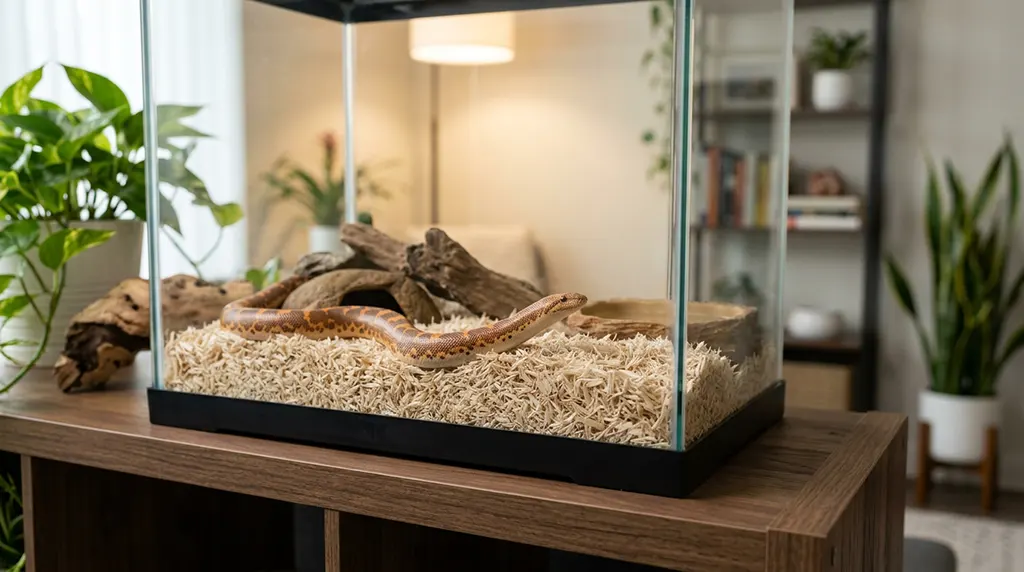
If you live in an apartment and you’ve been told a snake is out of the question, nobody told the Kenyan sand boa.
This chunky little burrowing snake tops out at two to three feet, spends most of its day quietly buried in its substrate, eats frozen mice once a week or so, and produces almost no noise, smell, or mess. No barking. No litter box. No 6 a.m. walks in January.
I’ve kept a female Kenyan sand boa named Waffles in a 450-square-foot studio for the past four years. She’s outlived two jobs, one breakup, and three apartment moves — each one as simple as putting her in a cloth bag and driving across town. That combination of small footprint, calm temperament, and simple care is exactly why this species has become the default recommendation for first-time snake owners renting in American cities. If you’re still comparing options, our roundup of the best pet snakes for beginners narrows the field, our Kenyan sand boa vs. western hognose comparison settles that particular head-to-head, and our pet snake tier list ranks all 15 species on hardiness and handleability.
But “easy to keep” doesn’t mean “no research required.” Get the heating, substrate, or feeding wrong, and even this hardy species will struggle. This guide covers everything you need to do it right — including the single biggest beginner mistake (yes, it involves sand — keep reading).
Why Kenyan Sand Boas Are Perfect for Apartment Living
Before the care sheet, let’s spell out exactly why this species fits small-space living. It’s not just about size.
They stay small. Adult males commonly measure 15 to 20 inches — barely longer than a ruler. Even big females usually top out around 24 to 36 inches, and they’re thick-bodied rather than long. Compare that to a ball python at 4 to 5 feet, and the space savings are obvious.
They’re nearly silent. No vocalizations, no scratching at glass at night (they’re mostly still, burrowed under substrate), no tank-mates to squabble with. My downstairs neighbor of three years had no idea Waffles existed until I mentioned her at a building party.
Odor is minimal. A well-maintained enclosure smells like clean aspen and warm air. Spot-clean daily, change substrate every few weeks, and smell won’t be an issue — a real selling point when your “reptile room” is your bedroom.
The footprint is tiny. A 20-gallon long tank measures roughly 30 × 12 × 12 inches. It fits on an IKEA shelf, a sturdy dresser, or a dedicated stand. A 10-gallon juvenile setup is even smaller.
Minimal landlord friction. Reptiles aren’t covered by most breed or size restrictions aimed at dogs, and a snake this small rarely triggers “exotic animal” clauses. That said: always check your lease. Some buildings have blanket “no snakes” policies. It’s your responsibility to know yours before bringing any animal home.
Costs are modest. A complete, correctly equipped setup in 2026 typically lands in the $300–$500 range at US retailers — Petco, Chewy, Amazon, or a local reptile shop — and monthly costs are mostly frozen mice.
If you can keep a 20-gallon fish tank, you can keep a Kenyan sand boa.
Meet the Species: What Makes a Sand Boa a Sand Boa
The Kenyan sand boa (Eryx colubrinus) is a small member of the boa family native to the dry scrublands and sandy regions of East Africa — Kenya, Tanzania, Somalia, Ethiopia, and neighboring areas.
These snakes are built for life underground. Their bodies are cylindrical and muscular with smooth scales, their heads are small and blunt (barely wider than their necks — a classic adaptation for pushing through loose soil), and their eyes sit high on the head so they can watch for prey while the rest of the body stays buried. In the wild, they hunt by ambush: lying nearly buried with just eyes and nostrils exposed, then striking sideways at rodents that wander past.
A few things about their natural history matter directly for your setup:
They are fossorial — a sand boa that disappears under its substrate for days is not sick or stressed; it’s being a sand boa. Expect to see very little of yours during daylight hours. They come from warm, seasonally dry environments, which drives their heating and humidity needs. They have a slow metabolism typical of boas, so they eat less often than colubrids. And they are long-lived — 15 to 20 years is a realistic expectation, and some individuals live longer. This is a two-decade commitment; budget your apartment moves accordingly.
How big do Kenyan sand boas get? (Male vs. female)
This is one of the most-searched questions about the species, and the answer matters a lot for enclosure planning, because Kenyan sand boas are strongly sexually dimorphic — males and females differ dramatically in size.
- Adult males: typically 15 to 20 inches, occasionally up to about 24 inches in very large individuals. They stay slim and light, usually well under 150 grams.
- Adult females: typically 24 to 30 inches, with 36 inches possible for large individuals. Females are considerably thicker-bodied — a mature female can weigh 400 to 900 grams, several times a male’s weight.
In practical terms, a male Kenyan sand boa is closer in size to a large garter snake than to what most people picture when they hear “boa.” A female is a hefty, impressive snake, but still far smaller than any common pet python.
This dimorphism also means the sex of your snake changes the tank size you need, the prey size you’ll feed, and sometimes the price at the breeder (females often cost more due to breeding demand). Always ask the seller to confirm the sex — any reputable breeder will know it for certain.
What Size Tank Does a Kenyan Sand Boa Need?
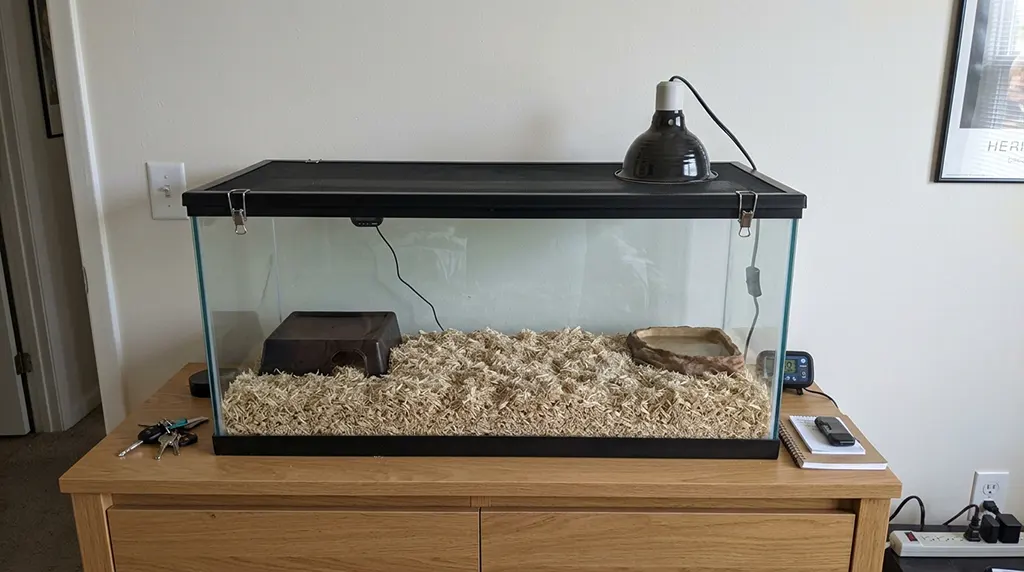
Here’s the short answer most care sheets agree on:
- Juveniles and hatchlings: a 10-gallon enclosure (20″ × 10″ × 12″) is a fine starting point.
- Adult males: a 10-gallon can work as a bare minimum, but a 20-gallon long (30″ × 12″ × 12″) is the comfortable recommendation — more room for deep substrate and a proper gradient.
- Adult females: a 20-gallon long is the widely accepted minimum, and many experienced keepers consider a 30- to 40-gallon breeder (roughly 36″ × 18″) the better long-term home for a full-grown, 2.5-foot female. Given the modest price difference, upsizing is cheap insurance for her quality of life.
You’ll see some keepers argue for 4-foot enclosures for any snake. That’s a legitimate philosophy for active, semi-arboreal species. For a fossorial ambush predator that travels maybe a few feet per day, a 20- to 40-gallon low enclosure with 4 to 6 inches of burrowing substrate is appropriate — arguably more enriching than a tall empty tank. Depth and loose substrate matter more to this species than raw length.
Glass, PVC, or plastic tub?
Glass tanks with screen lids (the classic Petco 20-long) work perfectly. Two requirements: the lid must be secure with clamps — sand boas are deceptively strong pushers and escape artists — and the dry air a screen top allows conveniently suits this arid-adapted species.
PVC enclosures (Kages, Animal Plastics, Dragonhaus) hold heat and humidity better and look sharp in a living room, but cost more than most apartment setups need.
Plastic tubs (Sterilite-style with drilled vents) are the budget classic — breeders use them by the shelf — and work fine, though they’re not pretty.
Whichever you choose, plan on a stand rated for 40+ pounds, away from direct sun, drafts, and AC vents. In an apartment, never place a snake tank where an HVAC blast can swing the temperature ten degrees in an hour.
Heating and Temperature: The One Thing You Can’t Wing
Kenyan sand boas are cold-blooded, and “room temperature” in a US apartment — anywhere from 68°F in winter to 78°F in summer — is not enough on its own. You must build a temperature gradient so the snake can self-regulate.
| Zone | Temperature |
|---|---|
| Basking spot surface | 92–95°F (33–35°C) |
| Warm side ambient | 85–88°F (29–31°C) |
| Cool side ambient | 75–80°F (24–27°C) |
| Nighttime drop | Safe down to about 70–72°F |
These ranges align with professional herpetological care guidelines for the species — see the full Eryx colubrinus care fact sheet for additional husbandry references.
Heat sources that work
An under-tank heater on a thermostat is the traditional setup: mount it on one end of the tank’s underside, run the probe inside the enclosure over the heated area, and it produces that 92–95°F warm-side floor. Zoo Med ReptiTherm UTHs paired with an Inkbird thermostat are the classic Amazon combo.
A heat lamp or deep heat projector over one end is increasingly preferred because it warms from above like the sun. Pair with a dimming thermostat. A ceramic heat emitter produces heat without light and helps boost ambient temps in a chilly apartment.
Non-negotiable: every heat source goes through a thermostat. Unregulated under-tank heaters have burned and killed snakes — this is the single most important safety purchase in the whole setup, not a “later” item. And skip heat rocks entirely; they develop hot spots, and snakes don’t sense belly overheating well.
Measure, don’t guess
Don’t trust stick-on dial thermometers from the big-box aisle. Buy an infrared temperature gun (Etekcity-style guns run about $15–25) for surface temps, plus a digital probe thermometer for ambient air on both ends. I check Waffles’ basking spot every Sunday morning with the temp gun — it takes 30 seconds and it’s caught a failing UTH before it became a problem.
Humidity: Dry, But Not Bone-Dry
Here’s where sand boa care gets a confusing reputation, because sources disagree. The practical consensus for a standard setup:
Keep baseline ambient humidity at 30–40%. Most US apartments sit naturally in this range, so you usually won’t need to do anything except avoid raising it. Don’t let substrate stay damp — chronically wet conditions promote respiratory infections in this species. Keep the water dish on the cool side and let the screen lid ventilate.
The exception is shedding. When your snake’s eyes go blue and its skin dulls, it needs extra moisture to shed cleanly. The clean solution is a humid hide: a small box with damp sphagnum moss inside, placed on the warm side during shed week, then dried out after. The snake gets a humidity boost on demand without turning the whole enclosure tropical.
A digital combo thermometer-hygrometer runs about $12. Check it when seasons change — winter heating and summer AC both swing indoor humidity more than people realize.
Do Kenyan Sand Boas Need Sand? (The Substrate Myth)
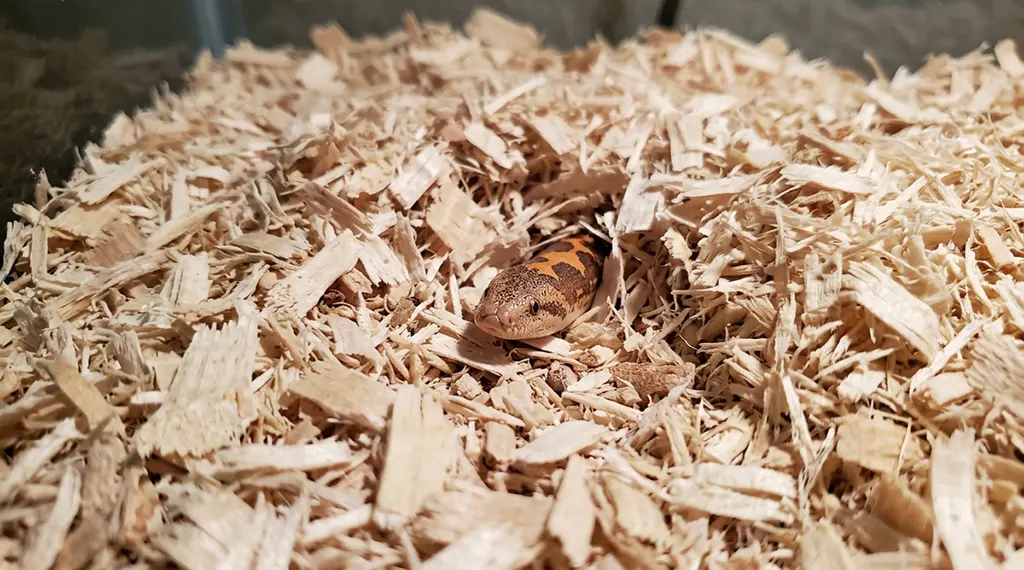
Time to address the elephant in the room — the one that shares its name with this snake.
No, a Kenyan sand boa does not need pure sand, and in many cases pure sand is a poor choice.
Despite the common name, “sand boa” describes where these snakes live in the wild, not a dietary requirement. The wild habitat is sandy soil — sand mixed with organic matter — not the clean, uniform quartz or calcium sand sold in pet store bags. Wild sand boas also aren’t fed by tongs in a small glass box, which is where the real captive danger comes in.
The impaction risk: when a snake strikes at a mouse on a loose sand surface, it inevitably swallows substrate with the prey. Occasional fine material usually passes. But fine quartz sand and especially calcium sand (the brightly colored “digestible” calcium carbonate substrate) can accumulate in the gut, causing impaction — a blockage presenting as lethargy, appetite loss, and no defecation, which can kill a snake without veterinary care. Calcium sand is marketed as safe and even edible, but it clumps when wet and is strongly implicated in impaction cases across the reptile hobby. Do not use it. Silica sand is similarly dusty and sharp-edged — also avoid.
Safe substrate options, ranked for beginners:
- Aspen shavings — the most popular choice. Cheap, widely available, dust-free if you pick a good brand, easy to spot-clean. It molds if it stays wet, so keep it dry and replace soiled sections promptly.
- Coconut coir / coconut fiber (Eco Earth, ReptiChip-style products) — holds moisture beautifully in a humid hide, decent for burrowing.
- A topsoil-based mix — roughly 60–70% organic, additive-free topsoil with 30–40% play sand or coco fiber. This best mimics the natural burrow and is the choice of many experienced keepers. Only use organic topsoil with no fertilizers, pesticides, or perlite.
- Fine dust-free sandblasting media or commercial desert sands — usable by experienced keepers with careful feeding management (feed in a dish), but not recommended as pure substrate for a first-timer.
Avoid: cedar and pine shavings (aromatic oils are toxic to reptiles), reptile carpet (prevents burrowing entirely — the opposite of what this species needs), and calcium/silica sand.
Whatever you use, make it deep: 4 inches minimum, 5–6 inches for adults. Burrowing isn’t a luxury for this species — it’s their core behavior, their security blanket, and their exercise. Waffles has a 6-inch aspen layer, and watching her bulldoze tunnels through it with that blunt little head never gets old.
Spot-clean feces and urates daily (they’re usually deposited on the surface, conveniently), and replace all substrate every 3–4 weeks with a full wipe-down using a reptile-safe disinfectant like F10 or diluted chlorhexidine.
Kenyan Sand Boa Feeding Schedule: What, How Often, and Frozen vs. Live
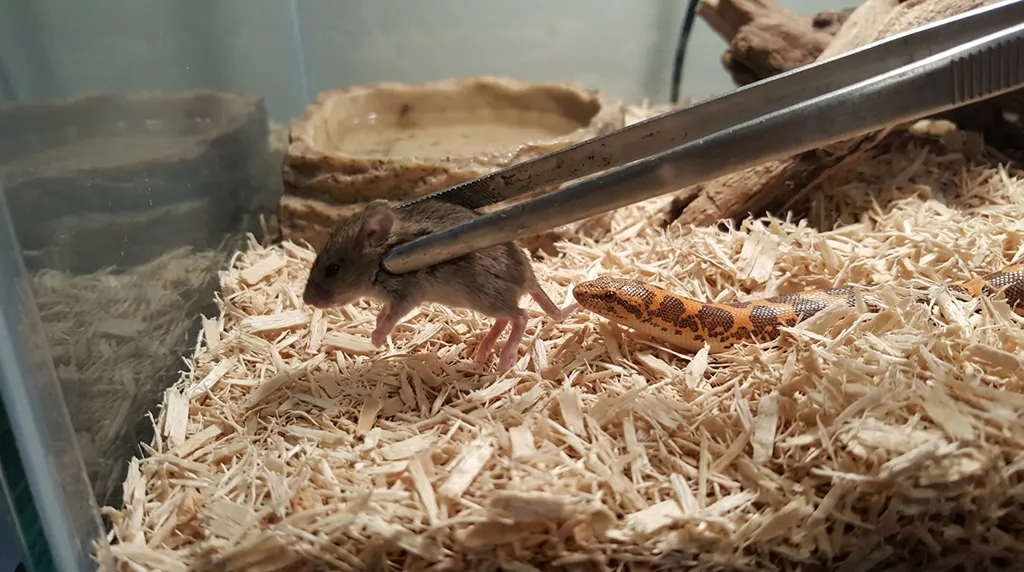
Feeding a sand boa is refreshingly simple once you understand the rhythm: these are slow-metabolism ambush predators that eat small rodents infrequently.
Frozen-thawed mice, full stop. Every major care source recommends frozen-thawed as the default. The advantages are safety (live mice can bite and seriously injure a slow-striking ambush snake), convenience (buy in bulk, store in a freezer drawer), and cost.
Frozen mice are available in bulk online (Perfect Prey, Layne Labs, RodentPro) or individually at pet chains and local reptile shops. A small chest freezer makes bulk ordering cheapest.
Prey size: match the mouse to the widest part of the snake’s body.
- Hatchlings/babies: pinky mice, every 5–7 days.
- Juveniles: fuzzies, then hoppers, every 7 days or so as they grow.
- Adult males: adult mice every 10–14 days.
- Adult females: large adult mice (or a small rat for very big females) every 7–10 days.
The widely used schedule across care sheets: young snakes every 5–7 days, adults every 7–14 days depending on size, sex, and body condition. An adult male at good weight can easily go two weeks between meals — don’t overfeed. Obesity is a genuine problem in sand boas because they barely move; a snake should have a gently rounded, not balloon-like, cross-section.
How to feed (the routine I actually use)
Thaw the mouse completely in warm water — never microwave it (hot spots burst prey) and never offer partially frozen prey (it causes regurgitation). Warm it in a cup of warm water so it reads as “alive” to the snake’s heat-sensing instincts. Some keepers wiggle it with tongs; sand boas often prefer to strike from ambush, so I just lay Waffles’ mouse at the entrance of her favorite burrow and leave the room.
Two rules I never bend: use tongs or place the prey on a flat dish — never hand-feed, because you don’t want mouse-scented fingers near a snake with a prey drive — and no handling for 48 hours after feeding, since moving a snake with a fresh meal in its stomach commonly triggers regurgitation.
Feeding quirks to expect
Fasting: adult males in particular may skip meals seasonally (often late winter/spring, tied to breeding biology) and can go weeks without eating while staying perfectly healthy. Don’t panic as long as body condition holds.
Shed refusals: most snakes won’t eat while in blue (opaque eyes before a shed). Offer again a few days after the shed completes.
Buried feeding: if your snake eats from under the substrate, that’s normal ambush behavior — and one more reason aspen or soil-mix substrates pass more safely than sand if swallowed incidentally.
Handling and Temperament
Is a Kenyan sand boa good for beginners?
Yes — with one caveat every honest guide should mention.
Kenyan sand boas are a “look, don’t touch” snake more than a “carry around the apartment” snake. They’re calm and tolerant, but not a species that seeks out interaction. Many sit contentedly in your hands; few will explore and climb like a corn snake. If you want a snake to watch and care for, they’re perfect. If you want a daily-handling companion, temper expectations — a corn snake might be a better fit.
Their defensive style is famously mild. When threatened, a sand boa’s first move is to burrow. If it can’t, it may strike — but the strikes are slow, the mouth is small, and bites rarely break skin. Some individuals “head-butt” with their blunt snout instead of biting at all. They are not venomous — no boa is. Compared to the musking, tail-rattling welcome you might get from other small snakes, a sand boa’s default is charming nonchalance.
Handling technique that matters
Scoop from below, out of the substrate. In the wild, predators attack from above; reaching down from overhead can trigger a startle response. Slide your hand under the snake through the bedding and lift from underneath.
Support the body. These are terrestrial burrowers, not climbers — they don’t grip like a ball python. A sand boa held loosely midair will squirm and can fall.
Keep sessions short at first. Five to ten minutes, a couple of times a week, is plenty while the snake settles in. Skip handling for the first week after bringing it home, during sheds, and for 48 hours post-feeding. And wash your hands before handling, especially after touching mice — food-scented fingers get mistaken for food.
A note on children: sand boas are among the better snake choices for supervised kids because of their small size and mild temperament — but an adult should always manage the interaction, for the snake’s safety and the child’s.
Health, Shedding, and Common Problems
Kenyan sand boas are hardy, but “hardy” isn’t “immune.” Here’s what actually goes wrong, in rough order of likelihood:
Incomplete sheds (dysecdysis). Skin coming off in patches, especially retained eye caps and tail tips. Almost always caused by humidity being too low during the shed. Fix: add the humid hide during shed weeks. Never peel skin off by force; a supervised soak in shallow 85°F water loosens stubborn pieces.
Respiratory infections. Wheezing, open-mouth breathing, bubbly nostril mucus, lethargy. Cause is almost always husbandry: humidity too high, temperatures too low, or a drafty, damp setup. Mild cases sometimes resolve when conditions are corrected; moderate-to-severe ones need a reptile vet and possibly antibiotics. This is the strongest argument for keeping the enclosure dry and warm.
Impaction. The risk we covered above — a real danger with pure sand or calcium sand substrates. Lethargy, appetite loss, and no waste passing over an extended period warrant a vet visit.
Regurgitation. Usually a husbandry signal, not a disease: temps too low to digest, handling too soon after eating, or prey too large. Waffles regurgitated once, early on, because I handled her 20 hours after a meal. I corrected my behavior — not hers — and it never happened again.
Mites. Tiny black or red dots moving on the snake or in the water bowl. Treat the snake and the entire enclosure (Provent-a-Mite is the hobby standard). Rarely a problem with frozen-thawed-only feeding and quarantined new arrivals.
Obesity. An underappreciated one. Fat sand boas develop visible fat deposits above the vent and a squarish body cross-section. Scale back feeding frequency and consider a larger enclosure.
Finding a reptile vet before you need one
This is the prep step most apartment beginners skip: locate an exotics vet who sees snakes before your snake gets sick. The Association of Reptilian and Amphibian Veterinarians (ARAV) maintains a find-a-vet directory — search your zip code, save a name in your phone, and ask about exam pricing. For general guidance on when a reptile needs medical care, the AVMA’s reptile care resources are a solid starting point. A wellness visit in the first few months is money well spent.
The Real Cost of a Kenyan Sand Boa in a US Apartment (2026)
Honest numbers, using typical US retail prices:
One-time setup: the snake itself runs $60–$150 for a normal morph from a breeder or reptile expo (males on the lower end), $150–$500+ for designer morphs like albinos or snows. A 10- or 20-gallon long glass tank with secure lid is $40–$100 at Petco or PetSmart (watch for dollar-per-gallon sales). Heat source: $15–$30. Thermostat: $25–$40 — not optional. Digital thermometer/hygrometer plus a temp gun: $20–$40. Substrate: $10–$20. Two hides, water dish, decor: $20–$40. Total: roughly $250–$500.
Ongoing monthly: frozen mice run about $0.50–$2 each depending on size; expect $5–$15/month for one snake, less with bulk orders. A $15–$25 bag of aspen lasts months. Electricity for the heat source is a few dollars. And set aside whatever you can for a vet fund — even $10/month builds a cushion for the inevitable surprise.
Compared to virtually any dog or cat, or even most reptiles, that’s a gentle bill — one reason sand boas are so often recommended to renters and students.
Apartment-Specific Tips (The Stuff Generic Care Sheets Skip)
A few practical notes for keeping a snake in a rental:
Read your lease first. Look for “exotic pets,” “reptiles,” or terrarium clauses. If it’s ambiguous, ask. Getting caught violating a pet policy can threaten your housing — over a quiet, odorless, caged animal that causes zero damage. Not worth the risk.
Moving is easy. A small snake, a secure deli cup or cloth bag, and a warm car ride. No sedation, no carriers, no airline drama. For a species with a 15–20 year lifespan, “portable pet” is a real feature for renters.
Power outages. In blackouts, the enclosure holds safe temps for hours on its own — the thermostat simply cuts the heat. For longer outages, chemical hand warmers wrapped in towels and placed outside the tank work for a day or two. If your building regularly loses power for days, factor that in.
Guests and roommates. Tell your roommate before move-in day. A buried sand boa in a tidy tank tends to win people over; a surprise reveal does not.
FAQ: Kenyan Sand Boa Care
Do Kenyan sand boas need sand?
No. The name refers to their wild habitat, not a husbandry requirement. They thrive on aspen, coconut coir, or a topsoil-based burrowing mix. Pure fine sand — especially calcium sand and silica sand — poses an impaction risk when swallowed during feeding strikes and is not recommended for beginners.
What size tank does a Kenyan sand boa need?
A 10-gallon works for hatchlings and juveniles. Adult males do well in a 20-gallon long, which is also the standard minimum for adult females — though a 30- to 40-gallon breeder is a worthwhile upgrade for a large female. Prioritize 4–6 inches of deep, burrowable substrate over raw tank length.
Are Kenyan sand boas good for beginners?
Yes — consistently ranked among the best beginner snakes for their small size, docile temperament, simple frozen-mouse diet, and forgiving care. The main adjustment is behavioral: they’re burrowers you mostly observe rather than constantly handle.
How big do Kenyan sand boas get?
Males typically reach 15–20 inches and stay slim; females typically 24–30 inches, occasionally 36, and are much thicker-bodied. Confirm the sex when buying, since it determines your enclosure and feeding plan.
How often should I feed my Kenyan sand boa?
Hatchlings eat pinky mice every 5–7 days; juveniles step up through fuzzies and hoppers roughly weekly; adults eat appropriately sized mice every 7–14 days. Use frozen-thawed prey, match prey width to the snake’s widest point, and never handle for 48 hours after a meal.
What temperature does a Kenyan sand boa need?
A 92–95°F basking surface on one end, 85–88°F warm-side ambient, 75–80°F cool side. Every heat source must run through a thermostat, verified with a digital thermometer and infrared temperature gun.
What humidity do Kenyan sand boas need?
Keep ambient humidity around 30–40% with good ventilation and dry substrate. The exception is shedding: offer a humid hide with damp sphagnum moss so the snake can self-regulate. Chronically high humidity raises respiratory infection risk.
Do Kenyan sand boas bite?
Rarely, and when they do it’s typically a slow defensive strike from a small mouth that usually doesn’t break skin. They are non-venomous. The most common “bite” scenario is a feeding response to food-scented hands — avoidable with tongs and hand-washing.
Can two Kenyan sand boas live together?
Not recommended. Snakes are solitary, and cohabitation adds stress, competition, and feeding risks. This species does perfectly well housed alone — which also keeps your space and costs minimal.
How long do Kenyan sand boas live?
With proper care, 15 to 20 years, sometimes more. Plan for a long-term commitment spanning several moves and life changes.
Final Thoughts
The Kenyan sand boa earns its reputation the honest way: it asks for very little space, money, or daily labor, and gives you two decades of one of the most charming oddballs in the reptile world — a snake that buries itself up to its eyeballs, ambushes dinner from below like a tiny orange submarine, and genuinely does not care that your studio is 450 square feet.
Get the five things right — a secure 20-gallon long, a thermostated heat source verified at 92–95°F, 30–40% humidity, 4–6 inches of safe burrowing substrate (not pure sand), and a frozen-mouse schedule matched to your snake’s age and sex — and this species will reward you with about the lowest-maintenance pet experience available in American apartment living.
Read your lease. Find your exotics vet. Clamp that lid. And when you catch those two little eyes peeking up from the substrate one evening, you’ll remember exactly why you got it.
This content is for educational purposes only and does not substitute professional veterinary diagnosis or treatment. If you observe any symptoms of illness, injury, or abnormal behavior, please consult a qualified exotic animal veterinarian immediately.
For more details, please review our full Medical Disclaimer.