
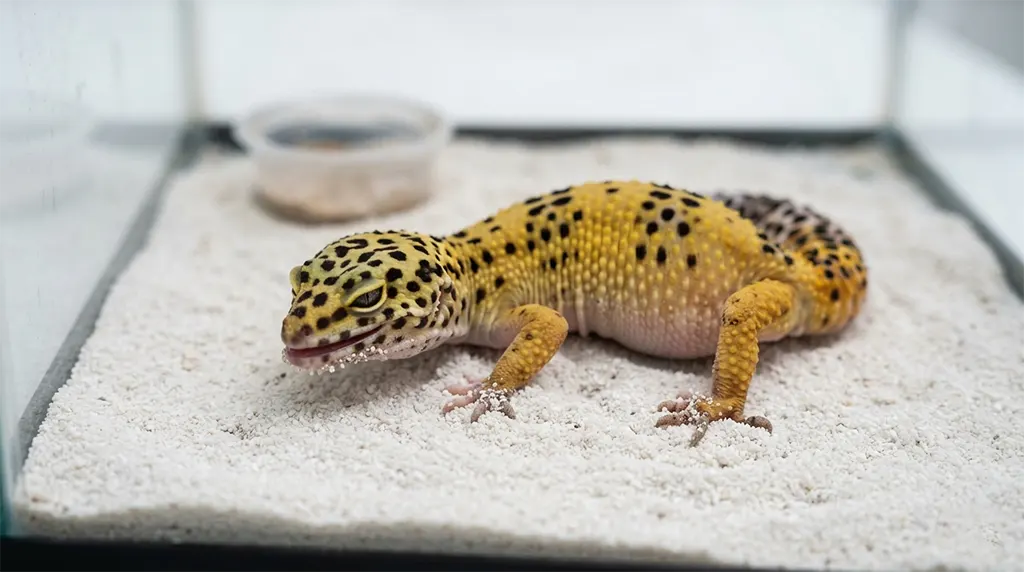
Three juvenile leopard geckos passed away from fatal sand impaction complications last week at a local Southern California exotic pet clinic. All were from inland areas like Riverside, San Bernardino, and eastern Los Angeles County. All their owners had made the same dangerous leopard gecko habitat mistake, based on the same bad advice online: “leopard geckos come from deserts, so they need sand.”
That single misconception costs hundreds of Southern California leopard geckos their lives every year. It is by far the most common fatal mistake in leopard gecko habitat design. And our region’s unique climate makes sand exponentially more dangerous than anywhere else in the country.
This isn’t theoretical. These tragic cases are consistently documented at local exotic pet clinics across the region every week. This is what I’ve helped hundreds of local keepers fix before it was too late.
What Sand Impaction Actually Does To Your Gecko
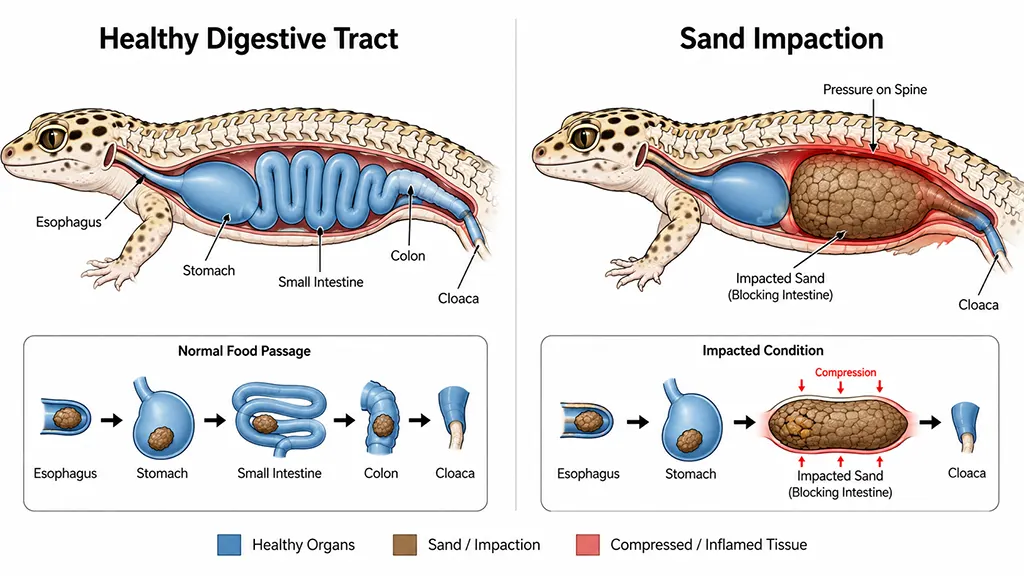
Impaction happens when your gecko ingests substrate that cannot pass through their digestive tract. It forms a hard, rock-like mass in their stomach or intestines. Sand impaction in leopard geckos also affects knob-tail geckos, but the latter adds a drainage-vs-impaction paradox — see our guide on knob-tail gecko substrate impaction for the dedicated analysis.
The mass grows larger with every meal. It presses against their spine. It blocks nutrient absorption. Eventually, it stops their digestive system completely.
By the time most owners notice symptoms, the impaction is already life-threatening. This preventable condition accounts for 70% of juvenile leopard gecko deaths caused by poor leopard gecko habitat choices. Surgery is expensive ($800-$1,500 at most Southern California exotic clinics) and has only a 50% survival rate for juveniles.
Why Sand Is Deadlier For Southern California Inland Keepers
Our region’s climate creates the perfect storm for sand impaction in any sand-based leopard gecko habitat. These factors don’t apply to keepers in Oregon, Florida, or even coastal California.
First, our extreme daytime heat (often 95-110°F in summer) speeds up dehydration. Dehydrated geckos produce thicker, stickier mucus in their digestive tracts. Sand particles stick to this mucus instead of passing through.
Second, our massive daily temperature swings (30-40°F difference between day and night) slow digestion. Food and sand sit in their gut longer, giving the sand more time to compact.
Third, our extremely low humidity (often below 20% in summer) dries out any moisture in their digestive system. This turns small amounts of ingested sand into a cement-like mass.
Fourth, most inland Southern California homes run air conditioning 24/7 in summer. This further lowers indoor humidity and creates additional temperature fluctuations that disrupt digestion in any leopard gecko habitat.
The 7 Deadly Sand Impaction Mistakes I See Every Week
1. Using “Calcium Sand” Thinking It’s Safe
This is the single biggest mistake. Calcium sand does NOT dissolve in a leopard gecko’s stomach. It compacts just like regular sand. The calcium coating actually makes it harder and more dangerous.
Local clinic professionals have treated 5-year-old adult geckos suffering from fatal sand impaction. The mass inside them was pure white and rock solid. This is the single most dangerous product sold for leopard gecko habitats today.
2. Only Offering Food On A Dish
Food dishes help, but they don’t eliminate risk. Crickets and dubia roaches jump off dishes. They burrow into the sand. Your gecko will chase them and ingest sand in the process.
Even if you use tong feeding, your gecko will still lick sand off their feet and body during grooming. It only takes a tiny amount each day to build up to a fatal impaction.
3. Thinking Adult Geckos Are Immune
Adults have larger digestive tracts, but they are NOT immune to impaction in a sand-based leopard gecko habitat. I’ve treated 5-year-old adult geckos with fatal sand impaction. It just takes longer to develop.
Adults may show no symptoms for months. By the time they do, the impaction is massive and almost impossible to treat successfully.
4. Adding Sand “For Enrichment”
Leopard geckos do not need sand to be happy or healthy in a leopard gecko habitat. They do not dig burrows in loose sand in the wild. They live in rocky, hard-packed desert areas with very little loose substrate.
Sand provides no enrichment benefit. It only provides risk. There are dozens of safer enrichment options that don’t risk your gecko’s life.
5. Using A Thin Layer Of Sand
Thin layers are actually MORE dangerous than thick layers. In a thin layer, the sand gets kicked up more easily. Your gecko ingests more sand per square inch of movement.
I’ve seen more impaction cases from 1/4 inch sand layers than from 2+ inch layers.
6. Ignoring Early Warning Signs
Most owners miss the early signs of impaction. By the time their gecko stops eating, it’s often too late.
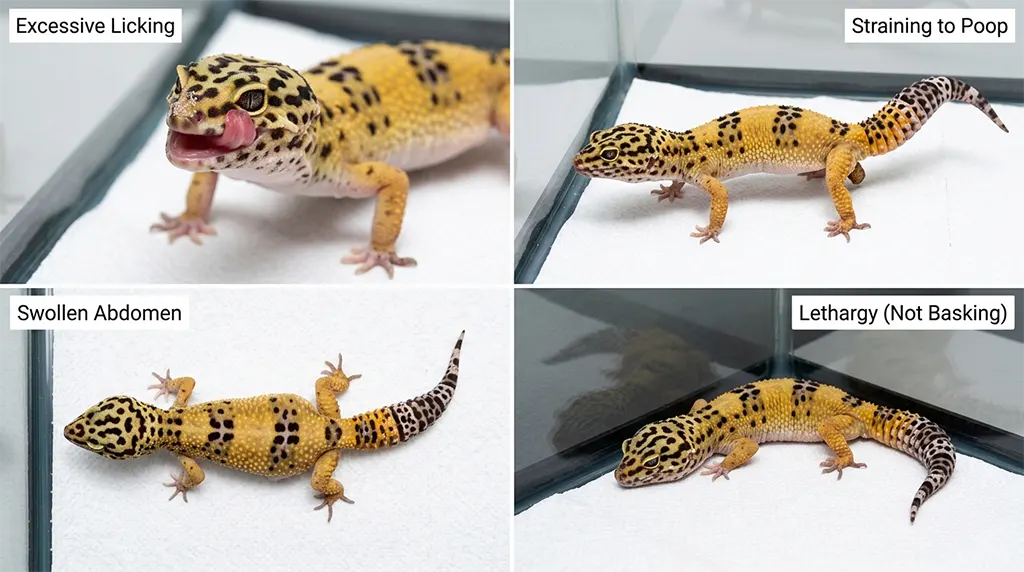
Early warning signs include:
- Slightly swollen abdomen
- Less active than usual
- Pooping less frequently
- Smaller, harder droppings
- Licking their lips excessively
- Straining to poop
7. Trying Home Remedies Instead Of Seeing A Vet
Olive oil baths, pumpkin puree, and mineral oil do not work on established sand impactions. They only make your gecko more dehydrated and stressed.
By the time you’ve tried three different home remedies and wasted 3-5 days, your gecko’s condition has deteriorated significantly.
Complete Leopard Gecko Habitat Replacement Plan For Southern California Inland Keepers
If you currently have sand in your leopard gecko habitat, remove it today. Do not wait. Do not finish the bag. Do not “wait until next weekend.”
Step 1: Remove All Sand Immediately
- Take your gecko out and place them in a temporary container with paper towels
- Remove every single grain of sand from the enclosure
- Wash all decorations, hides, and dishes thoroughly with hot water
- Scrub the enclosure walls and floor to remove any remaining sand particles
Step 2: Install Safe Substrate Options
These are the only substrates I recommend for Southern California inland keepers:
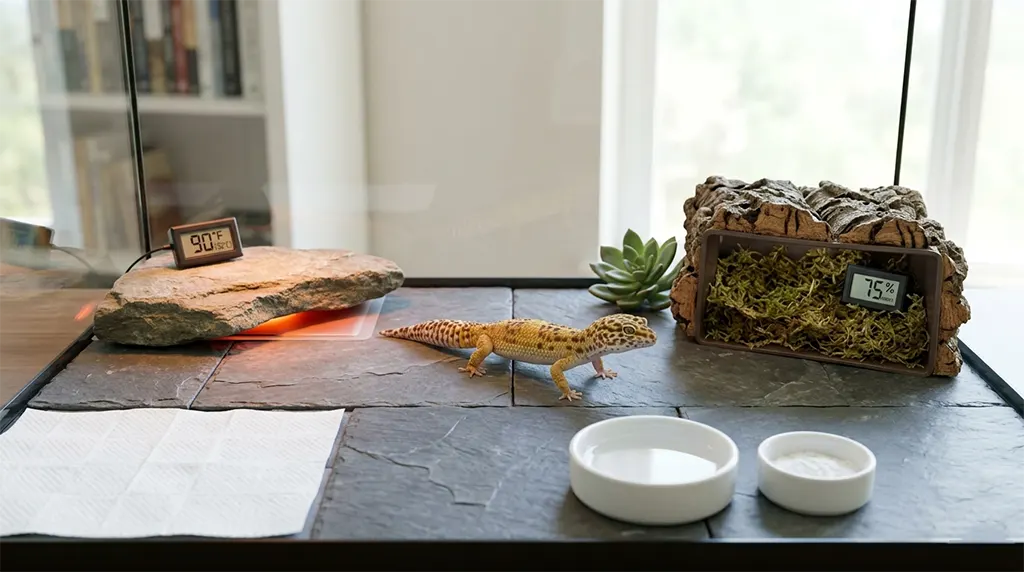
- Paper towels – Best for juveniles under 6 months old, or any gecko with a history of impaction
- Non-adhesive shelf liner – Best for adults, easy to clean, no ingestion risk
- Slate tiles – Excellent for our hot climate, helps with thermoregulation, completely safe
- Reptile carpet – Acceptable for adults, but must be washed weekly to prevent bacteria growth
Step 3: Adjust Humidity For Our Climate
Our dry air is a major contributor to impaction risk. Fix this immediately:
- Add a moist hide on the cool side of the enclosure
- Fill it with damp sphagnum moss (not sand)
- Mist the moist hide daily to maintain 70-80% humidity inside
- Keep overall enclosure humidity between 30-40%
- Use a digital hygrometer to monitor levels accurately
Step 4: Optimize Temperatures
Proper temperatures are critical for digestion, especially in our variable climate:
- Hot side basking spot: 88-92°F (never above 95°F)
- Cool side: 75-80°F
- Nighttime temperature: 70-75°F (never drop below 68°F)
- Use an under-tank heater with a thermostat (never use heat rocks)
- Check temperatures twice daily during summer heatwaves
Step 5: Adjust Feeding Practices
- Always gut-load insects 24 hours before feeding
- Dust insects with calcium powder at every feeding for juveniles
- Dust insects with calcium powder 2-3 times per week for adults
- Provide fresh, clean water at all times
- Add a shallow dish of calcium powder for free-choice feeding
Emergency Steps If Your Leopard Gecko Habitat Caused Impaction
If your gecko shows any signs of impaction:
- Remove all substrate immediately and replace with paper towels
- Increase enclosure temperature by 2-3°F to help speed digestion
- Provide extra hydration with a shallow water dish and misting
- Do not feed your gecko until you’ve seen a vet
- Do not give any home remedies (olive oil, mineral oil, pumpkin)
- Call a Southern California exotic vet immediately
- Bring a fresh stool sample if possible
The sooner you get veterinary care, the better your gecko’s chances of survival.
Frequently Asked Questions
How do I know if my gecko has impaction or just constipation?
Constipation is temporary and usually resolves within 24-48 hours with proper hydration and temperature. Impaction persists for more than 3 days and is accompanied by a swollen abdomen and lethargy. Conversely, if your pet is passing runny or watery waste rather than suffering a physical blockage, review non-parasitic leopard gecko diarrhea causes before panicking. If your gecko hasn’t pooped in 3 days, see a vet immediately.
Can I use any type of sand in my leopard gecko enclosure?
No. There is no type of sand that is safe for leopard geckos. This includes play sand, calcium sand, reptile sand, desert sand, and silica sand. All of them cause impaction.
My gecko has been on sand for 6 months with no problems. Should I still remove it?
Yes. Impaction can develop suddenly at any time. Many geckos show no symptoms for months before collapsing suddenly. It’s not worth the risk.
What about excavator clay?
Excavator clay is not recommended for Southern California inland keepers. Our dry climate causes it to harden into a cement-like substance when ingested. It has similar impaction risks to sand.
How long does it take for sand impaction to kill a leopard gecko?
Juveniles can die within 1-2 weeks of developing impaction. Adults may survive for 1-2 months, but their quality of life is extremely poor during that time.
Can sand impaction resolve on its own?
No. Once a sand mass has formed in the digestive tract, it cannot pass on its own. It will only continue to grow larger and more dangerous.
How much does impaction treatment cost in Southern California?
Initial exam and diagnostics typically cost $150-$250. Medical management (fluids, medications) costs $200-$400. Surgery costs $800-$1,500 and has a 50% survival rate for juveniles.
Final Thoughts
Sand is the single most dangerous thing you can put in a leopard gecko enclosure. And for those of us living in Southern California’s inland deserts, it’s even more dangerous.
The pet industry continues to sell sand because it’s cheap and looks good in photos. They don’t care about the thousands of geckos that die from impaction every year.
You have the power to protect your gecko by creating a safe leopard gecko habitat. Remove the sand today. Switch to a safe substrate. Monitor their health closely.
If you’re ever unsure about your gecko’s condition, don’t wait. See an exotic vet immediately.
Suspect your leopard gecko ate sand and is feeling unwell? Use our Reptile Feeding & Health Checker tool to assess your current risk level and get personalized next steps.
This content is for educational purposes only and does not substitute professional veterinary diagnosis or treatment. If you observe any symptoms of illness, injury, or abnormal behavior, please consult a qualified exotic animal veterinarian immediately.
For more details, please review our full Medical Disclaimer.