
Why I Wrote This Guide
I started keeping Gehyra marginata because someone told me they were “easy.” That someone lied. Or maybe I’m just bad at geckos. Probably both.
After several seasons of watching my colony sit there looking healthy but doing absolutely nothing reproductive, I finally figured out what I was doing wrong. Turns out Fish Scale Gecko breeding isn’t about throwing two adults in a tank and hoping for the best. It’s about replicating the exact environmental shifts that trigger gecko mating behavior in the first place.
This guide is everything I’ve learned through trial, error, and a frankly embarrassing number of failed clutches. If you’re running a Fish Scale Gecko breeding program or evaluating high-value exotic projects (similar to calculating the Lilly White Crested Gecko real breeding costs before investing), here’s what actually works — after proper Gehyra marginata husbandry became second nature, not before.
Part 1: Population Reality Check — What Your Colony Is Telling You
Before you even think about breeding, you need to understand your animals as individuals. Fish Scale Geckos (Gehyra marginata) are small, stocky geckos from northern Australia. They’re hardy, they’re forgiving of beginner mistakes in basic Gehyra marginata husbandry, and they look absolutely fantastic under the right light.
But “hardy” does not mean “will breed on autopilot.”
Signs Your Colony Is Ready
Healthy adult Fish Scale Geckos show specific behavioral shifts when environmental conditions align with their breeding triggers:
- Males become noticeably more territorial. They’ll start claiming specific hides, chasing other males away from basking spots, and doing that head-bobbing display thing that looks like they’re trying to impress you (they’re not — it’s all about the females).
- Females start spending more time near the warmer end of the terrarium, especially the spot where you’ve been putting the heat source. You’ll notice them pacing more, especially during early morning hours. If a female is carrying eggs, she’ll get restless and move around a lot more than usual.
- Both sexes show increased feeding response in the weeks leading up to pairing. If your geckos aren’t eating well, they’re not ready to breed. Period.
Signs They Are Not Ready
Here’s where I wasted my first couple of seasons. I assumed “healthy and eating” meant “ready to breed.” Not even close.
Red flags that your colony isn’t primed:
- No territorial behavior from males whatsoever — they’re just coexisting peacefully. In breeding context, peaceful males are useless males.
- Females showing no weight gain over a month — you should see subtle bulking in the midsection before they start carrying eggs.
- Animals staying in hides all day, every day. Some hiding is normal. Total reclusiveness means something in the setup is off — temperature, humidity, or stress from overcrowding.
I once kept a pair together for six months with zero mating activity. They looked great. Fed well. No stress signs. Nothing happened. The problem? I’d been running constant temperatures year-round with no seasonal variation. The geckos had no idea what season it was, let alone when to breed.
That was actually my third attempt at getting them going. Attempt number one, I tried just keeping them warm and well-fed — nothing. Attempt two, I cranked the heat way up thinking maybe they needed to feel summer — still nothing, and one gecko started looking pretty stressed. Attempt three was the six-month cohabitation disaster. It wasn’t until I actually started reading about proper Gehyra marginata husbandry that I realized I needed a cool-down period, not just heat.
Part 2: Environmental Triggers — The Simulated Wet-Dry Cycle
This is where most people, including past-me, completely drop the ball.
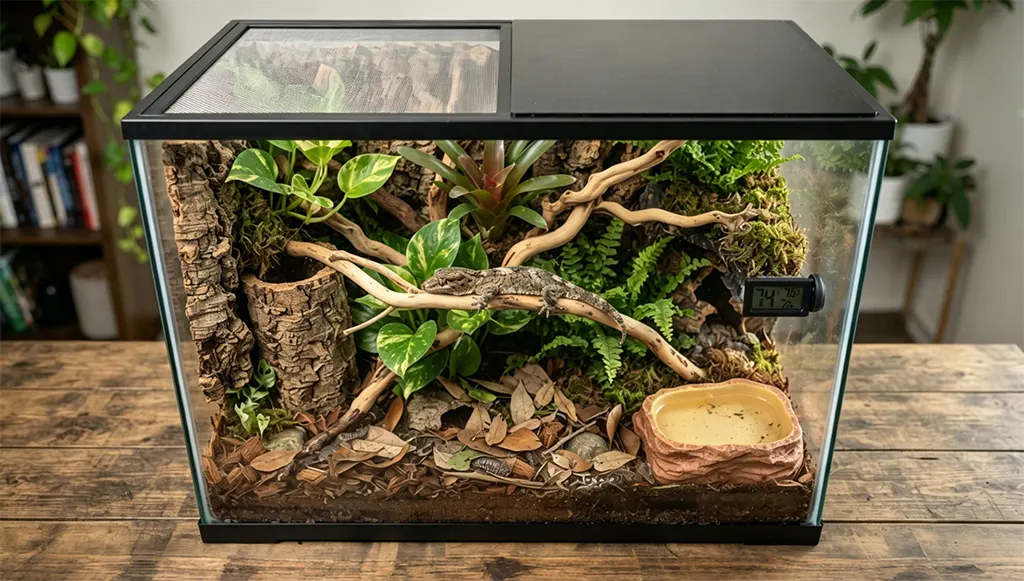
Fish Scale Geckos come from northern Australian environments with distinct wet and dry seasons. Their entire reproductive calendar is wired to these seasonal shifts. If your terrarium conditions never change, neither will your geckos’ breeding readiness.
The Temperature Gradient That Actually Works
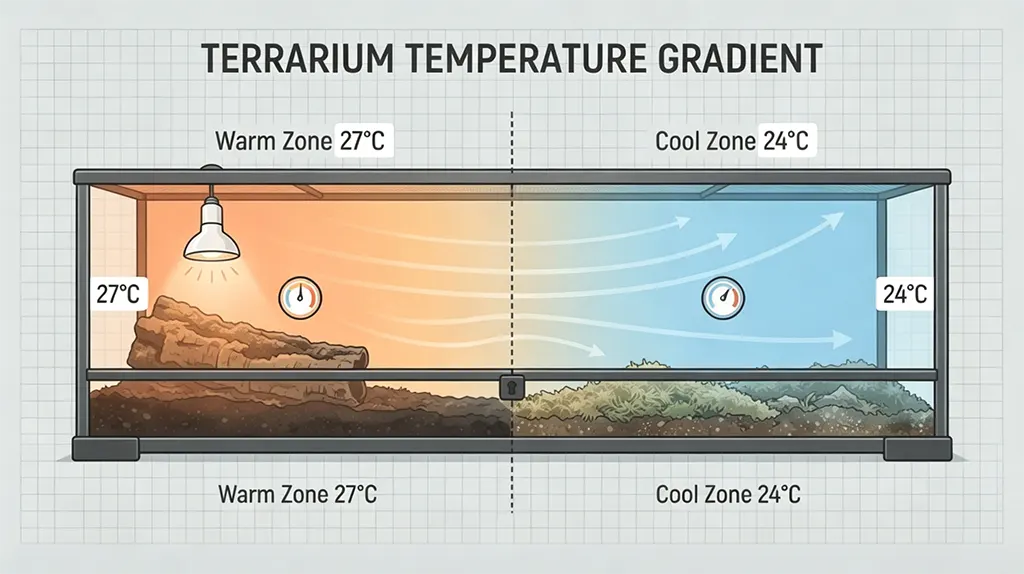
After years of tweaking, here’s the temperature setup that consistently triggers breeding behavior:
Daytime (lights on): 24-27°C (75-81°F)
- Warm end around 27°C, cool end around 24°C
- A slight gradient matters more than hitting exact numbers
Nighttime (lights off): 20-22°C (68-72°F)
- This 4-5 degree drop from daytime is non-negotiable
- The nighttime temperature decrease mimics natural conditions and resets their internal day-night cycle
The seasonal shift that triggers breeding:
- Pre-breeding cooling phase (4-6 weeks): Drop nighttime temps to 18-20°C (64-68°F) and reduce photoperiod to 10 hours. This is your simulated “dry season cool-down.”
- Breeding trigger (weeks after cool-down): Gradually raise temps back to standard range and extend photoperiod to 13-14 hours. This is your simulated “wet season arrival.” The combination of warming + longer days is what fires the gecko mating behavior sequence.
Getting this right took me way longer than it should have. I didn’t just skip the cool-down phase once — I tried three different versions of a cool-down before landing on what actually works. First time, I dropped temps to 16°C for two weeks. Too aggressive, geckos basically shut down. Second time, I did 20°C but only for a week. Too mild, nothing changed. Third time, I went to 18°C for five weeks and finally saw the males start displaying. I honestly don’t know if it was the temperature, the duration, or some combination — but five weeks at 18-20°C is what stuck.
Terrarium Humidity Control — The Number One Failure Point
Here’s where I lost more clutches than I care to admit.
Target humidity range: 60-75%
This is a narrow band. Below 60% and geckos get dehydrated, females struggle during their laying cycle, and shed quality tanks. Above 75% and you’re inviting skin issues — scale discoloration, stuck shed that won’t come off, and in the worst cases, fungal growth on skin.
What I do now:
- Morning misting: Light spray across the enclosure, let humidity spike to 75-80% naturally, then let it drift down through the day
- Hygrometer in every enclosure — not one hygrometer for the room, one per tank. Room-level monitoring tells you nothing about what’s happening at substrate level
- Substrate choice matters: coco husk holds moisture well without getting soggy
The mistake I kept making:
I’d mist the enclosure, see humidity hit 80%, and think “perfect.” Then it’d drop to 50% within two hours because I hadn’t accounted for ventilation. A screen-top terrarium in a dry room loses humidity fast. I was basically running my geckos through a daily humidity rollercoaster and wondering why the females weren’t holding eggs well.
It took me a while to figure out the right approach. I tried paper towels first — terrible idea, humidity crashed every time I misted. Then I switched to a fully enclosed glass tank with no ventilation at all — humidity was stable but the geckos started looking moldy and I panicked. Then I tried a screen top with a humidity tent over half the tank — closer, but the tent created a microclimate that was too damp. Finally I landed on partial enclosure covering (half screen, half solid lid) plus a shallow water dish. That combination keeps baseline around 65% and misting pushes it up to 75% for a few hours. I’m not sure which part of that journey taught me the most, honestly — probably the moldy gecko moment.
Proper terrarium humidity control is probably the single most important part of Gehyra marginata husbandry once you’ve nailed temperatures.
Proper terrarium humidity control is probably the single most important part of Gehyra marginata husbandry once you’ve nailed temperatures. [If you need help calculating the exact environment for your gecko, use our professional reptile environment temperature and humidity calculator to get instant, stage-specific requirements.]
Part 3: Pre-Breeding Body Condition Assessment
You can’t skip this step. I did, and it cost me.
Female Readiness Indicators
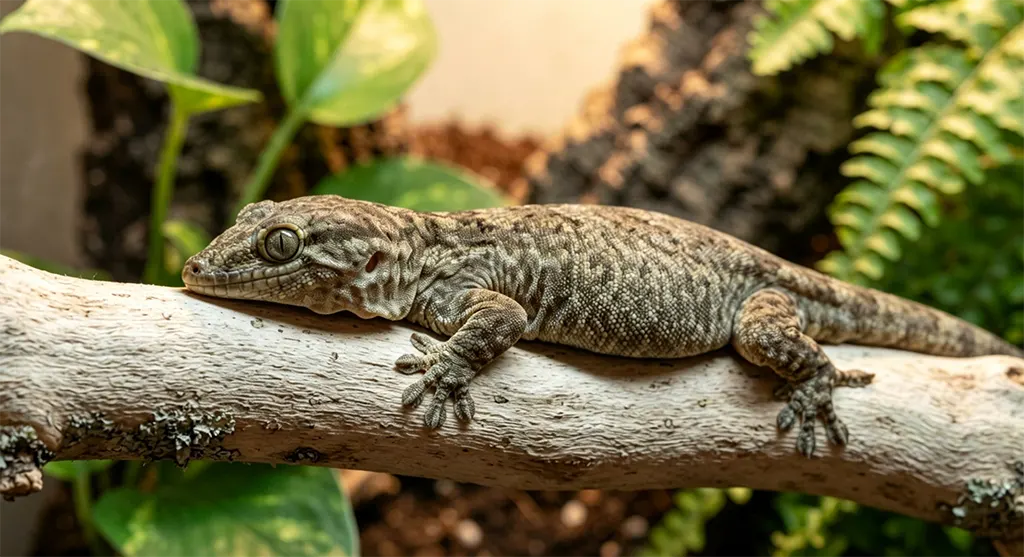
- Body weight: Females should be at a healthy adult weight — typically 25-35 grams for mature Gehyra marginata. Underweight females will either skip ovulation entirely or produce weak, underdeveloped eggs.
- Visible egg development: Around 2-3 weeks before laying, you may notice slight swelling along the sides of the body. This is eggs developing internally. If you don’t see any change after your environmental triggers, the female likely isn’t carrying yet.
- Calcium stores: Females need serious calcium reserves for egg production. I dust feeders with calcium powder at every feeding during the pre-breeding buildup phase. No shortcuts here — calcium-deficient females either don’t carry well or produce soft-shelled eggs that won’t survive incubation.
Male Readiness Indicators
- Hemipenal bulge visibility: Males in breeding condition show more prominent hemipenal bulges. If you can’t clearly see them, the male probably isn’t ready.
- Behavioral activation: A ready male is an active male. He should be patrolling, displaying, and showing interest in the female. A passive male during the breeding window is a male that didn’t get the environmental cues — go back to Part 2.
The Pairing Mistake I Made
I once paired a male and female who were both clearly not ready, because I’d run out of patience with the cool-down phase. I’d actually done the cool-down correctly that year — or at least I thought I had — but the female wasn’t bulking up the way I expected, so I forced the issue anyway. The male ignored the female completely. The female retreated to her hide and stayed there for a week. I felt like an idiot and probably stressed both animals unnecessarily.
Then I started second-guessing everything. Was my cool-down too short? Too long? Did I mess up the photoperiod? I spent two weeks obsessing over thermostat logs and humidity readings, comparing them against notes I’d half-heartedly kept. Turns out the female just wasn’t at breeding weight — she’d been a late grower and needed another season to bulk up. Nothing was wrong with my setup. I was just impatient.
Rule I follow now: If you don’t see clear readiness signs in both animals, don’t force the pairing. Wait for the next cycle. A missed season is nothing compared to stressed-out geckos who associate each other with bad experiences.
Part 4: Egg Incubation Parameters — Where the Rubber Meets the Road
So you’ve got eggs. Congratulations. Now don’t mess up the egg incubation like I did my first time.
Temperature Settings
Optimal incubation temperature: 26-28°C (79-82°F)
This is the range where Fish Scale Gecko eggs develop reliably. Here’s the breakdown:
- 26°C (79°F): Slower development, slightly longer incubation period, but lower risk of developmental issues. I prefer this end for my first few attempts.
- 28°C (82°F): Faster development, but if your incubator has even slight temperature fluctuations, you risk the embryos stopping development altogether. I don’t recommend the high end until you’re confident in your equipment stability.
What I use: A dedicated reptile egg incubator with a digital thermostat. I set it at 27°C and check it twice daily with a separate thermometer. Redundancy is cheap insurance.
Humidity During Incubation
Target: 70-80% relative humidity inside the incubation substrate
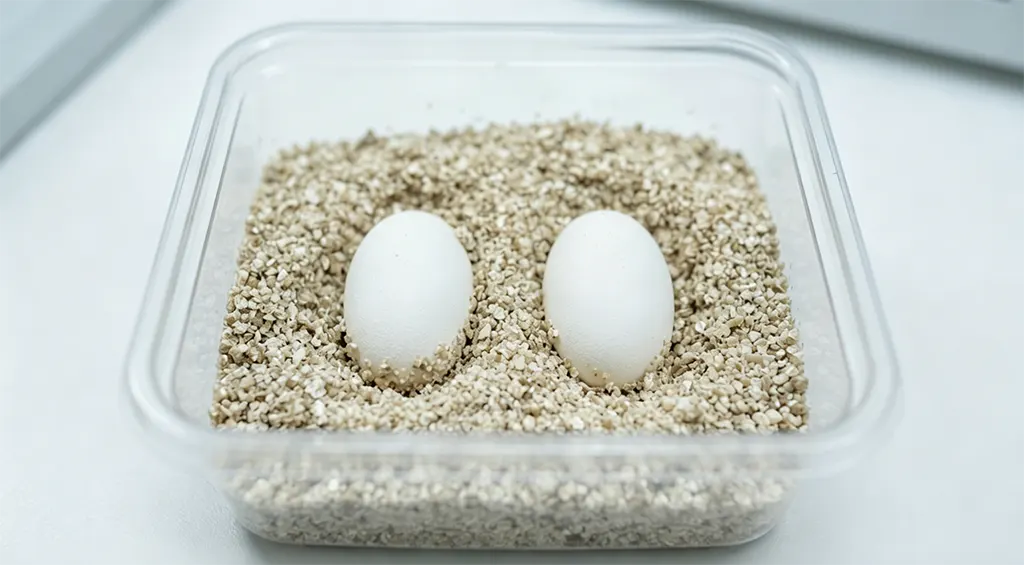
- I use vermiculite as the incubation medium, mixed at a 1:1 ratio by weight with water
- Check substrate moisture weekly — it should feel damp but never wet. Squeeze test: if water drips when you squeeze a handful, it’s too wet
- Eggs will physically deflate if humidity drops too low and swell if it’s too high. Both are bad—if you notice shell indentation or moisture buildup, follow our emergency protocol on fixing dented and moldy gecko eggs before embryo collapse becomes irreversible.
Incubation Timeline
At 26-28°C, Fish Scale Gecko eggs typically hatch in 55-75 days. Don’t panic if yours take longer — temperature stability matters more than speed.
The clutch I almost ruined:
One season, I had a clutch that hadn’t hatched at day 70. I started freaking out, candling them obsessively, moving the incubator around trying to bump temps up. I also tried increasing humidity because I read somewhere that might help — made things worse, eggs started looking a bit waterlogged. Then I tried dropping the temp to 25°C thinking slow and steady — also wrong, they took even longer. Turns out my separate thermometer had drifted 2 degrees low and the eggs were actually sitting at 25°C the whole time. I was fixing something that wasn’t broken. Fixed the thermometer, stopped messing with settings, waited another three weeks, and got four healthy hatchlings.
Lesson learned: Trust your data, verify your tools, and stop panicking.
Substrate Choice for Egg Incubation
- Vermiculite (my current standard): Consistent moisture retention, easy to mix to the right dampness level, eggs sit well on the surface without sinking
- Perlite (tried once, switched back): Too dry, too fast. I couldn’t maintain stable humidity without constant topping up
- No substrate (dry incubation): Don’t. Just don’t. Fish Scale Gecko eggs need ambient humidity or they’ll dehydrate and collapse
Part 5: Other Stuff I Got Wrong — A Miscellaneous Mess-Up List
Everything in Parts 2-4 covers the big topics. But there’s a long tail of smaller mistakes that burned me along the way. This is the stuff nobody warns you about until you’re already deep into it.
The Substrate Incident
Early in my breeding journey, I used cedar shavings because they smelled nice and “felt natural.” Within a week, two of my geckos were acting sluggish and one had respiratory irritation. Turned out cedar oils are basically toxic to small reptiles. Switched everything to coco husk and never looked back. That was an expensive lesson — those two geckos lost almost a month of growth.
The “Helpful” Roommate
A roommate decided to be helpful by adjusting the thermostat while I was out of town. Bumped the cool-down temps up by 3 degrees because “the geckos looked cold.” Completely blew the entire cool-down protocol I’d spent weeks carefully executing. I didn’t figure it out until the mating season ended with nothing to show for it. I should have put a lock on the equipment room. Lesson learned the hard way — label your equipment, tell people not to touch it, and maybe invest in a padlock.
Feeding Schedule Chaos
I used to feed on a rigid schedule: crickets every Monday and Thursday. Worked fine for maintenance. But during the pre-breeding buildup, I needed to ramp up feeding frequency. I switched to every other day but didn’t adjust portion sizes — geckos started looking bloated and one refused food for days. Took me a while to realize I was basically overfeeding them on the bigger portions and underfeeding on the smaller ones. Eventually figured out that smaller portions more frequently works better than big meals on a compressed schedule. But the transition period was ugly.
Incubator Placement
Put my first egg incubator on a shelf near the window. Thought it’d be fine. Forgot about direct afternoon sun hitting the shelf for about 90 minutes every day. Temperature inside the incubator was bouncing between 25°C and 31°C while I was at work. Didn’t realize until I checked the data logger and saw the spike pattern. Moved it to an interior wall and the problem disappeared. But that first clutch was already toast.
The Labeling Disaster
I had multiple incubators running simultaneously — one at 26°C, one at 28°C, and a small backup unit. Forgot to label them clearly. Ended up moving a clutch from the 26°C unit into the 28°C unit “to give them more warmth” without realizing I was moving eggs that were already halfway through development. The temperature jump was too much and the embryos stopped developing in at least half the eggs. Should have had a proper labeling system from day one. Basic stuff, but when you’re juggling multiple clutches and enclosures, basic stuff falls through the cracks.
Frequently Asked Questions
How long does it take for Fish Scale Geckos to start breeding after the cool-down phase?
Most pairs will show mating behavior within 2-4 weeks after temperatures are raised back to the standard range and the photoperiod is extended. If nothing happens after 6 weeks, your cool-down wasn’t sufficient — extend it next cycle.
What’s the ideal terrarium humidity control setup for breeding Fish Scale Geckos?
Maintain 60-75% humidity using partial enclosure covers, daily misting, and a shallow water dish. Use a separate hygrometer per enclosure — not per room. This control setup keeps humidity stable without daily swings.
Can I incubate Fish Scale Gecko eggs at room temperature?
Room temperature (typically 20-22°C) is too low for reliable egg incubation. Eggs need a stable 26-28°C. You need a dedicated incubator with a thermostat.
How do I know if my female Fish Scale Gecko is ready to lay eggs?
Look for visible midsection swelling, increased time near the warm end of the terrarium, and reduced appetite in the days immediately before laying. These are the standard pre-laying signals.
What substrate is best for Fish Scale Gecko egg incubation?
Vermiculite mixed 1:1 by weight with water is the most reliable option. It holds moisture consistently and allows easy monitoring of egg condition.
Quick Reference: Key Parameters at a Glance
| Parameter | Value |
|---|---|
| Daytime temperature | 24-27°C (75-81°F) |
| Nighttime temperature | 20-22°C (68-72°F) |
| Cool-down nighttime temp | 18-20°C (64-68°F) |
| Cool-down duration | 4-6 weeks |
| Photoperiod (breeding) | 13-14 hours |
| Photoperiod (cool-down) | 10 hours |
| Terrarium humidity | 60-75% |
| Incubation temperature | 26-28°C (79-82°F) |
| Incubation humidity | 70-80% |
| Incubation duration | 55-75 days |
| Female breeding weight | 25-35g |
Wrapping Up
Fish Scale Gecko breeding isn’t rocket science, but it’s not casual either. These geckos need seasonal environmental variation to trigger gecko mating behavior, stable terrarium humidity control to stay healthy through the breeding process, and precise egg incubation conditions to actually produce viable offspring.
Everything in this guide comes from real failures. Every parameter listed was learned the hard way — usually because I assumed something would “probably be fine” and then watched a clutch fail because of it.
The good news: once you get the environmental triggers right and nail your Gehyra marginata husbandry basics, Fish Scale Geckos are genuinely rewarding to breed. They’re tough, they’re interesting to watch, and when you get that first successful clutch hatching after months of careful preparation, it’s one of the best feelings in reptile keeping.
Just do the cool-down phase. Seriously. Don’t skip it like I did.
For health concerns, consult an ARAV-certified exotic animal veterinarian.
This content is for educational purposes only and does not substitute professional veterinary diagnosis or treatment. If you observe any symptoms of illness, injury, or abnormal behavior, please consult a qualified exotic animal veterinarian immediately.
For more details, please review our full Medical Disclaimer.