
Opening: The Red Light Mistake
I built my first dedicated reptile room early on. Made what seemed like a smart choice: red heat lamps for nighttime heating. Bragged about my “professional” setup on social media. Friends commented about how cool it looked.
The logic was straightforward—red light doesn’t mess with circadian rhythms, right?
Wrong. Spectacularly wrong.
Took me eight months to figure out why my crested geckos kept being active at weird hours. Didn’t connect it to the lights until one night I happened to be in the room at 2 AM and watched one cruising around like it was high noon.
Took another three months to rebuild the whole lighting system.
This isn’t a gear recommendation list. This is a real-world optimization record from someone who’s made every mistake possible and lived to write about it.
Part 1: Where Light Pollution Actually Comes From
The Real Sources of Visual Disruption
Light pollution in a reptile room isn’t about what looks harsh to human eyes—it’s about what screws with gecko day-night cycles and natural behavior patterns.
Primary contamination sources:
Full-spectrum visible light spillover: Too much ambient lighting overwhelms the UVB gradient you carefully set up. Zone 1 species (crested geckos) act stressed and hide constantly under high-intensity broad-spectrum exposure.
Heat lamp spectral issues: Ceramic heat emitters and infrared basking lamps emit visible red light despite what the packaging says. These wavelengths mess with gecko light-sensitive responses. Documented outcomes show altered rest-activity patterns in geckos exposed to continuous infrared at night.
Blue light excess: Standard white LEDs contain high blue light ratios. Blue wavelengths affect melatonin production. Night-active species get hit hardest.
Observed signs of day-night cycle disruption:
- Feeding at weird hours instead of predictable times
- Territorial behaviors that don’t match normal patterns
- Breeding cycles all over the place, not synced with seasons
- Geckos looking perpetually sluggish
I’ve watched these problems across multiple species—the root cause was always lighting management, usually something dumb I’d done.
Measurement Tools
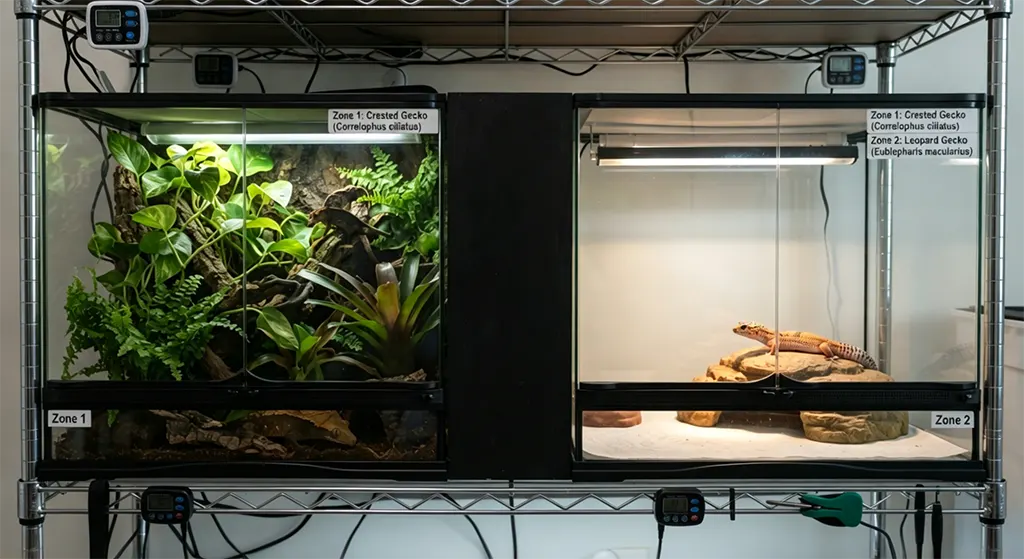
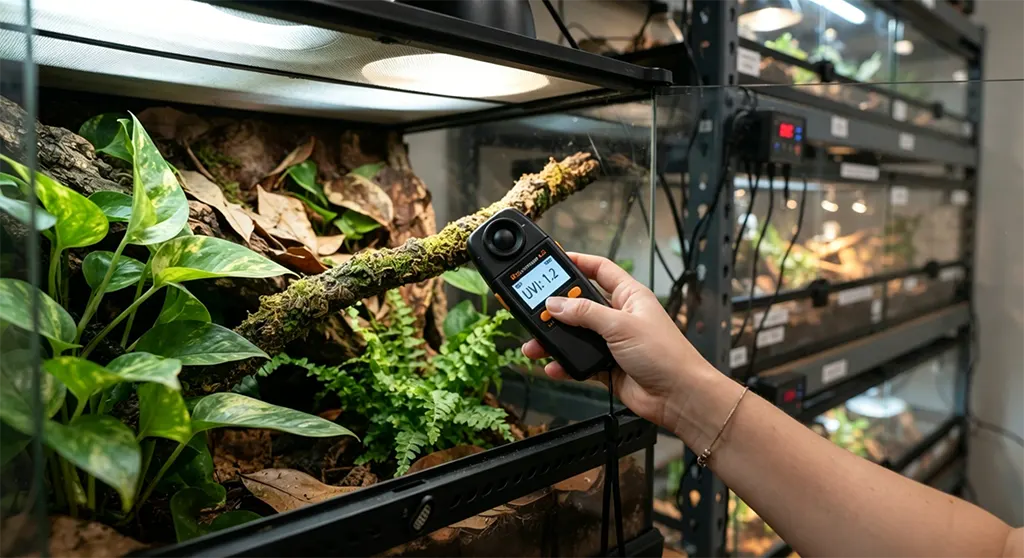
Spent an entire year realizing that eyeballing light intensity tells you nothing.
Required measurement equipment:
- Lux meter: Measures visible light intensity in Lux
- UV index meter: Measures UVB radiation in UVI
- Spectrometer (optional): Detailed spectral breakdown
Without measurement data, you’re just guessing.
Part 2: UVB Configuration by Ferguson Zone
Zone Requirements Per Species
UVB requirements follow Ferguson Zone classifications, ranging from Zone 1 (barely needs it) through Zone 5 (lots of sun in habitat, typical for higher-UVB diurnal species featured in our Blue-Tongued Skink decision blueprint).
Gecko species Zone distribution:
Crested geckos (Correlophus ciliatus): Zone 1—barely needs UVB, naturally living under thick rainforest canopy that filters most sunlight.
Leopard geckos (Eublepharis macularius): Zone 2-3—moderate-low UVB need, naturally living in semi-arid scrub with partial direct sun.
African fat-tailed geckos (Hemitheconyx caudicinctus): Zone 2 positioning, similar to leopard geckos.
Per-species UVB setup:
Zone 1 species: 5% UVB tube or 2-3% compact fluorescent, providing low-intensity gradient exposure. Arcadia 6% or Zoo Med 5.0 tube fixtures both work fine.
Zone 2-3 species: 5-6% UVB tube, positioned above basking zone, providing moderate UVI readings at 30-45 cm distance from animal.
My Zone Configuration Disaster
Early in my breeding program, I housed crested and leopard geckos in the same room using a unified UVB system for both species with completely different Zone requirements.
Result: leopard geckos looked amazing—color really popped (Zone 2-3 requirement satisfied). But crested geckos started showing scale whitening—classic overexposure symptoms.
Took two months to figure out what was happening. By then I’d already stress-sold one of my best crested geckos to someone because I thought it was sick. The buyer sent me updates for months showing how well it recovered after I told them about my lighting situation. Felt like a total amateur.
Crested gecko Zone 1 requirement means their UVB tolerance ceiling sits way below leopard gecko levels. Shared systems guarantee over-exposure for the sensitive group.
Solution implemented: Completely separated UVB sources, Zone 1 areas using attenuated placement (UVB tube much farther from enclosure, or shading materials blocking some output).
Part 3: Day-Night Cycle Management Through Thermostat Integration
The Heat Lamp Problem
Traditional thermostat setups rely on ceramic heat emitters or infrared basking lamps. Here’s the thing nobody tells you: their spectral characteristics are garbage.
Ceramic heat emitters emit visible red light despite “heat-only” marketing claims. Infrared basking lamps produce visible red and near-infrared radiation. These wavelengths mess with photosensitive systems even when you think you’re running “dark mode.”
Real outcome I observed: With all visible light sources off and ceramic heating alone running, crested gecko activity peaks shifted 2-3 hours later than expected. They were basically jet-lagged 24/7.
Alternative heating approaches:
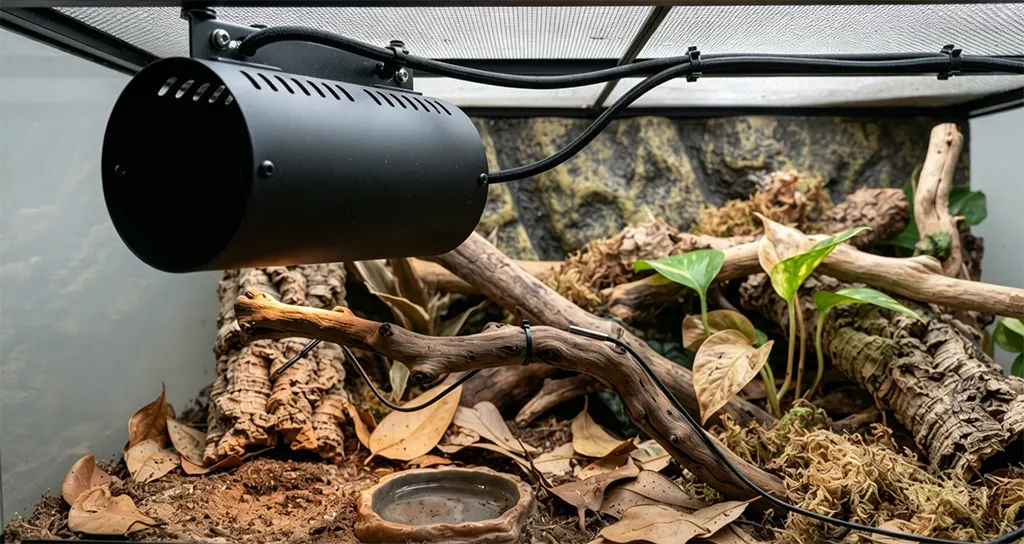
What I use now: DHP (Deep Heat Projector) or CHE (Ceramic Heat Emitter) with completely opaque light shields, eliminating all visible light leakage. This is my current standard for all Zone 1 species.
Acceptable backup: Deep-spectrum ceramic heat emitters, visible spectrum substantially reduced, still producing minor red light but manageable.
Last resort: Ambient-only temperature management and substrate heating, no active heating during warm seasons.
How to heat a crested gecko tank properly
Crested gecko temperature at night is critical. They don’t need hot temps—they need stable temps. I run my crested gecko room at 72-76°F (22-24°C) ambient, with humidity staying around 60-80%. Night temps can drop to 68°F (20°C) without problems as long as it doesn’t fluctuate wildly.
Automated Thermostat Architecture
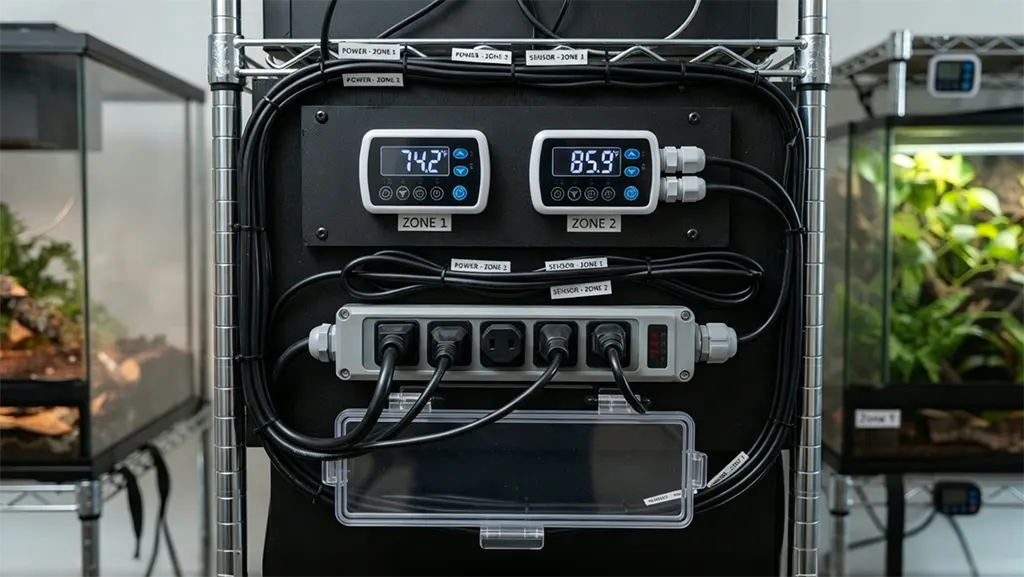
Multi-species integrated rooms cannot sustain manual temperature management. The first time I left town on a weekend early in my automation journey, I came back to find every single enclosure had dropped 15 degrees because my “robust” system had a single controller fail.
Took me fourteen months to build an automation system I initially thought was complete. It wasn’t.
System architecture:
Thermostat → Heating equipment (zone-controlled) → Temperature probes (species-specific independent circuits) → Environmental sensors (aggregate monitoring)
Actual operational problems I hit:
- Probe positioning was completely wrong—measured air temp above the gecko, not where the gecko actually sat
- Winter heating interruption caused simultaneous cooling across multiple species, exposing that my backup plan was just “hope nothing breaks”
- One thermostat failure knocked out heat to twelve enclosures at once. Lost two eggs that season.
Final improvements that actually worked: Independent thermostat circuits per enclosure zone, dual-power redundant supply for critical heating equipment, probes positioned at substrate level where the geckos actually live.
Part 4: Complete Hardware Configuration
My Current reptile room setup guide
Complete lighting and thermostat configuration for multi-species breeding room:
Zone 1 Area (Crested Geckos):
- UVB source: Arcadia 6% D3 tube with reflective fixture, positioned 60+ cm above enclosure
- Visible light source: Timer-controlled white LED, 5000K color temperature, adjustable intensity
- Heating source: DHP deep heat projector or CHE with complete light-blocking housing
- Thermostat: Independent circuit, temperature setpoint 72-76°F (22-24°C) range
- Monitoring: Dual probes (warm side/cool side), daily logging
Zone 2-3 Area (Leopard/Fat-Tailed Geckos):
- UVB source: Arcadia 6% or Zoo Med 5.0 tube, 30-40 cm above basking surface
- Visible light source: 12-hour photoperiod, intensity satisfying 150-300 Lux per industry observation
- Heating source: Undertank heating mat + ambient DHP combination
- Thermostat: Basking spot independently monitored, warm zone 88-92°F (31-33°C), cool zone 75-80°F (24-27°C)
- Monitoring: Weekly probe accuracy calibration
Seasonal Lighting Adjustments
Day-night cycle management isn’t “set once, run forever.”
Winter adjustment protocol:
- Reduce photoperiod to 10 hours, simulating natural decreasing day length
- Decrease active heating reliance as ambient temperature drops
- Use seasonal cooling to help trigger breeding cycles
Summer adjustment protocol:
- Extend photoperiod to 14 hours, supplementing natural day length extension
- Ramp up ventilation as thermostat systems work harder
- Watch for temperature spikes during heat waves
Part 5: Common Configuration Mistakes
Mistake 1: Same UVB System for Everything
This is the most common beginner error I see people make. “UVB is good for reptiles” leads to uniform high-output UVB everywhere.
Zone 1 species get overexposure symptoms when overall environmental UVI exceeds their tolerance. Shared systems guarantee this outcome for sensitive species.
Mistake 2: Ignoring Heat Lamp Spectral Issues
“Ceramic heat emitters don’t produce light”—this claim is marketing nonsense. Testing shows most “lightless” heating equipment emits measurable red and infrared radiation.
Nighttime operating heating equipment, even with minor visible output, screws up photosensitive species rest patterns.
Mistake 3: Wrong Probe Placement
Positioning probes in enclosure top corners or bottom corners produces readings completely different from actual gecko-perceived temperatures.
Probes must be positioned at substrate level in actual animal activity zones. One each for warm and cool sides.
Frequently Asked Questions
Do crested geckos actually need UVB?
Crested geckos occupy Zone 1 low-UVB environments. They survive without UVB through dietary supplements. However, UVB helps calcium synthesis support, which improves overall health. Providing low-intensity UVB (5% output) is a solid setup approach.
Are red heat lamps safe for nighttime heating?
No. Red heat lamps are not recommended for nighttime heating. Observed outcomes show red light disrupts day-night cycles in crested geckos and other night-active species. Use fully light-blocking ceramic heating or DHP equipment instead.
Do LED lights meet gecko lighting requirements?
Standard white LEDs don’t provide UVB radiation—they only satisfy visible light needs. LEDs alone can’t support species requiring UVB exposure. Pair LEDs with a proper UVB source.
How do I verify my thermostat system is working correctly?
Log warm-side and cool-side temperature readings daily, comparing against thermostat setpoints. Calibrate probe accuracy weekly. Perform manual temperature verification testing quarterly.
Quick Configuration Checklist
Lighting System:
- [ ] Independent UVB source per enclosure zone, configured per Zone requirements
- [ ] Visible light sources on timers, simulating natural photoperiod
- [ ] Night heating completely light-blocked, no visible light leakage
- [ ] Ambient light intensity matches species requirements (Zone 1: low light; Zone 2-3: moderate light)
Thermostat System:
- [ ] Independent thermostat circuit per enclosure zone
- [ ] Warm-side/cool-side dual probe monitoring
- [ ] Critical equipment dual-power backup supply
- [ ] Daily temperature logging verification
Monitoring Equipment:
- [ ] Lux meter for visible light intensity
- [ ] UV index meter for UVB coverage verification
- [ ] Regular sensor calibration across all equipment
If you are ready to start building your own setup but aren’t sure where to begin, I’ve put together an interactive reptile equipment checklist that suggests the necessary gear based on your specific species needs.
Conclusion
Building a reptile room lighting configuration isn’t about “buying the best equipment.”
It’s about understanding each species’ lighting needs, then replicating them as closely as budget and practicality allow.
My setup took three years to reach its current state. Every step involved stumbling. The embarrassing part is how many of these mistakes were things I’d read warnings about—I’d just ignored them because the warnings seemed exaggerated.
The core logic never changes: zone separation, precise monitoring, day-night cycle priority.
For health concerns, consult an ARAV-certified exotic animal veterinarian.
This content is for educational purposes only and does not substitute professional veterinary diagnosis or treatment. If you observe any symptoms of illness, injury, or abnormal behavior, please consult a qualified exotic animal veterinarian immediately.
For more details, please review our full Medical Disclaimer.