
Introduction: Why Starter Kits Target New Keepers (And Why That’s the Problem)
Every major pet retail chain sells Leopard gecko starter kits. Colorful boxes promising “everything you need” for $40-$80. Glossy photos showing a Leopard gecko posed next to a compact enclosure, heat lamp, and decorative hide. The message is clear: reptile ownership is simple, inexpensive, and approachable.
That message is designed to sell products. It’s not designed to keep your Leopard gecko healthy.
Walk through the reptile section at any large pet retailer. Count the starter kit options. Now count how many include a quality thermostat. The answer consistently disappoints. These kits sell because they look complete. They sell because new keepers don’t know what they actually need. They sell because the Leopard gecko inside the marketing photo looks content in an undersized enclosure surrounded by inappropriate substrate.
This guide exists to save you from that marketing trap. By the end, you’ll understand exactly what’s in those boxes, what’s dangerously missing, and how to build a setup that actually supports Leopard gecko health for 15-20 years.
Part 1: The Psychology of the Starter Kit Purchase
Why New Keepers Fall for the Bundle
When you’re starting any new hobby, complexity feels threatening. You don’t know what you don’t know. A bundle promising “everything included” reduces cognitive load. You see one price, one box, one decision. The alternative—researching individual components, comparing options, building a parts list—feels overwhelming when you’re still learning basic species requirements. (If you are still deciding between similar beginner species or regional climate setups, read our African Fat-Tailed Gecko vs Leopard Gecko Inland Southern California beginner breakdown.)
Pet retailers understand this psychology. They design products specifically targeting new keeper anxiety. The starter kit isn’t selling optimal husbandry. It’s selling confidence and simplicity to people who don’t yet know better.
This isn’t malicious. It’s marketing. But marketing and animal welfare don’t always align.
What Starter Kits Actually Accomplish
Starter kits provide genuine value in one specific scenario: they reduce the number of separate transactions required to begin Leopard gecko ownership. If you’re purchasing from a retailer that doesn’t carry individual components, or if you’re uncomfortable assembling a setup from separate purchases, a starter kit eliminates some friction.
Beyond that narrow use case, starter kits consistently underperform compared to purpose-built setups. The components inside trade quality for packaging appeal. The enclosures are sized for marketing photos, not Leopard gecko welfare. The heating elements prioritize visual design over functional reliability. The substrate choices reflect cost management rather than safety standards.
Understanding what’s actually in these boxes requires examining each category honestly.
Part 2: What’s Actually Inside Those Kits
The Enclosure: Sized Wrong from the Start
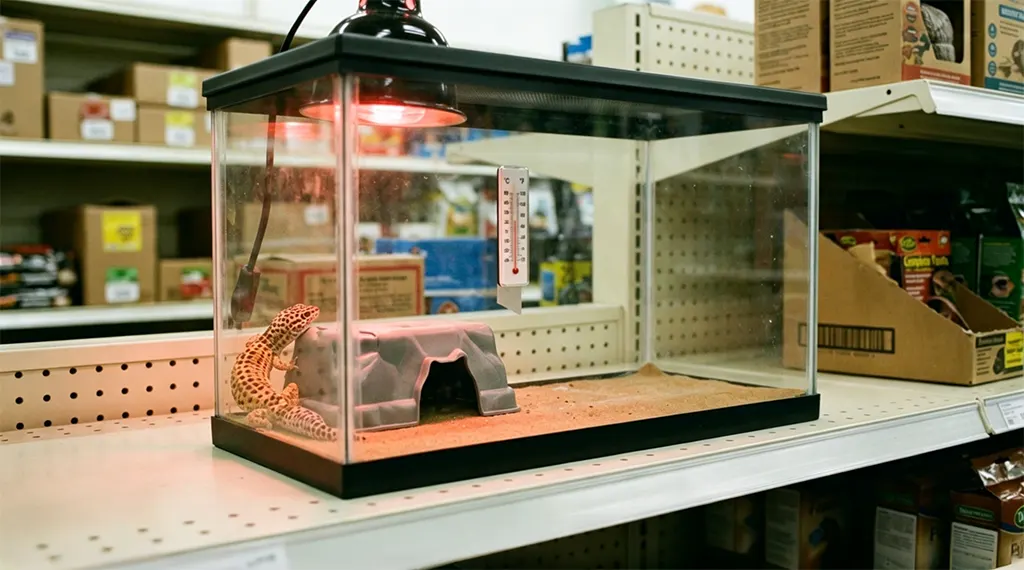
Starter kit enclosures typically measure 10-20 gallons. Marketing often suggests these sizes suit adult Leopard geckos “comfortably.” That claim doesn’t withstand scrutiny.
A 10-gallon tank—measuring approximately 20″ x 10″ x 12″—provides less floor space than a standard desktop. An adult Leopard gecko in this enclosure cannot achieve appropriate thermal gradient separation without significant compromise.
Reptile husbandry consensus recommends minimum 40-gallon enclosures for adult Leopard geckos. Resources like Reptifiles.com provide detailed husbandry specifications supporting these minimum sizing recommendations. Some keeper standards call for 20-gallon minimum for juveniles transitioning to adult housing. A 10-gallon starter kit sets new keepers up for failure before they even begin.
Why do retailers sell undersized enclosures? Because larger tanks cost more and require more equipment. Starter kit pricing needs to hit attractive price points. Something gets cut. Unfortunately, what gets cut is the space your Leopard gecko actually needs.
Heating Elements: Danger Without Control
Every starter kit includes some form of heating. Heat lamps, heat mats, or ceramic heat emitters—typically without a thermostat.
Here’s what that means in practice: heating elements produce heat continuously unless interrupted. Without a thermostat regulating power based on temperature readings, your heat mat runs at full output 24/7. Surface temperatures climb until something changes—either the mat fails, the ambient room temperature rises enough to reduce the differential, or you notice the problem.
Thermal burns in Leopard geckos most commonly occur from under-tank heating without thermostat control. The animal seeks warmth, presses against the heated surface, and tissue damage accumulates over hours of exposure. New keepers often don’t notice until visible burns appear.
Quality thermostat systems cost $30-$80. They’re absent from virtually every starter kit on the market. Why? Because thermostats are invisible in marketing photos and add cost without visual appeal.
Substrate: The Silent Killer
Walk through any pet store reptile section and count how many starter kits include sand, calcium sand, or pine/cedar shavings as substrate options. These materials appear frequently. They’re inexpensive, visually appealing, and catastrophically inappropriate for Leopard geckos.
Sand and calcium sand pose impaction risk. Leopard geckos ingest substrate while hunting, during feeding responses, and accidentally while shedding. Sand accumulates in the digestive tract. Impacted Leopard geckos require emergency veterinary intervention—if caught in time. This is documented repeatedly across keeper forums and veterinary case reports.
Pine and cedar shavings contain aromatic oils (phenols) toxic to reptiles. These materials release vapors that damage respiratory tissue and can cause neurological symptoms. Cedar shavings in particular have documented toxicity. Yet they appear in budget reptile substrates and starter kit bundles.
Safe substrate options—reptile carpet, paper-based substrates, tile, or properly composed bioactive mixes—don’t fit the marketing aesthetic of a desert-themed habitat. They don’t appear in starter kits.
UVB: The Missing Essential
Early Leopard gecko husbandry literature suggested they didn’t require UVB lighting. That guidance is outdated.
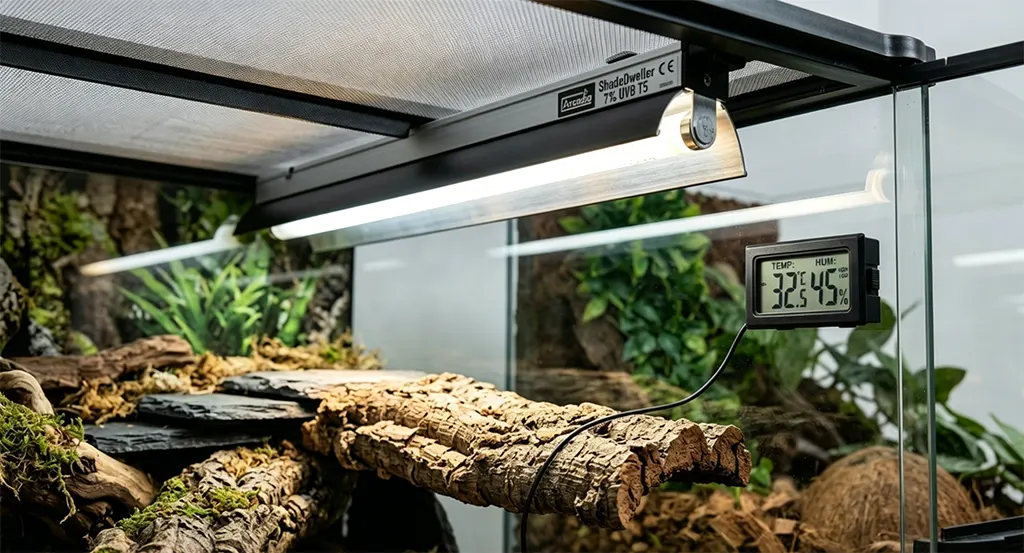
Current research and reptile veterinary consensus acknowledge that Leopard gecko calcium metabolism benefits from low-level UVB provision. Products like the Arcadia ShadeDweller (7% UVB output) support vitamin D3 synthesis more reliably than dietary supplementation alone.
Starter kits don’t include UVB lighting. They don’t include fixtures. They don’t include guidance about UVB provision. The “no UVB needed” myth persists because Leopard geckos survive without it. They don’t thrive. They develop metabolic bone disease at higher rates. Starter kits reinforce outdated science while marketing convenience.
Hides: Style Over Function
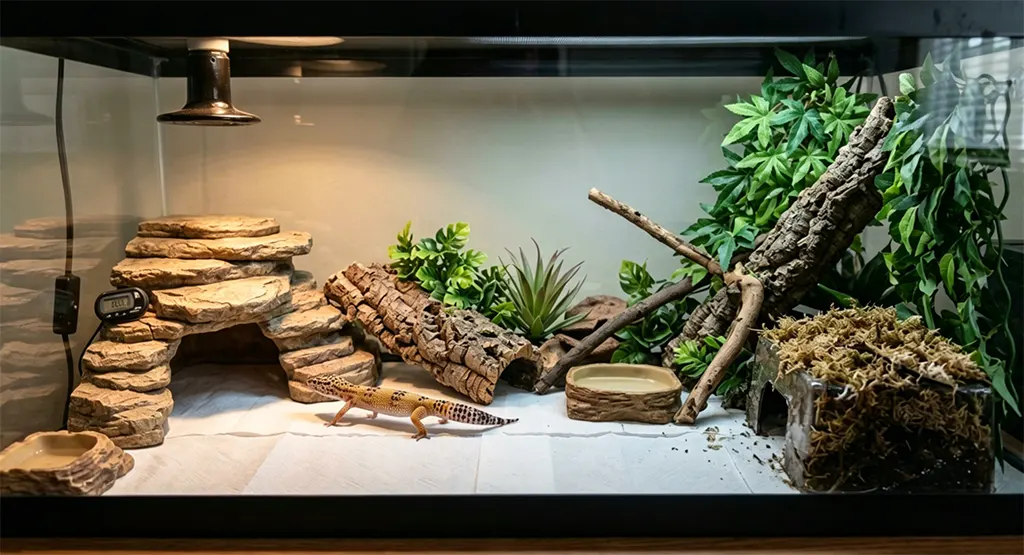
Starter kits include hides—usually one. Leopard geckos require minimum two hides: one on the warm side, one on the cool side. A single hide forces the animal to choose between temperature preference and security. They compromise both.
Part 3: Essential Gaps That Must Be Filled
The Thermostat Problem (Non-Negotiable)
Before anything else: if your starter kit doesn’t include a quality thermostat, that item becomes your first purchase after bringing home your Leopard gecko. Not optional. Not “nice to have.” Non-negotiable.
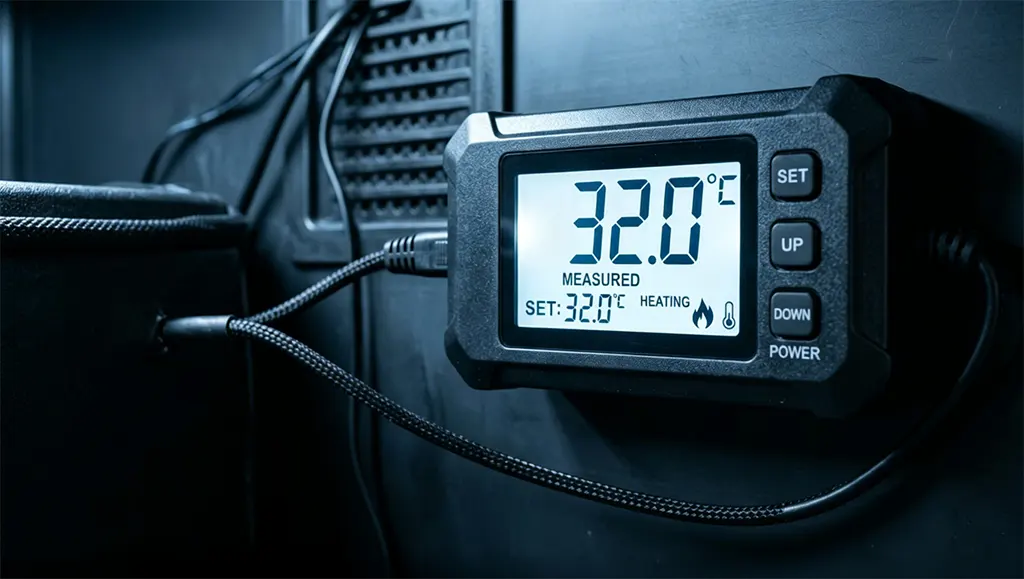
A thermostat monitors temperature and controls heating element power accordingly. Set your warm side target, connect your heat source, and the system maintains parameters automatically. Thermostats prevent the temperature spikes that cause burns and the equipment failures that create life-threatening overnight drops.
Digital probe thermostats from reputable manufacturers (Jump Start, Herpstat) provide reliable performance at reasonable cost. Budget $40-$80 for a unit that will last years.
This single addition prevents the most common starter kit disaster scenario. Without it, you’re operating a heating system with no safety controls on an animal you barely know yet.
Temperature Verification Equipment
Your thermostat setting isn’t your actual temperatures. Heating elements degrade. Probe placement matters. Room temperature fluctuations affect outcomes.
Digital probe thermometers—separate from your thermostat—provide verification readings. Place probes at substrate level, warm side and cool side. Budget $15-$30 per unit, minimum two.
Quality hygrometers measure humidity. Leopard geckos require 30-40% ambient humidity. Without humidity monitoring, you won’t know until stuck shed problems appear. (For keepers advancing into delicate exotic species that rely on precise climate control and parameter triggers, explore our Fish Scale Gecko breeding guide to environmental simulation.)
Appropriate Enclosure Sizing
A 40-gallon breeder-style enclosure (36″ x 18″ x 18″) provides minimum adequate space for adult Leopard geckos. The critical factor: your Leopard gecko must be able to move between distinct temperature zones within the enclosure.
UVB Lighting Implementation
Add a low-output UVB source. The Arcadia ShadeDweller (7% UVB output) or similar 7% T5 tube provides appropriate supplementation. Position the tube to cover the warm side basking zone.
Part 4: Building Your Actual Setup
To simplify the process and ensure you have exactly what’s needed for your pet’s specific size and species, you can use our interactive reptile equipment checklist tool to generate a customized shopping list.
The Professional Checklist
Essential equipment:
- Appropriately sized enclosure (40-gallon minimum for adults)
- Quality thermostat controlling heat source
- Under-tank heating mat OR ceramic heat emitter
- Digital probe thermometers (minimum two)
- Hygrometer for humidity monitoring
- Minimum two hides (warm side and cool side)
- Water dish
- Paper-based substrate, reptile carpet, or appropriate loose substrate
- Low-output UVB source (optional but recommended)
Feeding supplies:
- Calcium supplement with D3
- Multivitamin supplement
Emergency supplies:
- Reptile-safe antiseptic
- Digital kitchen scale for weight monitoring
Budget Realism
Professional setups cost $200-$400 for complete equipment when starting appropriately.
That investment sounds significant compared to $50 starter kits. Consider the alternative: veterinary bills for thermal burns, impaction treatment, or nutritional deficiencies. Emergency exotic animal care costs $200-$500 for initial examination alone.
The expensive setup is actually the budget option.
Where to Purchase Components
Individual component purchasing offers significantly better outcomes than bundle approaches. Online retailers specializing in reptile equipment (Arcadia, Zoo Med, Exo Terra authorized dealers) provide quality options with accurate specifications.
Part 5: FAQ
Are starter kits ever worth buying?
Starter kits provide convenience value when purchasing from retailers lacking individual component options. However, virtually every starter kit requires supplementation—most critically, a quality thermostat.
What’s the most dangerous missing item in starter kits?
The thermostat. Heating elements without temperature control create burn risk, fire hazard, and overnight temperature failures. This single addition prevents the most common and serious starter kit failure modes.
What size enclosure do Leopard geckos actually need?
Adults require minimum 40-gallon enclosures (36″ x 18″ x 18″). The “10 gallon is fine for adults” claim reflects marketing convenience, not husbandry standards.
Why is sand dangerous for Leopard geckos?
Sand and calcium sand substrates pose impaction risk when ingested during feeding or shedding. Appropriate substrates include reptile carpet, paper-based materials, tile, or properly composed bioactive mixes.
Do Leopard geckos need UVB lighting?
Current reptile husbandry consensus recommends low-level UVB provision. Products like the Arcadia ShadeDweller provide appropriate supplementation.
What temperature gradient do Leopard geckos need?
Warm side surface temperatures: 88-92°F. Cool side ambient temperatures: 75-80°F.
How do I know if my starter kit equipment is adequate?
Assess each component against husbandry standards. Enclosure 40 gallons+? Heating connected to a quality thermostat? Substrate safe (not sand, not pine/cedar)? Monitoring on both sides? Minimum two hides? If any answer is no, that component requires attention.
Conclusion: Don’t Buy the Kit, Build the Setup
Starter kits are marketing products. They sell because they look complete. They’re not designed to optimize Leopard gecko welfare.
Don’t buy the kit. Build the setup.
Your Leopard gecko will thank you across 15-20 years of healthy companionship.
For Leopard gecko health concerns or medical guidance, consult a reptile-specialist veterinarian.
Leopard gecko husbandry recommendations reflect current keeper consensus and veterinary guidance. Resources like Reptifiles.com provide detailed care guides supporting these standards.
This content is for educational purposes only and does not substitute professional veterinary diagnosis or treatment. If you observe any symptoms of illness, injury, or abnormal behavior, please consult a qualified exotic animal veterinarian immediately.
For more details, please review our full Medical Disclaimer.
Pingback: leopard gecko stuck shed on toes: 5 Safe Steps to Avoid Toe Necrosis & Infection (2026 Inland CA Seasonal Fix)
Pingback: Black Night Leopard Gecko Stuck Shed Inland California Tap Water Mineral Content Issue: 8 Hidden Tap Water Risks & 2026 Local Seasonal Fix